
 Maryland
I live near Denton on the upper Choptank and stop by the old Black Dog Boat Works yard now and then. Each of my sons had worked there while in high school, maintaining Downeast lobster yachts for BDBW's renowned and cantankerous owner, Bob Stine.
I was surprised to find a sharpie yacht there in 2019, resting on jacks in the boat shed out back.
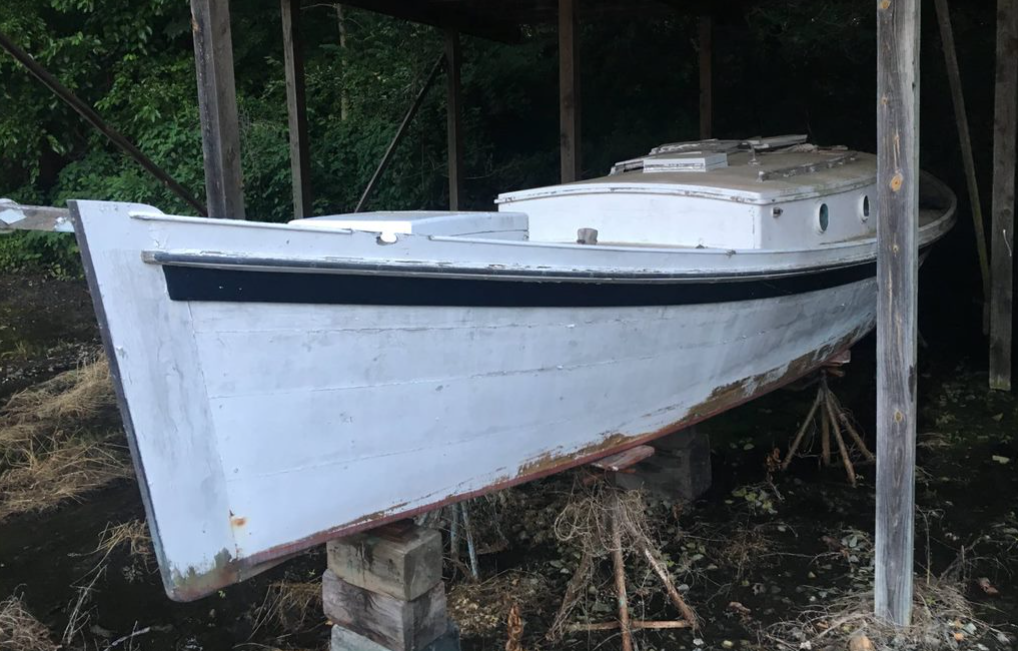
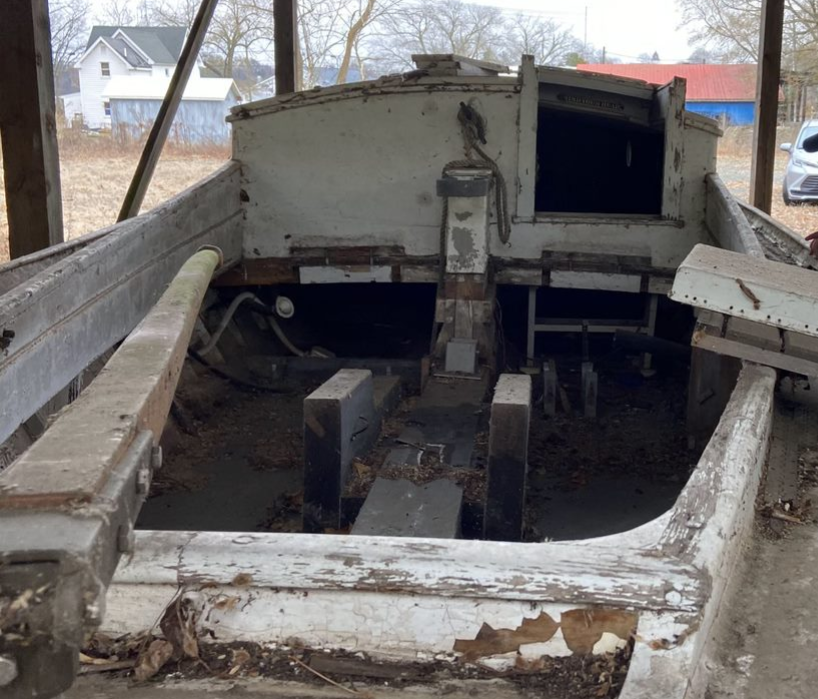
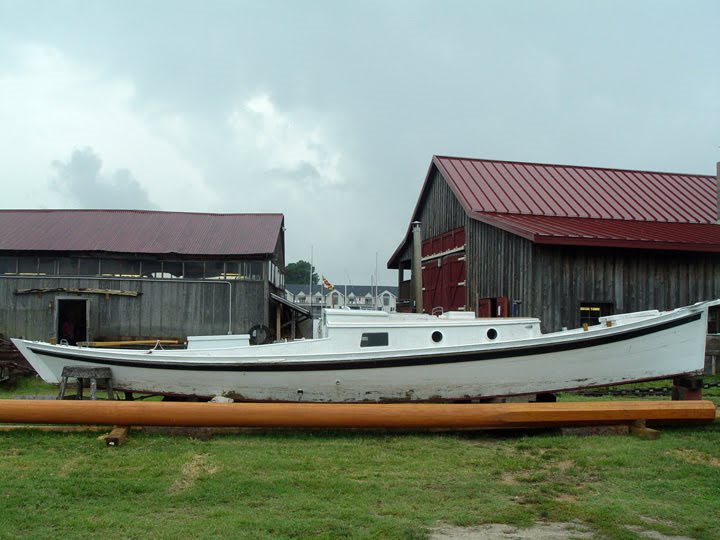
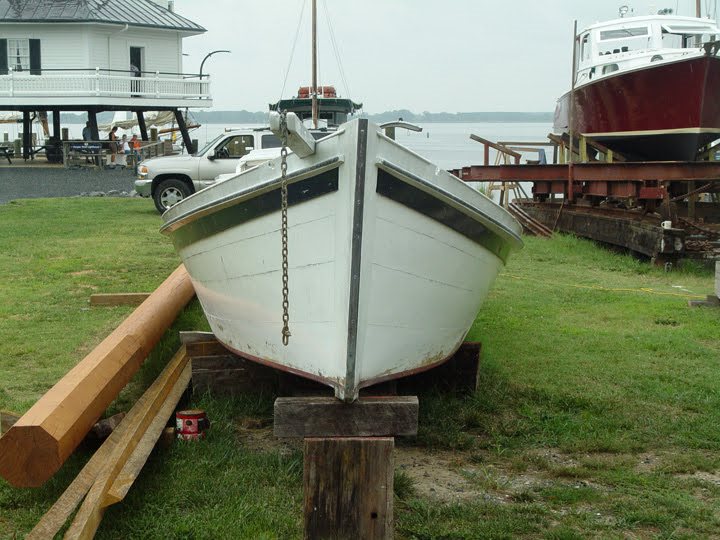
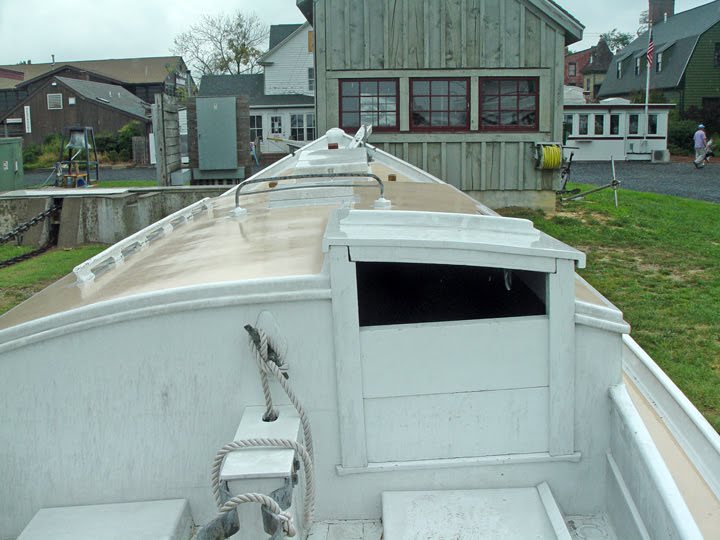
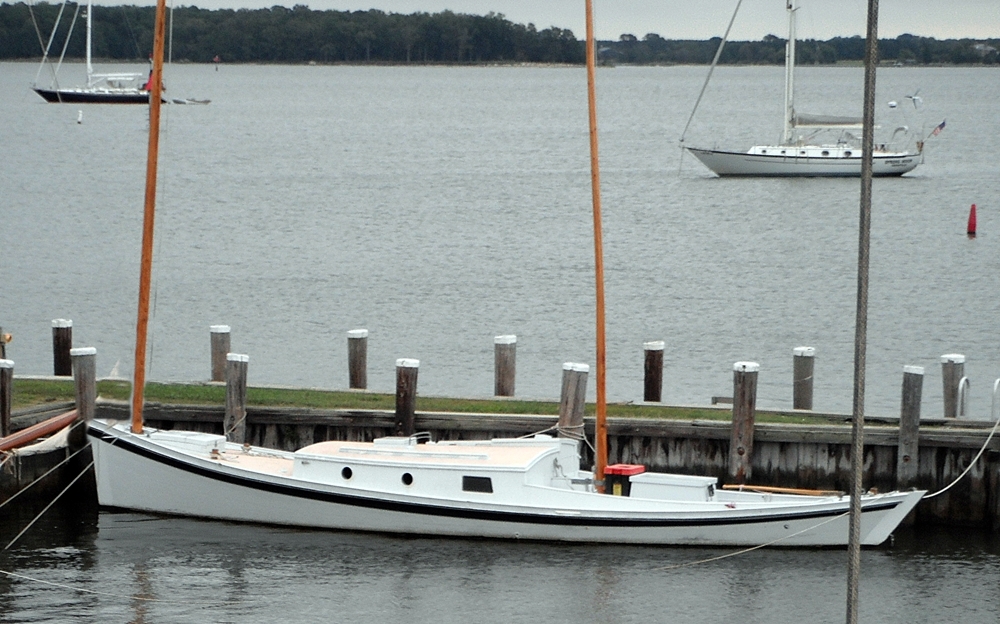
At Chesapeake Bay Maritime Museum 2013.
Photo provided by Dave Gentry in 2025.
But I could learn nothing more about this boat until I stopped by the yard again last summer (2024).
The old BDBW office was now occupied by the River City Cruise Co., which runs a river history tour boat between Denton and the Suicide Bridge Restaurant 20 miles downriver. I stopped in and met the skipper, Allen Thomason, who put me in touch with the sharpie’s owner, Mike Amory. Mike texted me that he’s the one who bought this sharpie at the CBMM sale, and that he planned to start work on it over the winter. He hoped to have it finished by the end of 2025.
That was all I knew until my friend Charley Humphrey passed through Denton in February and happened to see her in the shed. He recognized her as one of the Egret-type single-hander sharpies that Howard Chapelle designed in the 1950s, based on the renowned Egret that Commodore Ralph Munro sailed in Florida in the 1890s. Below is what he disovered about this sharpie’s connection to Chapelle.
Chapelle's Plan HIC 119
By Charley Humphrey
---
One of the nerdish thrills of researching Dusty Old Things is finding out that your initial assumption was very, very close…and sometimes, just as equally…completely wrong. Metaphorically speaking it’s like playing the correct sport on the correct field, but bringing the wrong equipment. When I first saw the sharpie sitting in the shed in Denton, I’d initially assumed it was one of Howard Chapelle’s three Egret type replica attempts. And it might be. Kind of.
Chapelle’s Egret designs came from in-person discussions with the original designer and captain of Egret, the Commodore himself, Ralph Middleton Munroe. To those uninitiated, Ralph Munroe achieved his well-deserved master mariner/boat designer reputation by introducing the New Haven sharpie design to the skinny waters of southern Florida in the late 1800’s. Those decades saw the gradual arrival of a few hundred people, then real estate developers, then thousands more people, then the railroads, then millions more people and ultimately a spider web of roads for their automobiles which slammed the door on southern Florida’s long existence as a forgotten, swampy frontier and began it’s metamorphosis into the vacation and retirement wonderland it continues to be today.
After perfecting the flat bottomed sharpie design with his Egret model, Munroe went on to create the round-bottom sharpie designs of the Presto type which are still, 130 years later, considered by many to be the ultimate in sharpie seaworthiness. Unluckily all of Munroe’s design drawings were lost in the big Miami hurricane of 1926, but luckily the half-hull model of the Egret was saved and Commodore Munroe graciously allowed Howard Chapelle to lift lines from it. According to an article published in the July 1956 issue of Boats magazine, Chapelle wrote of the half-hull, “It was plain that the model was not followed precisely in building, for the model was for a boat 26 ft. 3 in. overall, 7 ft. 1 in. in beam. I believe the lengthening was done by spacing out the stations to give an overall length of about 29 feet…”.
I am unable to determine in what year these discussions and the taking of lines took place, except that it would have been between the Hurricane of 1926 and Munroe’s death in August of 1933. Chapelle also teases us with a line in the same July 1956 article when he states: “Since coming into possession of the lines of Egret’s half-model, I have designed a number of sharpies in the 30 to 35 ft. range as double-enders; some as attempted “improvements” by reducing freeboard or by widening the beam over the chines so as to have reduced flare, as well as by increasing the size and height of trunk. Experience with these departures from the Egret have convinced me that the general proportions hit upon by Munroe in Egret were the one combination that produced the best results.” High praise indeed from a man who respected the empirical development of boat types.
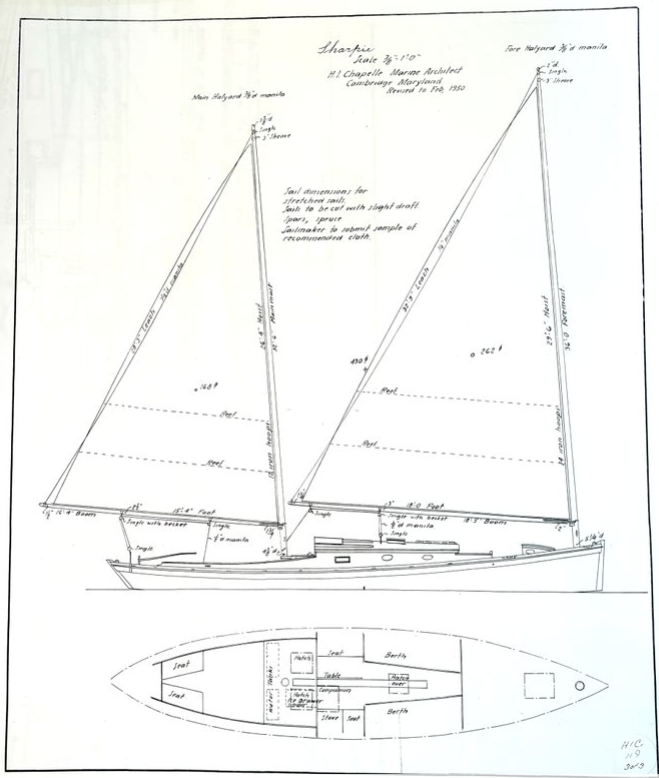
Which brings us to our current mystery sharpie. In my opinion, she is one of the versions Howard Chapelle drew of his HIC 119 design. The Smithsonian’s Ship Plan List catalogue describes her as “33’ 10” Sharpie – revised”, where the actual drawings themselves are simply titled: “Sharpie”. She was initially designed in January 1931, with a noted revision in September 1933 which modified the rudder and flare, another revision in October 1939 that removed the Lift Cabin Top, and the final version of her drawn up in February of 1950 which is listed as a retracing of the design. I have no proof at all what the intent of the retrace was, but my assumption is that it was a practical effort to preserve and consolidate what was then a 19 year old, much thumbed set of drawings.
[You can view and download large-format images of the HIC 119 plans and of Crescent here.]
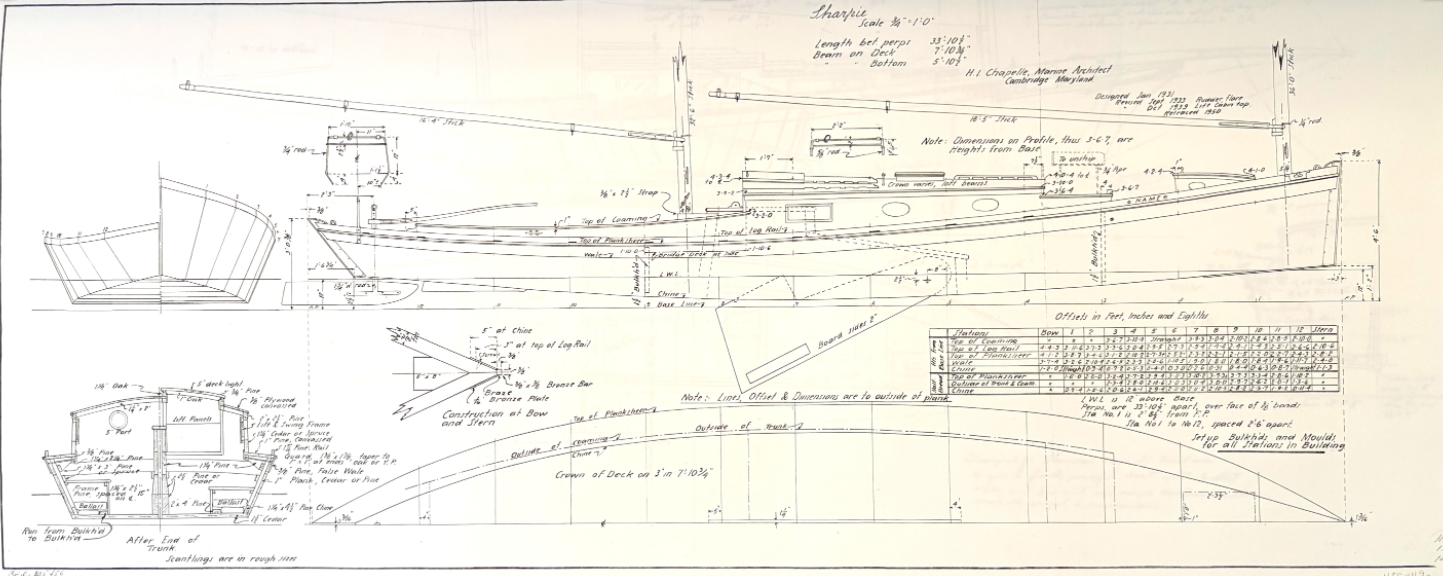
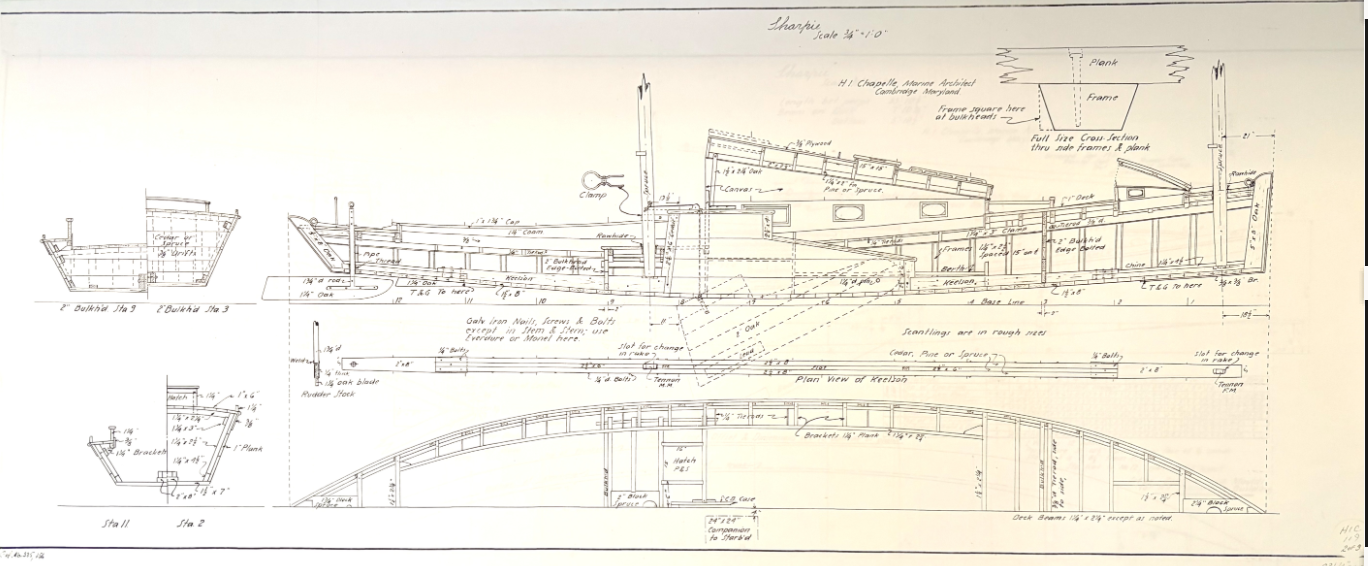
[You can view and download large-format images of the HIC 119 plans and of Crescent here.]
If you look at the design itself, it has characteristics of both the Egret and its more traditional New Haven oyster sharpie ancestors. Take the bow for example, the sharpie in Denton and HIC 119 both share a more plumb, single piece stem than Chapelle’s Egret replicas. In his Egret style designs he favors the Chesapeake style of inner stem liner bolted to an outer stem as well as more forward rake. HIC 119 and the Denton sharpie also share a New Haven style rig. Unfortunately I have yet to see any spars in Denton, but the mast holes show that she was either a cat-ketch like the New Havens, or a cat-schooner like the Egrets (the determining factor between rigs would be the height of the aft mast in comparison to the forward mast) The placement and style of the forward hatch on the Sharpie in Denton also matches HIC 119. Of course she shares the double ended hull design of the Egret, but Chapelle never raises the bottom of the stern as high out of the water (on any of his Egret style sharpies) as Munroe did on his original Egret. Also Chapelle prefers to add a small skeg forward of the balance rudder on his designs in comparison to Munroe’s smooth bottomed original Egret. The cabin size and layout is exceptionally close between the Denton sharpie and the 119, with noticeable differences being the omission of the well at the forward edge of the cabin house on the sharpie in Denton, as well we the use of round port holes to the drawing’s oval ports. The HIC 119 drawings also do not show an auxiliary motor, and there appears to be engine bed logs and a shaft hole through the keel of the sharpie in Denton. Any and all of these changes could have been the preference of the original owner who commissioned the build, or changes suggested by the builder, or even modifications installed by subsequent owners…and with a boat of this age who can say with certainty?
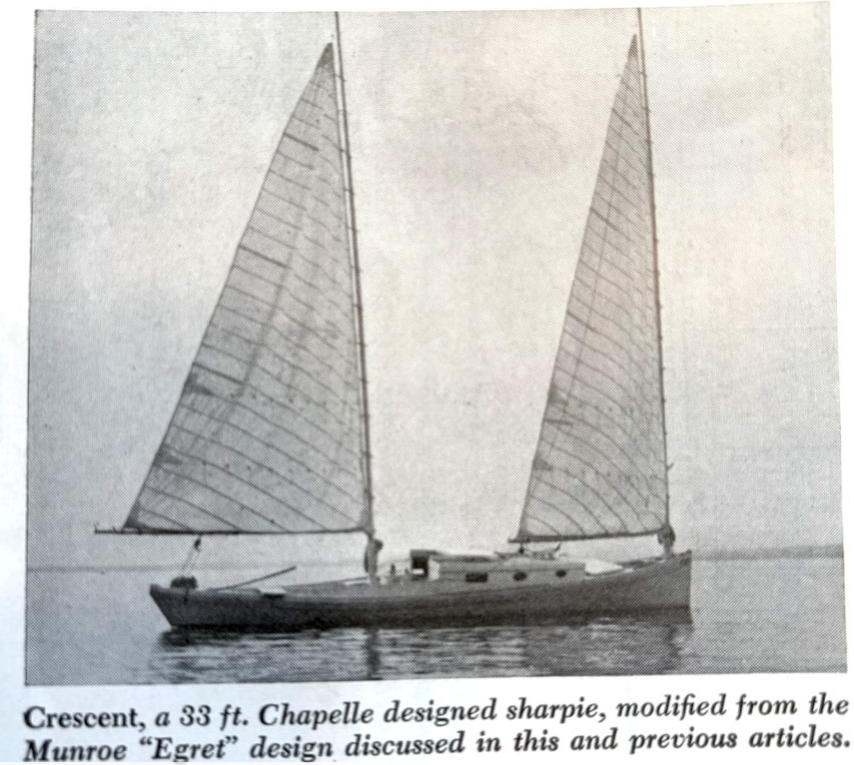
I suppose the easiest way to begin determining what and who she is would be to ask the current owner, but where’s the fun in that? Instead let’s take our best guesses, lay our bets on the line and when we find out for sure, we’ll either get to say “Thought so!” or “ Ah shit…well, I was close.” So here’s my bet: She is either (originally) the Crescent seen in the next photo (from an August 1956 Boats article), or she is a sister ship built at the same yard near the same time. That’s my $00.02 and I’m gonna let it ride.
Charley Humphrey grew up on Texas' Gulf Coast, but he got to the Eastern Shore as soon as he could. His grandfather was a shrimper in south Texas, he and his father built a sailboat together, he and his son built a John Wright crab skiff together, and he currently spends his free time tinkering on a 42 year old lobster boat he brought down to the Choptank from Maine.
Read a follow-on essay about the Denton sharpie, by maritime historian and modelbuilder Edward R. Thieler - here.
More about Small Boats
I also write about volunteer work in small boat conservation at the Chesapeake Bay Maritime Museum:
Small Boat Shed Volunteers
And about sailing with the Dinghy Cruising Association in small open boats on the Chesapeake and its tributaries:
Shallow Water Sailors
Archived Comments
These comments are preserved from the original WordPress site as read-only text.
I attended 3 of the "Fugscuffs" (Florida Gulf Coast Small Craft Festival) put on by the FGCTSCA and Roger Allen at FL Maritime Museum in Cortez (west of Bradenton) back in the day. I remember there was an Egret-type sharpie there. 29' sounds about right. I don't remember the owner's name; maybe Roger or someone in FGCTSCA would know.
Cortez was a great place, I hope it hasn't gotten all touristy, LOL. There is a funky little seafood place (the name escapes me) on the pier. If you go, definitely have the Caribbean-style grouper, maybe with a side of smoked mullet, washed down with a Red Stripe.