
 Maryland

Thieler received dozens of images, historic documents, and research notes about the seaside bateau in 2004 from Edward Henry Bachmann (1947-2015). Bachmann was working as an informal research assistant for Joseph Conboy when he (Bachmann) compiled material on the seaside bateau. According to Conboy, Bachmann was living in Onancock, Va., at the time and was gathering material from local historical societies and newspapers. [2]
Chapelle’s Description – Transom Sterns and Round Sterns
Maritime historian Howard I. Chapelle published the first detailed description, plans, and tables of offsets for the construction of a seaside bateau in 1951 as Figures 118 and 119 in American Small Sailing Craft. [3] Chapelle presented two versions of the seaside bateau - a “Sinepuxent Skiff” and a “Chincoteague Skiff”. The two designs differ from one another primarily in the stern shape. While the “Sinepuxent Skiff” is shown with a square raked stern, the “Chincoteatue Skiff” has a round stern “of a form once used by some Chesapeake Bay bateaux”.
Both bateaux shown by Chapelle are hard-chine, V-bottom craft with marked sheer, strong side flare, a broad foredeck, washboards, and very shoal draft. Seaside bateaux typically had a herring-bone, cross-planked bottom with no floor framing. They carried an unstayed two-mast sprit rig, while smaller boats were often single-masted. The beam was typically about half the keel length, which gave the boat both power and stability in exposed shallow water. They were commonly 16-20 feet in length.
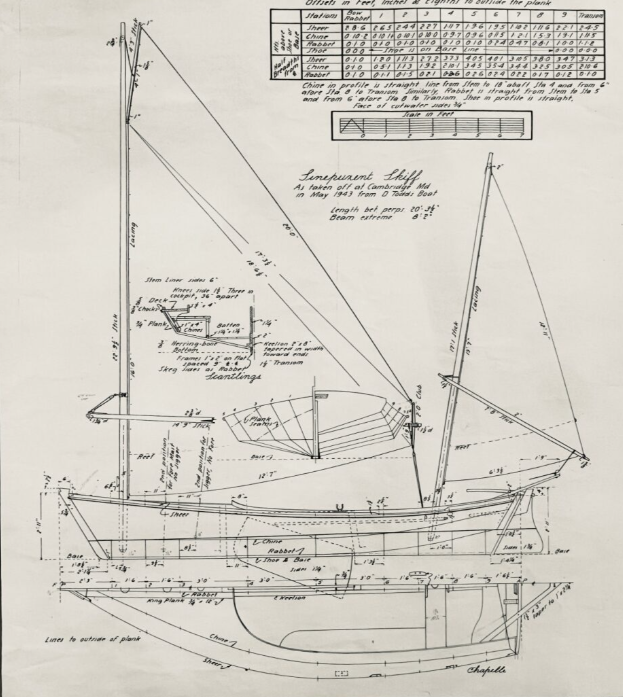
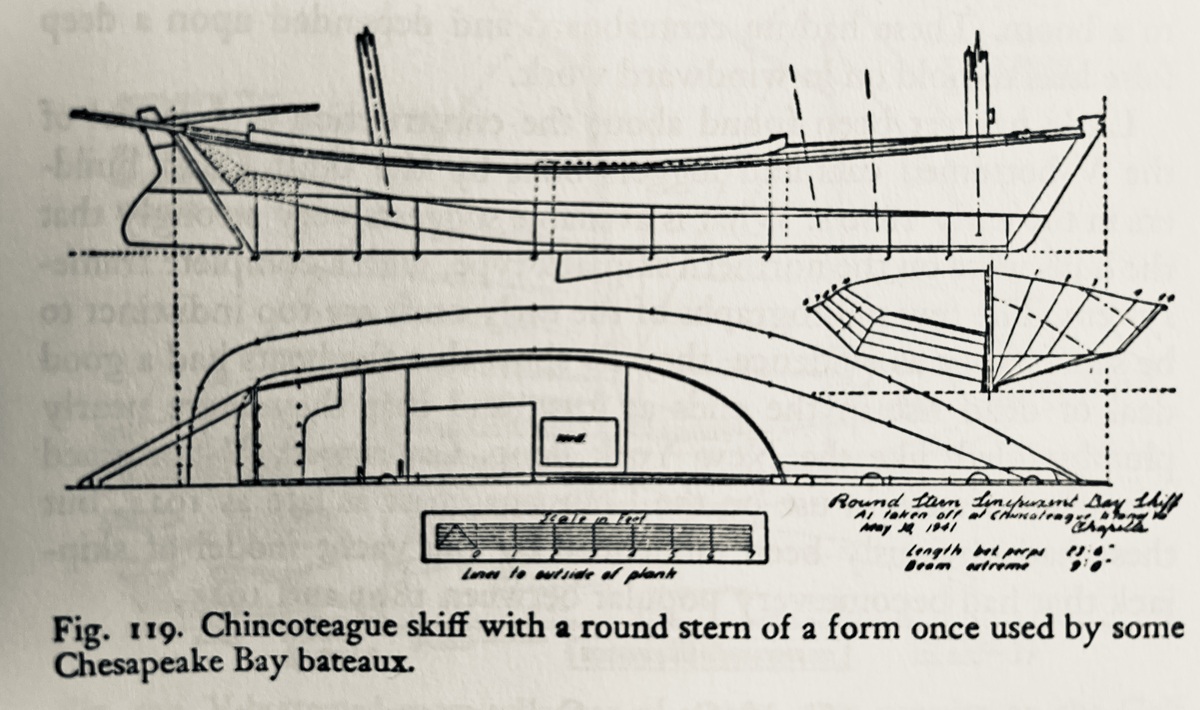
Sinepuxent Skiff or Seaside Bateau?
Brewington’s Influence
Chapelle was probably influenced by Marion V. Brewington to use “Sinepuxent Skiff” and “Chincoteague Skiff” nomenclature for the seaside bateau. During 1929-31, Brewington took 32 photos of seaside bateaux at Ocean City, Md., and Chincoteague, Va., and he took measurements and compiled notes about their typical characteristics. His notes, which are now in CBMM's Brewington collection, bear the label “Sinipoxent Sharpies”. It’s unclear whether Brewington heard this term from local builders and users, or he invented it himself. “Sinepuxent” is an uncommon name that refers to the small northern section of Chincoteague Bay, near Ocean City.
What is clear is that the “Sinipoxent Sharpies” in Brewington’s photos match the descriptions and plans published by Chapelle, and they show the characteristics of seaside bateaux on exhibit at CBMM and The Mariners' Museum. [4]
At least ten of Brewington’s Ocean City and Chincoteague photos, now archived at The Mariners' Museum, are also found in the Chapelle collection at CBMM. The reverse sides of the photos have notations (probably not Chapelle’s handwriting) such as “big sharpie”, “small sharpie”, “built by Wimbrough Bros. at Chincoteague”. (Although these photos match photos at MM which doccument Brewington as the photographer, none of the copies in the CBMM Chapelle collection are attributed to The Mariners' Museum nor to Brewington.) Although it’s uncertain when and how Chapelle acquired these photos, it’s plausible that it was before his 1951 publication of American Small Sailing Craft, so that Chapelle used Brewington’s nomenclature in the text. [5]
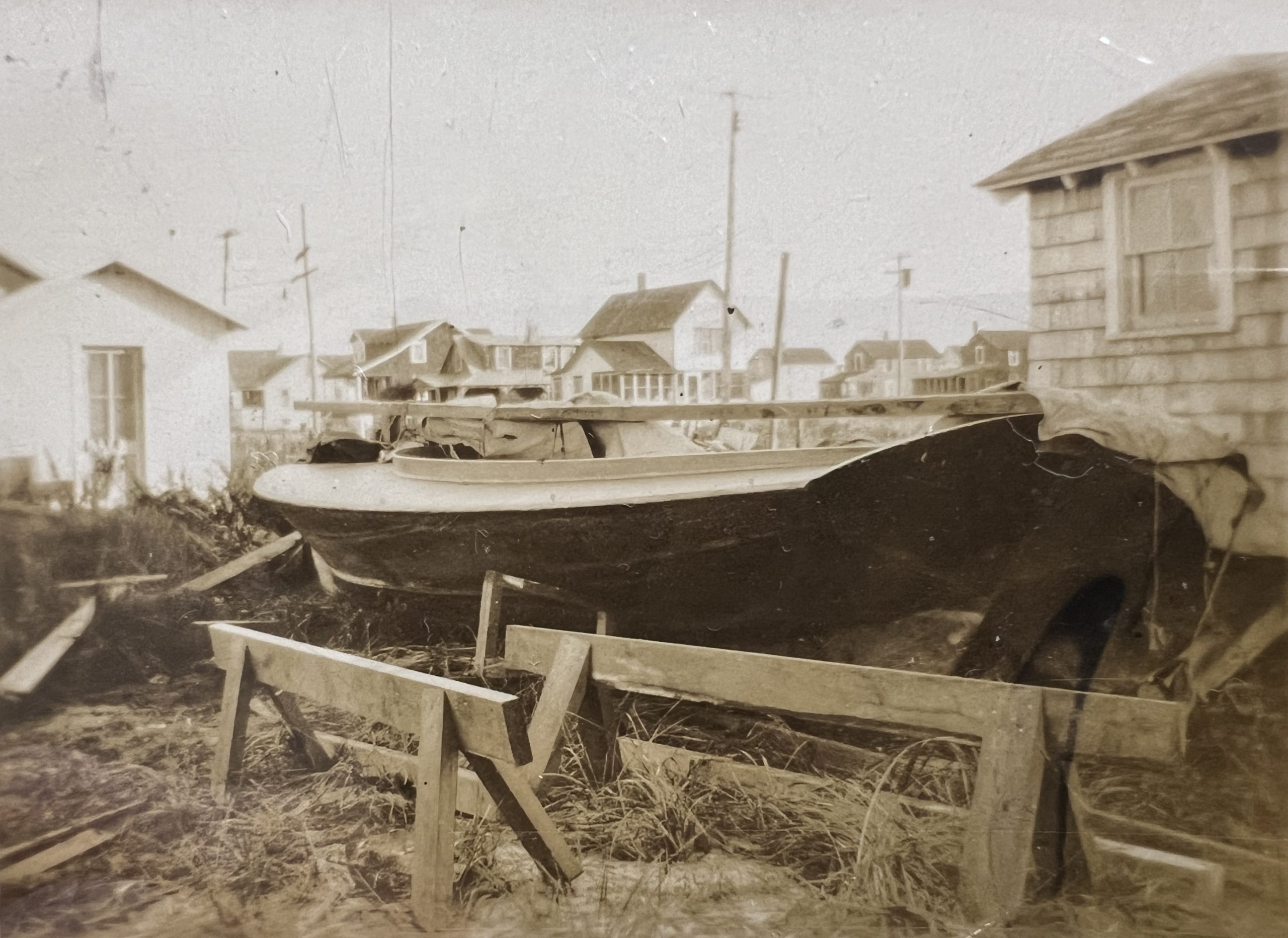
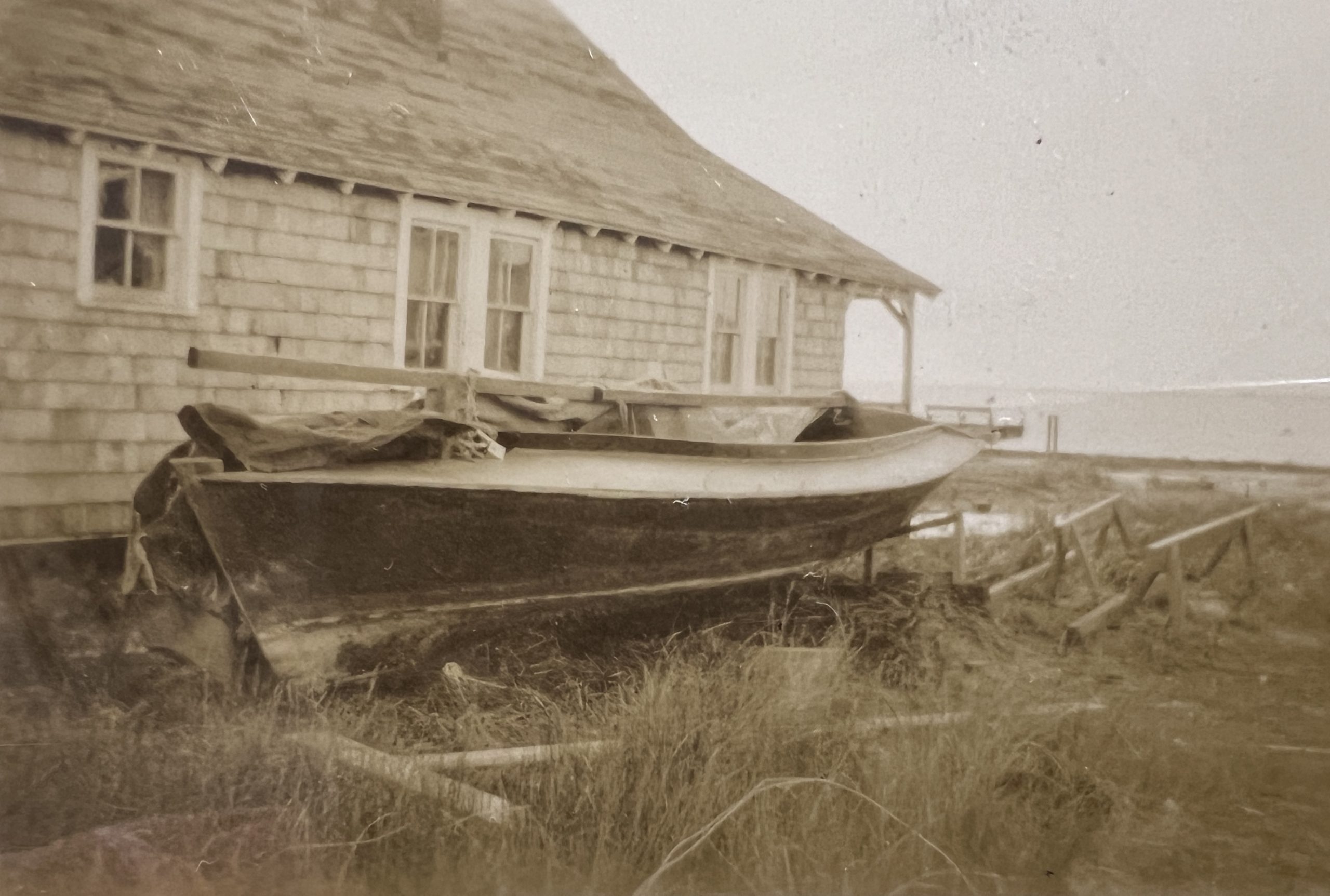
'Big Sharpie' at Ocean City. Brewington photos in the CBMM Chapelle collection. Undated at CBMM; Dated 1929, Chincoteague, Va., at The Mariners' Museum. CBMM Cat. No. 0000.0901.0355, 0359-0360
It also seems likely that Brewington’s photos and notes informed the work of Robert Burgess as exhibits curator at The Mariners Museum. The Mariners Museum’s exhibit of a seaside bateau built in 1936 at Wachapreague, Va., was probably prepared under Burgess’s supervision. This bateau is catalogued and displayed as a “Sinepuxent skiff” – Brewington’s terminology. [6]
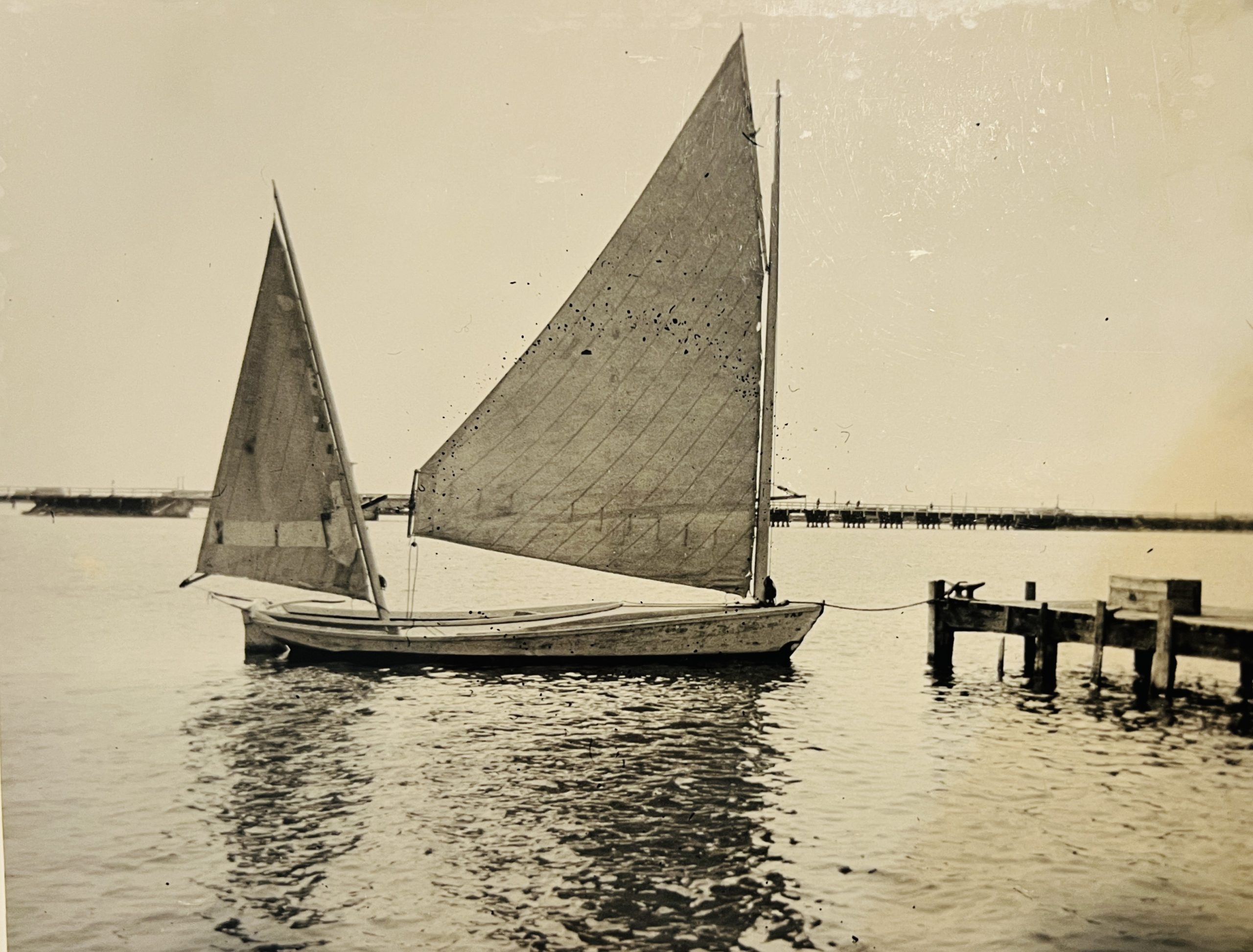
Two other Brewington photos of a seaside bateau at Ocean City are found in the Robert Burgess Collection at CBMM. These are stamped with metadata that credits photographer Brewington, The Mariners Museum collection, and the photographic negatives from which they were printed. These are annotated on back as “Sinepuxent Sharpies, Ocean City, 1931”. [7]
Joe Conboy Disagrees
Joseph Conboy of Accomack and Urbanna, Va. (Joseph Laidlaw “Joe” Conboy (1934-2022)), a local maritime historian and builder of seaside bateaux, strongly disagreed with Chapelle. In his correspondence with Chapelle in 1955, and with CBMM curators who were documenting Bessie Lee in the 1980s, Conboy asserted that neither “Sinepuxent skiff” nor “Chincoteague skiff” were used for the deadrise boats that worked on the ocean side of Virginia’s Eastern Shore.
Larry Mathews was a long-time resident of Townsend, Va., was acquainted with the Bessie Lee during her working life. He was also familiar with a half dozen other seaside bateaux built by Bessie Lee’s builder, his neighbor Hanson Downes. Mathews told CBMM curators in 1991 that these ESVA deadrise sailing workboats were called “seaside bateaux” or simply “bateaux”. [8]
Local maritime historian Joe Walsh stated in 2012 that his father was “pulling [deadrise skiffs] out of the weeds down at Chincoteague in the 1960s”. One of the skiffs built by Ira Hudson at Chincoteague, V.,a is now on display at the Eastern Neck Refuge visitor’s center. Walsh said the skiffs his father found at Chincotague were the same as the deadrise skiffs which Chapelle called "Sinepuxent Skiffs” in American Small Sailing Craft. According to Walsh, deadrise skiffs built by Hudson and others were known locally by the maker's name (e.g. a “Hudson skiff”), or they were called “seaside bateau”. [9]
The consensus among local maritime historians like Ed Thieler and CBMM curators is that Chapelle’s and Brewington’s “Sinepuxent Skiff” and “Chincoteatue Skiff” were local names more commonly used at Ocean City, the northern end of their geographic range. And that Conboy’s “seaside bateau” was local usage which had persisted farther south, on the ocean side of Virginia’s Eastern Shore.
Read more: Seaside Bateau Plans and Characteristics
The Round-Bilge Seaside Skiff
The seaside bateau was used as a workboat from at least the mid-1800s into the 1930s. It worked mainly on the Atlantic side of the Delmarva Peninsula, especially around Chincoteague Bay and the shallow bays and inlets behind the barrier islands of Eastern Shore of Virginia and Maryland. It was used for tonging oysters and clams, for net fishing, for carrying people and gear, and for general transportation among the islands and through the inlets. Its wide beam, shallow draft, flared sides, and flexible sail arrangements made it well suited to shallow water, shifting winds, and the need to move between protected bays and the open-water passages at the inlets.
Besides its role as a sailing workboat, the seaside bateau was used as a pleasure craft from at least the 1880s into the mid-1900s. As a pleasure craft, it was used mainly recreational sailing and seaside outings and, especially with the faster seaside skiff design, for racing in Magotha Bay and off Hog and Cobb Islands. Many ESVA newspapers, starting around 1885, describe seaside skiffs being bought, sold, and raced for sport. By the 1890s, seaside bateaux were also seen around Sinepuxent Bay and at the ocean resorts in the area which later became part of Ocean City, Maryland.
Seaside Bateaux as Workboats
The seaside bateau was used as a workboat from at least the mid-1800s into the 1930s. It worked mainly on the Atlantic side of the Delmarva Peninsula, especially around Chincoteague Bay and the shallow bays and inlets behind the barrier islands of Eastern Shore of Virginia and Maryland. It was used for tonging oysters and clams, for net fishing, for carrying people and gear, and for general transportation among the islands and through the inlets. Its wide beam, shallow draft, flared sides, and flexible sail arrangements made it well suited to shallow water, shifting winds, and the need to move between protected bays and the open-water passages at the inlets.
Seaside Skiffs as Pleasure Craft
Besides its role as a sailing workboat, the seaside bateau was used as a pleasure craft from at least the 1880s into the mid-1900s. As a pleasure craft, it was used mainly recreational sailing and seaside outings and, especially with the faster seaside skiff design, for racing in Magotha Bay and off Hog and Cobb Islands. Many ESVA newspapers, starting around 1885, describe seaside skiffs being bought, sold, and raced for sport. By the 1890s, seaside bateaux were also seen around Sinepuxent Bay and at the ocean resorts in the area which later became part of Ocean City, Maryland.

Footnotes
[2]
[3]
[4]
[5]
[6]
[7]
[8]
[9]
More about CBMM Collections
Items that are not exhibited around the CBMM campus are kept in the Norman & Ellen Plummer Center for Museum Collections. This is a climate-controlled facility that was expanded and modernized in 2023.
You can search all the collections online here. Look for the links at lower left to search these collections separately:
Objects, Photographs, Manuscripts, Ships Plans
Regional Oral History Database
Books and Periodicals
See my CBMM Collections Search Tips.
The collections and library are accessible only by appointment. Email collections@cbmm.org or visit the Library and Research page.
More about Small Boats
I also write:
About volunteer work in small boat conservation at the Chesapeake Bay Maritime Museum: Small Boat Shed Volunteers
For the Shallow Water Sailors (Chesapeake Bay) chapter of the Dinghy Cruising Association: Shallow Water Sailors
For the Chesapeake Eastern Shore Chapter of the Traditional Small Craft Association (TSCA): TSCA ES