
 Maryland
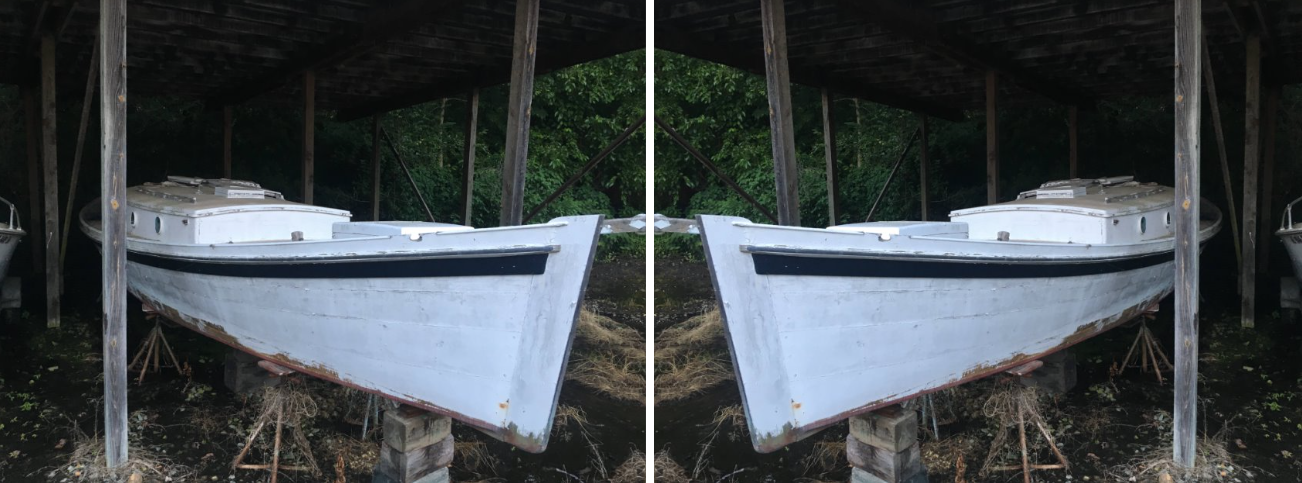
I discovered this sharpie cruiser at Denton on the upper Choptank a few years ago. My friend Charley Humphrey stopped by for a look, recognized her Howard Chapelle design origins, and wrote here about this boat and Chapelle's plan 119 in the Smithsonian Ship Plans catalog.
My friend Ed Thieler, another local maritime historian and an expert model builder, felt to add his own observations about this boat and about Chapelle. Ed's essay is below.
I'm grateful to Charley and Ed for their contributions.
Enjoy.
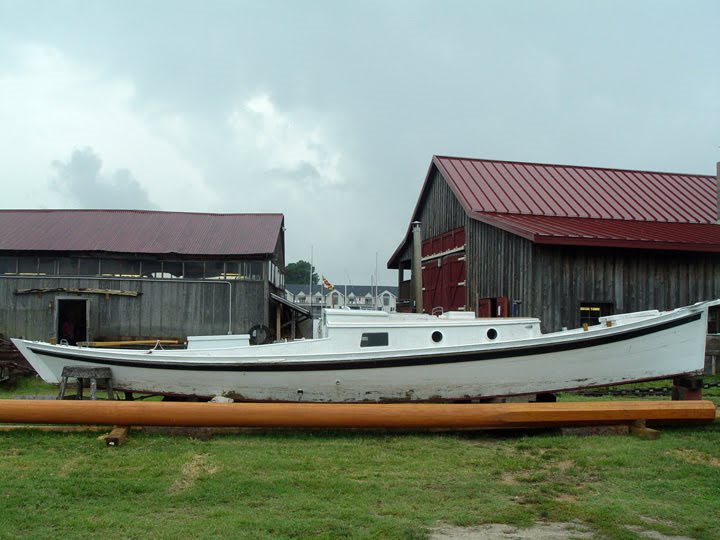
The Denton sharpie at auction at the
Chesapeake Bay Maritime Museum, 2013
By Ed Thieler
I hope I am able to add some context to Charley's analysis of this intriguing quest:
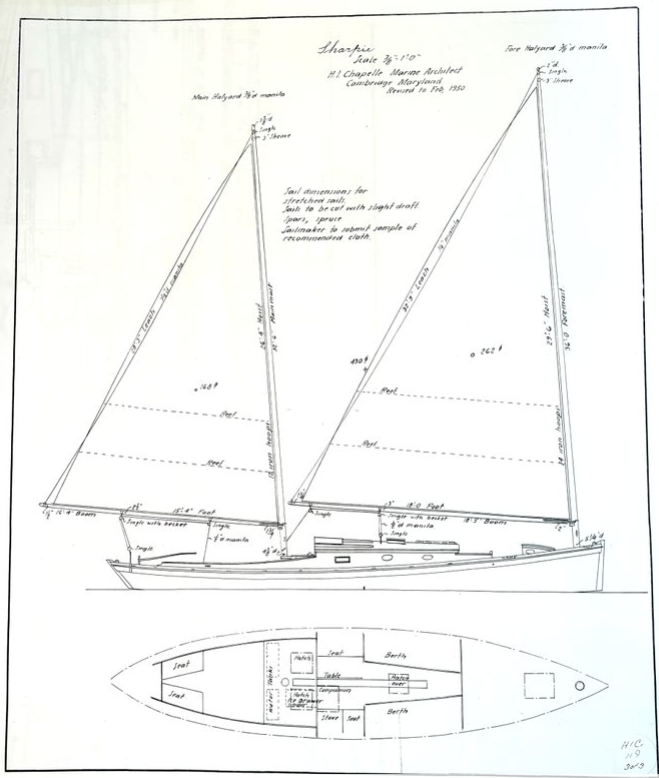
In plan HIC 119C - the sail plan - the masts are labeled "Mainmast 32' 6" and "Foremast 36", so I would call this a "bugeye rigged" sharpie. Yes, it is a "cat-ketch" to normal people, but few old Bay watermen, and maybe some young ones, would not know what is being described.
The "leg-of-mutton" spritsail and the "bugeye-rig" used in the Connecticut sharpies got there from the Chesapeake Bay log canoes which had used this sail and rig combination since the mid-1700s.
New England, oysters were about gone by the early 1800s. New Englanders sailed into the Bay in sloops and schooners starting after the War of 1812, bringing the oyster dredge with them. They took Bay oysters back to the north to seed their depleted beds, and the leg-of-mutton sail and rig went with them, too. These days almost every oyster on the northeast coast has a Chesapeake Bay heritage.
[You can view and download large-format images of the HIC 119 plans here.]
Howard Chapelle Plan 119C from the
Smithsonian Ship Plans Catalog
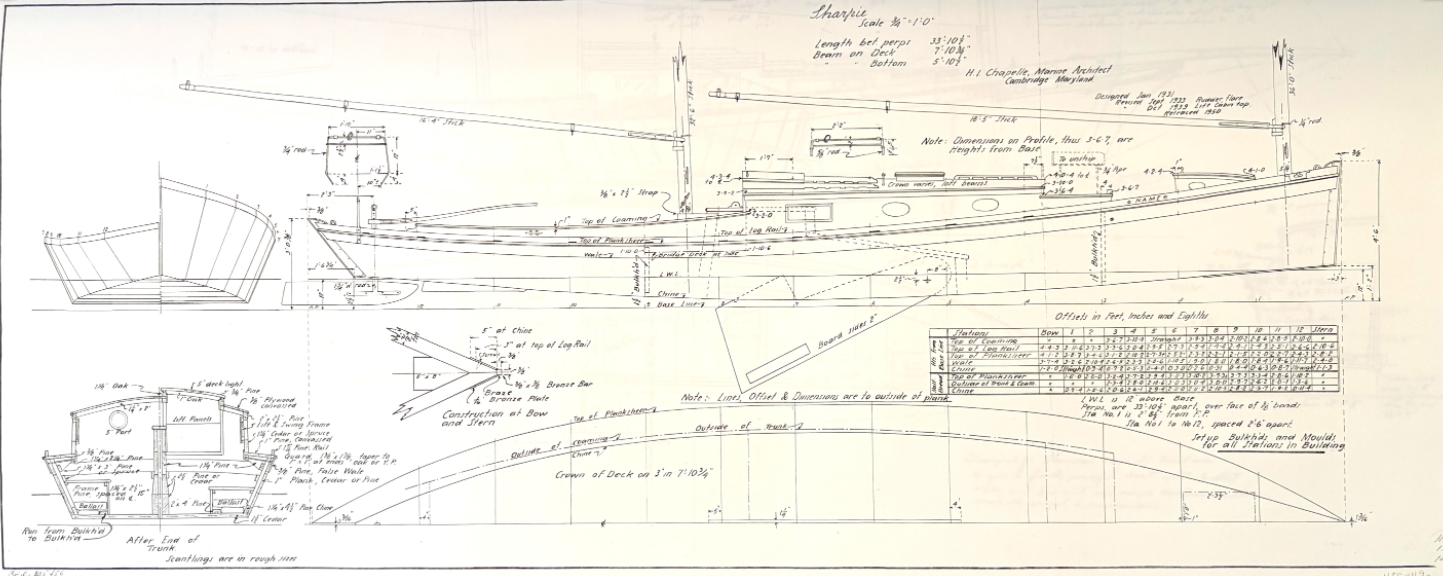
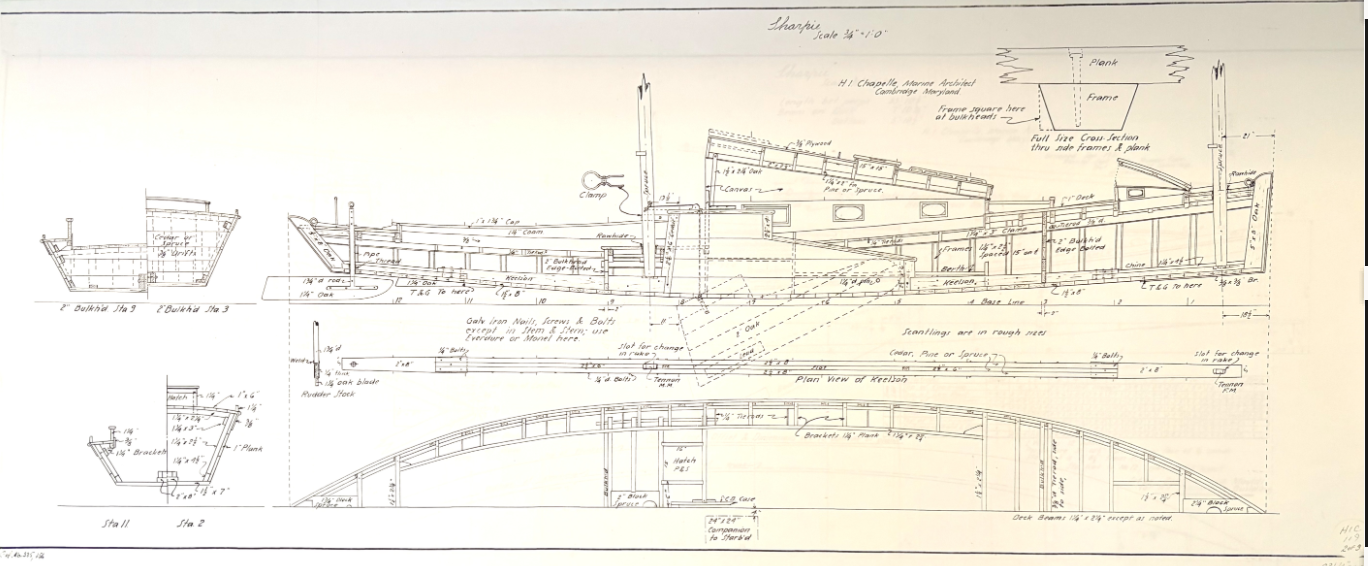
In plan HIC 119A - the construction plan - the little skeg in front of the rudder is supposed keep sea-grasses from getting wedged between the hull and rudder. Of course, it would not have been very effective when the rudder was a little off center, as rudders usually are. Maybe that's why this kind of rudder was never common in the Bay where sailing through SAVs (subaqueous vegetation) was a way of life.
(I would have made it deeper or devised a cutter/slicer like they had on America 3, to cut away kelp from the keel and rudder during the San Diego America’s Cup races in 1992.)
Howard Chapelle Plan 119A from the
Smithsonian Ship Plans Catalog
After HIC moved to the Eastern Shore of Maryland in 1940, he recognized the underwater grasses problem and put a modified Chesapeake Bay Crabbing Skiff rudder on the 18 ft. Chesapeake Sharpie he designed and published in a 1956 issue of Boats magazine.
The inset of the stem structure shows a New Haven stem - an inner-stem with the side planks meeting in front of it and a bronze structure covering the delicate, almost, knife edge. A Bay stem has an inner stem/apron with an outer stem/cutwater covering the sawed off ends of the side planks. The Denton sharpie has a Bay stem.
I enjoyed seeing the VW-Westfalia "pop-top" - just like he drew for Blue Crab in 1952 and for his own bateau, Sweepstakes, in 1964. (HIC drove a Karmann-Ghia – maybe there is that connection. ;-) )
Chapelle Publication and Design Timeline
It is interesting that he initially addressed this design in the 1930-1939 time frame - he was a New Englander then. He had just moved back to Massachusetts after spending some years working in Florida, and I suppose he was happy to reacquaint himself with the sharpie vessels he grew up with in his youth and admired so much.
1929 to 1939 were the Depression Years.
He had just published The Baltimore Clipper in 1930, and in 1931 he was Editor of ‘The Mariner’ magazine.
He was Director for HAMMS in New England from 1936-1937.
And, during this time he designed and had built his pinky schooner, Glad Tidings [1937].
His mother died in 1932 and he married Alice Zayma in 1935.
In 1935 he produced The History of American Sailing Ships and in 1936 he published American Sailing Craft and Yacht Designing and Planning.
And between 1937 and 1940, he worked with W. A. Robinson building Swift and gathering the materials he published in Boatbuilding in 1941. All while living and working in Massachusetts.
In 1940 he left Massachusetts, “because of the taxes,” he said, and moved to Maryland’s Eastern Shore where he lived and worked until 1975.
Comment on Howard Chapelle
Howard I. Chapelle was able to watch craftsmen perform tasks in a shipyard and turn those observations into paragraphs and chapters in a book. It appears that he did very little, if any, woodworking on real boats or models, yet he knew how to do it, and was able to describe how it should be done.
He seems to have been able to recall everything he saw and read, and where, and everything he heard, and from whom.
He appears to have been able to write, type, or dictate, the contents of a letter, article, or book - once - with little or no wasted time looking things up or re-writes, and still get it right, the first time, most of the time – remarkable !
As Peter Spectre [1] put it:
He singlehandedly defined the scope of the history of small-vessel naval architecture.
There were flaws in his research and inaccuracies in his published findings and plans.
It may be that he wanted the lines to conform to what he thought they should be rather than what they actually were.
But Chapelle’s academic and artistic licenses must be balanced by the prodigious amount of work the man did – all on his own. If he hadn’t done it, inaccurate or not, we would now have nothing.
----
[1] Spectre, Peter - The Legacy of H. I. Chapelle - WoodenBoat #84 - Sep – Oct 1988 - p76-84. This is the most thoughtful essay written about the life and work of Chapelle.
Howard Chapelle Plan 119B from the
Smithsonian Ship Plans Catalog
[You can view and download large-format images of the HIC 119 plans here.]
More about Small Boats
I also write about volunteer work in small boat conservation at the Chesapeake Bay Maritime Museum:
Small Boat Shed Volunteers
And about sailing with the Dinghy Cruising Association in small open boats on the Chesapeake and its tributaries:
Shallow Water Sailors