
 Maryland
Chesapeake Bay Maritime historian and Edward R. Thieler did extensive research and conducted many interviews with boatbuilders and watermen to produce historically-accurate models of Bay workboats. While preparing and building his model of the crab scrape Sarah May, he compiled these notes about the crab scrapes and how they were used. Ed generously reviewed these profiles and helped me prepare this compendium.
I've retained Ed's original outline or narrative format for most of the profiles, with minimal explanatory text, in order to preserve important content and meaning. The complete collection of these profiles in their original form can be found here.
You can read more below about the Edward R. Thieler III Collection of workboat models at the Chesapeake Bay Maritime Museum (CBMM).
"If a boat pulled a scrape, it was a “scrapin’ boat.” - A phone conversation with Morris Goodman Marsh
We were curious about the different names for scrape-boats. So I sent [the two photos below] to Eddie Somers with the names I had heard and asked him if he knew of others, or edits to mine, and if he could see if some older guys could add/subtract.
Eddie gave these to Morris Goodman Marsh, one of the last of the old timers. (Morris Marsh was featured in Beautiful Swimmers by William W. Warnter, 1976.)
He lives in Ewell with wife Brenda. I called Morris this morning [2 October 2024]. He is still sharp ... They do not fuss over technical nuances as I tend to do, and as I think others of us that are interested in their culture, do.
Here is an outline of our phone call:
Scraped 65 years – sold my boats a few years back.
Had knee replaced. Scraping was hard on your knees when you were pulling the scrapes aboard.
Eddie [Somers] brought your pictures over….
Tides been really high for a while. Every October.
Pulled scrapes on the windward side and over the stern. If you pulled one on the leeside it might get stuck in the mud.
If a boat pulled a scrape, it was a “scrapin’ boat.”
If it was from Tangier, it was a bar-cat. They built good ones in Jenkins Creek.
Morris recognized the two-sail rig as the one on the bigger oyster dredgers.
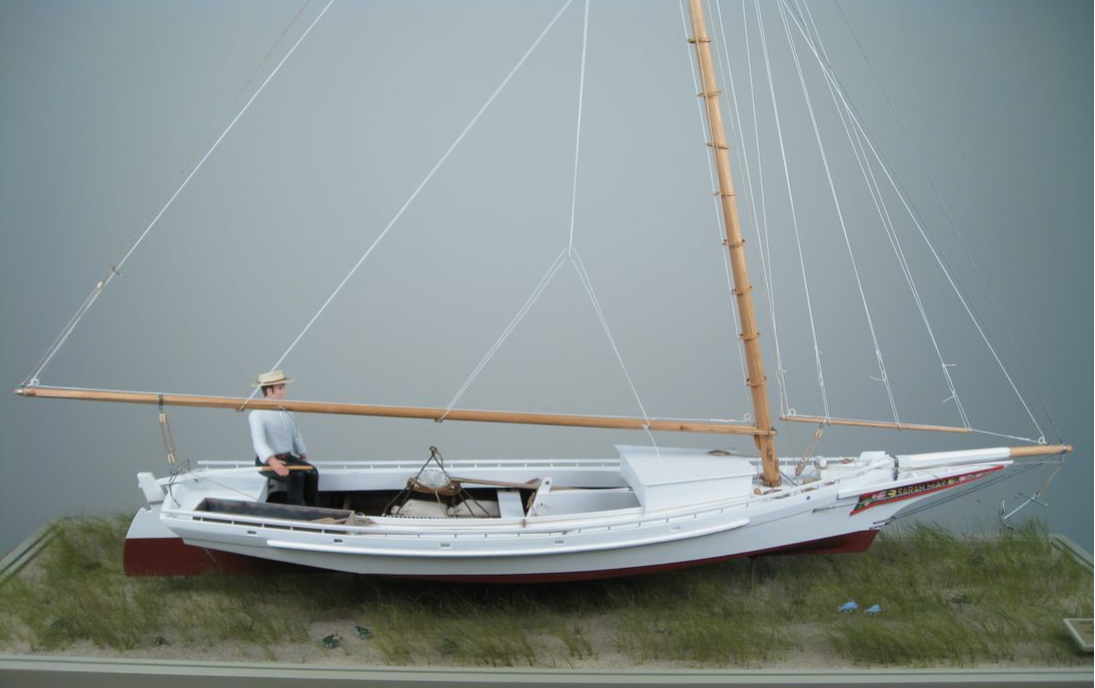
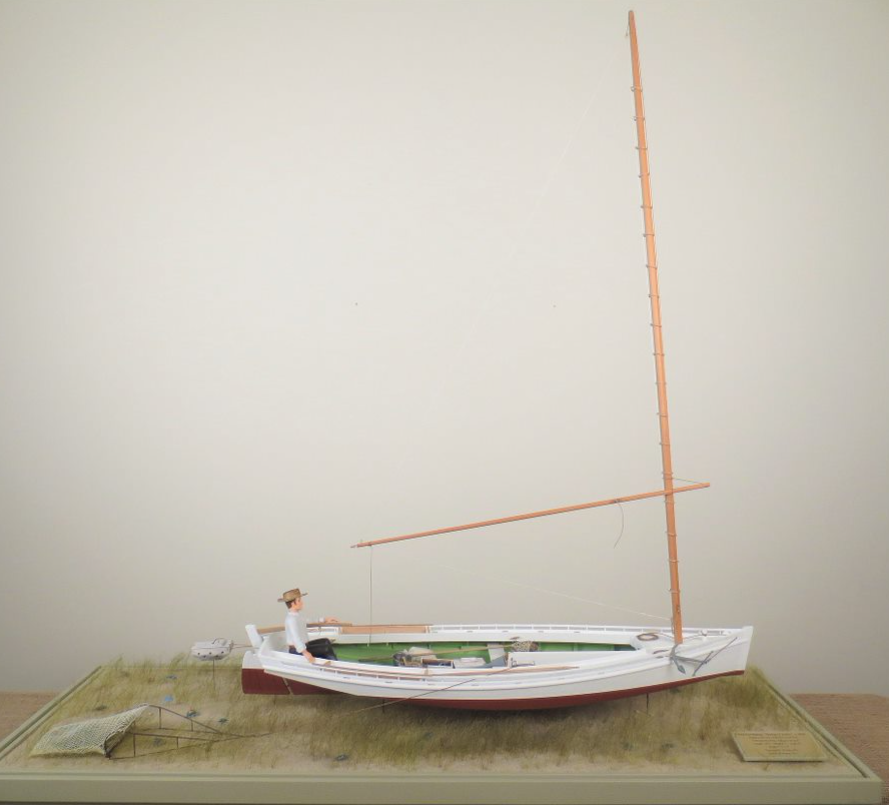
The boat above is called a one-sail crabbing bateau, Jenkins Creeker, Bar-cat.
Both boats carry scrapes and are used for scraping for crabs.
Both sailed out of the harbors surrounding Tangier Sound.
Both are beamy.
Both are low to the water.
Both have “monkey rails”– pin-rails – pipe-rails.
Both have wide “washboard” side decks.
Both sometimes carried a removable cabin.
Both were converted to power when engines came along.
One has a bowsprit, the other does not.
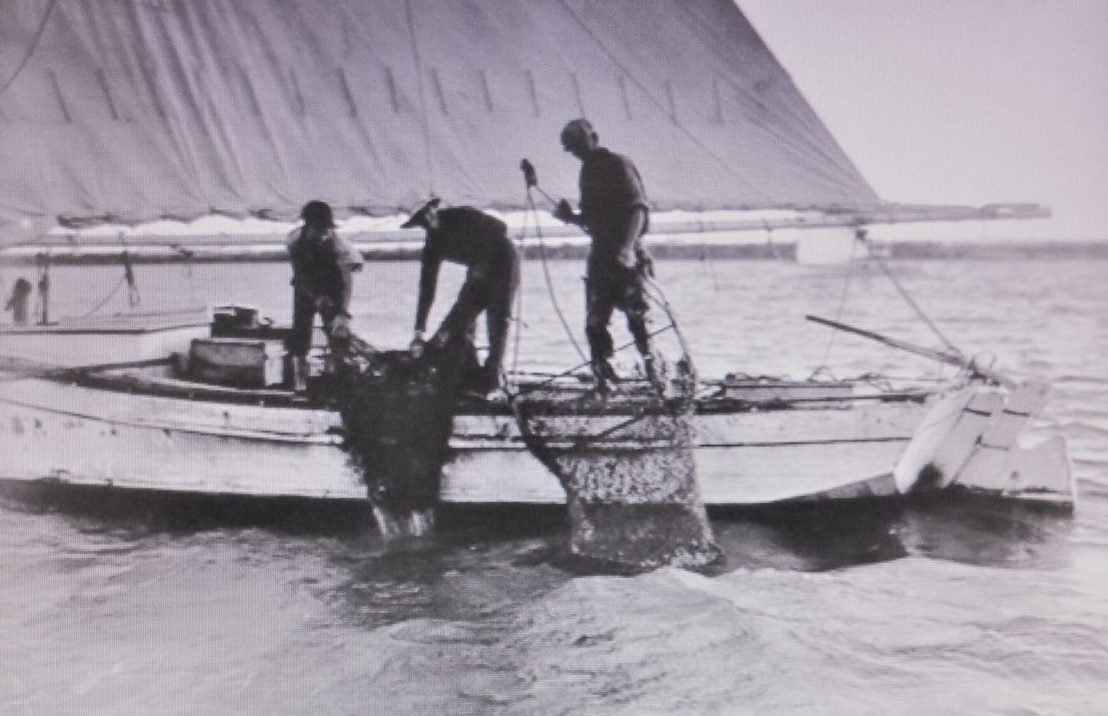
The photo above was taken on Chesapeake Bay, Tangier Sound. Three men on a typical "two-sail crab scrape bateau" are scraping for soft crabs, possibly a family, the younger son forward, father in brimmed hat, older son in cap.
Here the younger son is helping father bring aboard a scrape with bag loaded with underwater grasses in which peeler and soft crabs are hiding.
The older son has an empty scrape ready to lower it to the bottom.
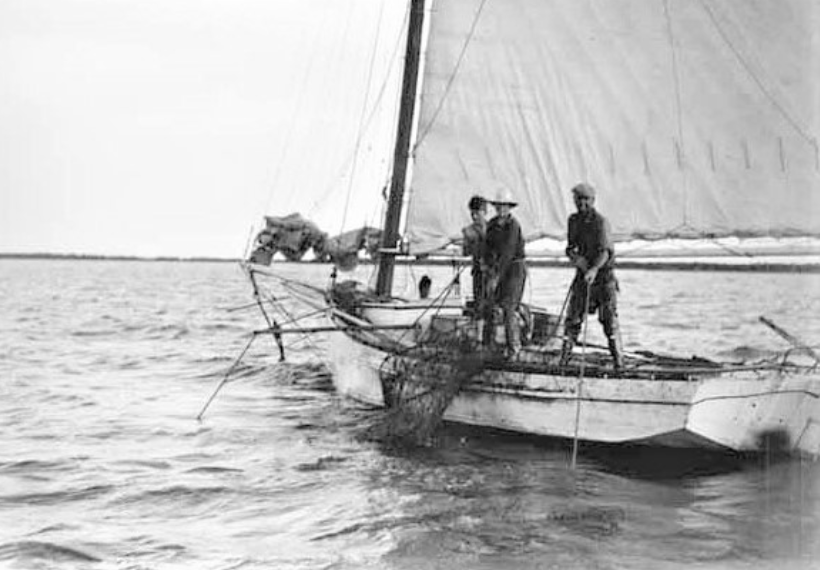
In the photo above, the anchor is hanging from the tip of the bowsprit. Behind that, a 'prop-stick' is holding another scrape line away from the boat.
The younger son is looking on.
Aft of him, the father has dumped his full net and is standing upright for the camera, about to drop his empty scrape back into the water.
The older son is holding on to the line of the scrape he had launched in the first photo.
This boat has a “scrape guard” along the bottom of the wale protecting the hull planking.
Typical of these boats, a low pin-rail, “monkey rail,” follows the sheer around the deck.
The breeze is slowly moving them – sail set for a beam reach – the choppy waves are smoothed behind it - dragging their three scrapes.
There is a small dark thing sticking up to the right of the mast - maybe a stove pipe, if they hand scrape for oysters in winter. Or possibly the top of a galvanized hand bilge pump.
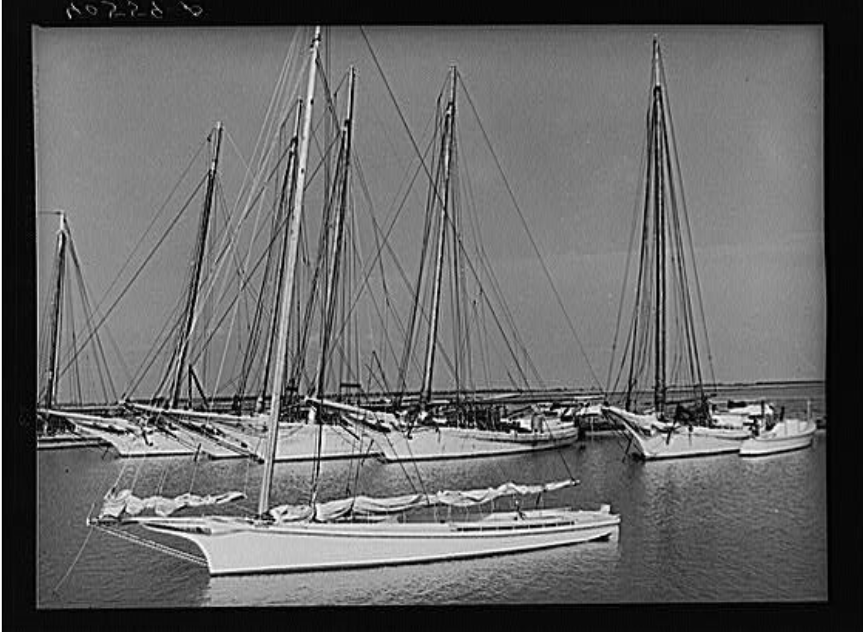
This two-sail bateau, brand new or freshly painted, rides at anchor in front of a fleet of skipjack, oyster-dredge boats, and a Hooper’s Island draketail workboat.
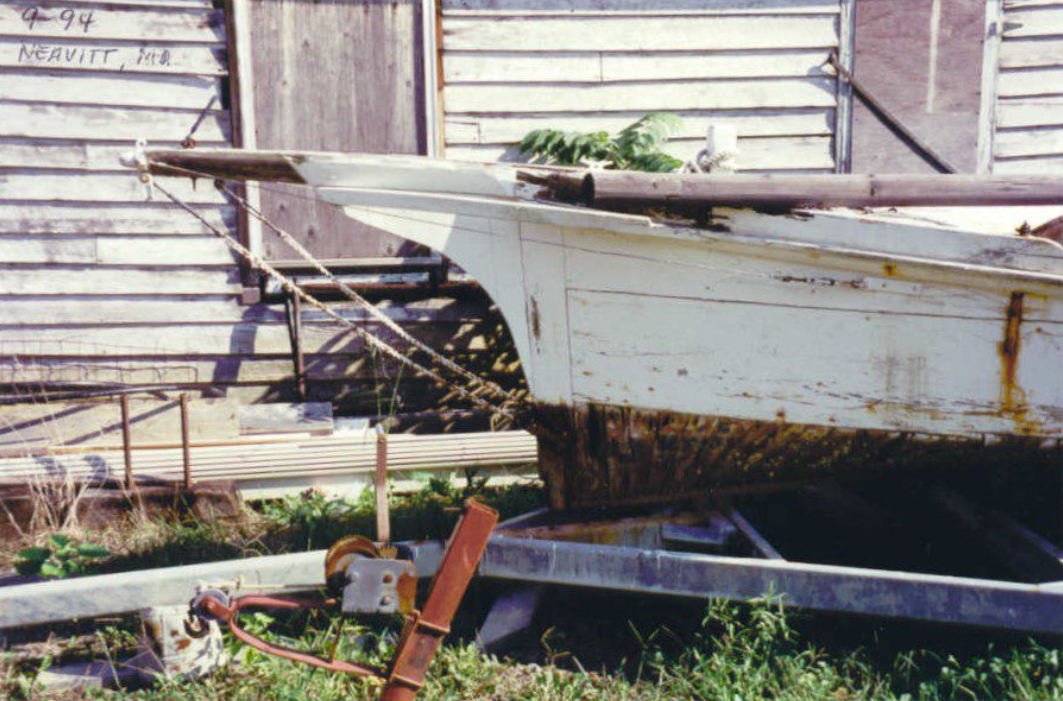
Crab skiff in Neavitt
I saw this skiff while driving to a friend’s home, September 1994. I came back the next day and took these photos.
I had no idea I would become interested in this kind of craft. I simply liked the look of it.
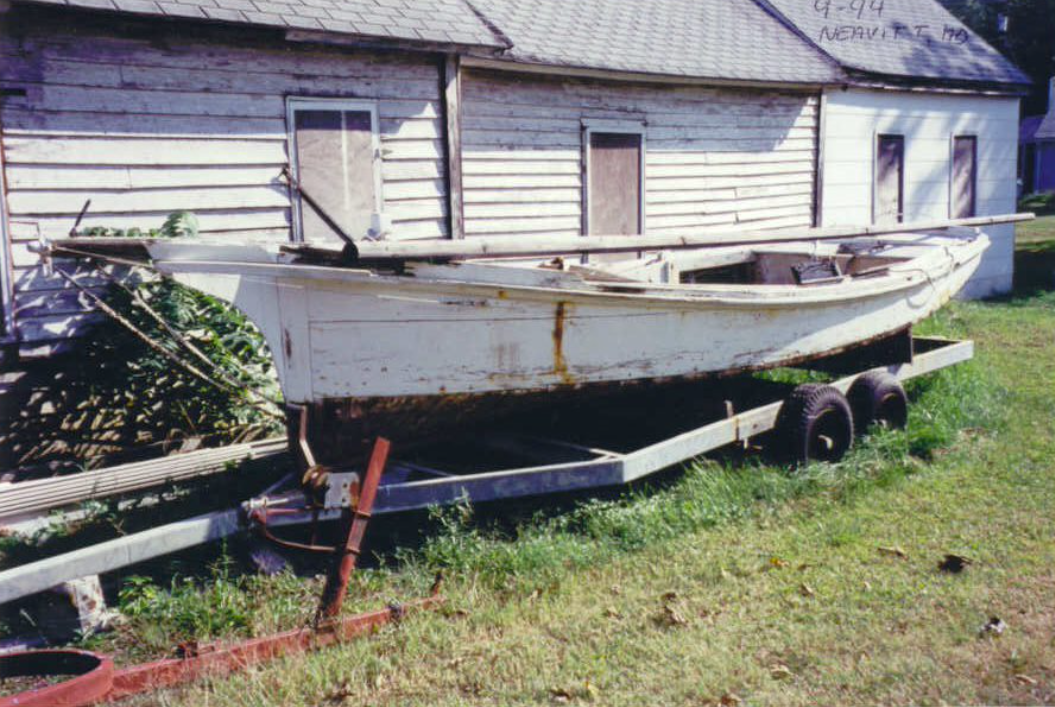
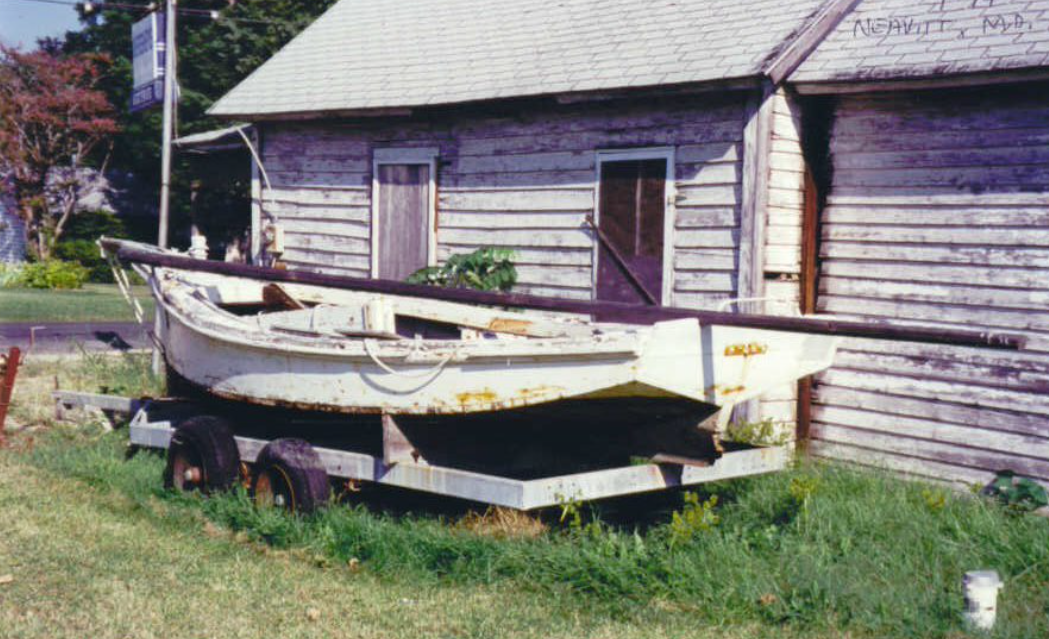
Converted from sail to power
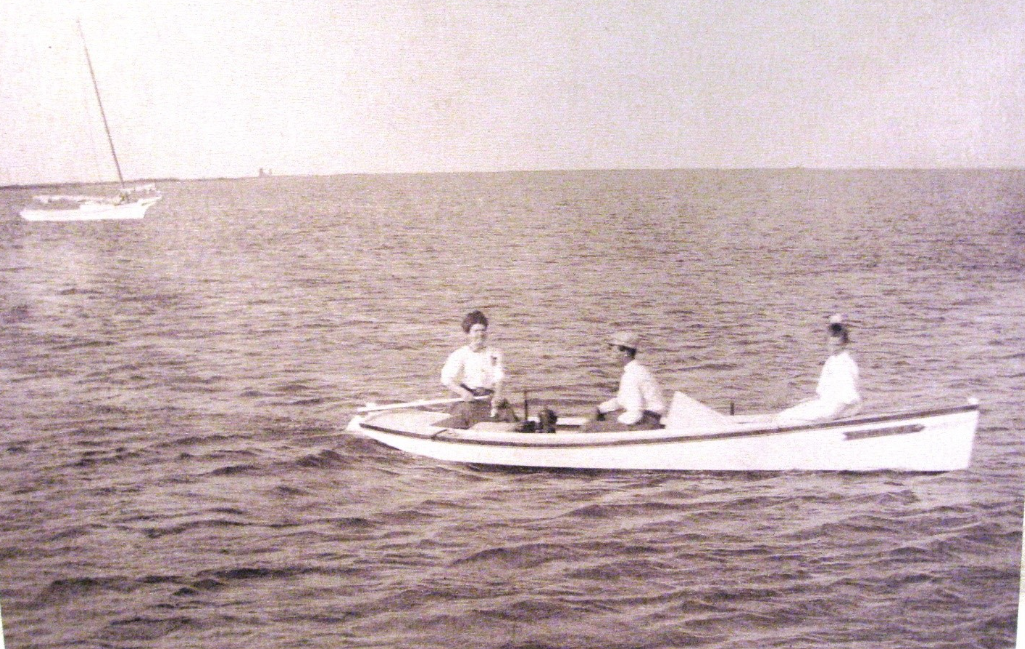
Photo caption: "I.T. Todd's parents and sister ride in the island's first gas-powered launch. Todd was born on Holland Island in 1917 but moved - with his family and their house - to Crisfield while still a baby."
In the far distance is Holland’s Island.
Anchored in the mid-distance is a two-sail bateau.
This crabbing skiff has been converted from sail to power.
Mother is at the tiller steering; father is keeping the motor going.
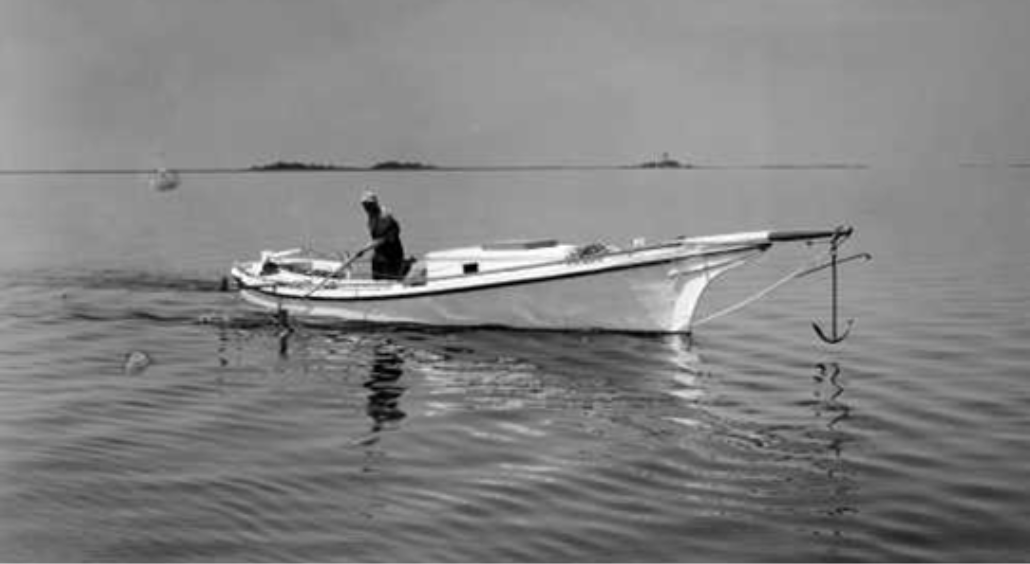
Crab scraping apparatus
THE CRAB INDUSTRY OF MARYLAND - 1905
By Winthrop A. Roberts.
Agent of the Bureau of Fisheries.
[The complete document is here. This survey was done and report written before gasoline engines appeared in crabbing skiffs on the Chespeake.]
Apparatus.-—Soft crabs are taken with three forms of apparatus— scrapes, scoop nets, and small seines. A few also are taken incidentally on trot lines, together with hard crabs, as will be mentioned in connection with the latter fishery. The catch by seines is insignificant compared with that by scrapes and scoop nets.
The scrapes used for crabbing are similar to the oyster dredge, except that they are lighter, have no teeth on the front bar, and have a cotton instead of a chain bag. Scrape frames are usually sold by weight, the price being from 7 to 10 cents a pound and the weight from 25 to 35 pounds each. The average price for a scrape, including bag and line, is about $8.50. Most of the scrape frames are made at Crisfield and Deal Island, while the netting comes from Boston and is made into bags by L. Cooper Dize, of Crisfield, who holds a patent on the bag in general use. The patent consists of a cord running along the back of the bag to keep it stretched. The width of a scrape varies from 2 feet 6 [30] inches to 3 feet 6 [42] inches, though few of the latter size are used.
The bags originally used were 3 feet deep, but deeper ones were found more effective in preventing the escape of the crabs, and 4 feet is now the usual depth. The same apparatus is occasionally used both in dredging for oysters and scraping for crabs.
A scoop net, or dip net, as it is sometimes called, consists of a circular bow of iron, with a cotton bag from 6 to 8 inches deep knit around it, and a handle about 5 feet long.
The seines are from 40 to 50 feet long and are hauled by two men. Crabs taken in scoop nets and seines are less mutilated than those caught in scrapes, and consequently command better prices.
Scrapes are used exclusively upon sailing vessels, and, like oyster dredges, are drawn over the bottom while the boat is moving under sail. The boats vary in size from the smallest used in dredging for oysters to 9 tons net tonnage, which was the largest size used during the season of 1901. From two to four scrapes are carried on each boat, four being exceptional, however, and only on the larger size vessels. As a rule there are two light scrapes and one heavy one to a boat. With a good breeze a crew of two men can manipulate two light scrapes, but with a light wind the two men together handle a heavy one. A crew of three men can, with a favorable breeze, handle three scrapes at the same time. It is the object of the scraper to have the boat get sufficient headway to go slightly faster than the crabs can travel, so that they can not escape when once in the bag. Scrapes are not allowed to sink in the soft bottom, as the mud covering the bottom of the bag would furnish a means of escape. The scrapes are taken aboard every few minutes, or after covering from 75 to 200 yards, and the contents are emptied out and sorted over, usually on a board platform or broad flat trough conveniently located at the side of the boat. The bulk of the material brought up is grass and mud, from which the crabs are picked out and distributed in the several receptacles provided for them, according to the successive stages of their development.
Scrapers endeavor to reach the crabbing grounds as early in the morning as possible, before the crabs are moving about and have become scattered. The best catches are made between daylight and 10 o'clock in the forenoon, and between 3 o'clock in the afternoon and evening. The bright sun in the forenoon drives the crabs back into their holes until hunger forces them out again in the afternoon. On cloudy days they remain out much longer.
The Edward R. Thieler Collection at the Chesapeake Bay Maritime Museum
The Edward R. Thieler III Collection of workboat models at the Chesapeake Bay Maritime Museum (CBMM) is a valuable resource for historians, builders, and owners of sailing and power workboats and gunning and recreational skiffs of Chesapeake and Delaware Bays and the New Jersey coast.
Thieler built most of his models at a scale of 1:12 (one inch = one foot), large enough to display fine detail in both the boat design and the tools and accessories which show the working context of each boat.
Thieler’s models are historically accurate in the smallest detail. His careful research and detailed plans and notes reveal many aspects of the history and traditional use of each boat type. In many cases, he interviewed watermen who used these boats themselves, or whose fathers and grandfathers did. From them he learned about building materials and methods, sail rig, handling and working under sail, and tools and methods for oystering, crabbing, and fishing.
Thieler’s photos of the model building process are a valuable resource for the traditional builder who wishes to build an authentic full-size reproduction of any one of these workboats.
Text and photos are published here with permission from CBMM and Ed Thieler.
More Resources
Catalog of Models in the Edward R. Thieler Collection at CBMM
Eastern Shore Sailing Workboats – “Thieler” search in this website
More about CBMM Collections
Items that are not exhibited around the CBMM campus are kept in the Norman & Ellen Plummer Center for Museum Collections. This is a climate-controlled facility that was expanded and modernized in 2023.
You can search all the collections online here. Look for the links at lower left to search these collections separately:
- Objects, Photographs, Manuscripts, Ships Plans
- Regional Oral History Database
- Books and Periodicals
See my CBMM Collections Search Tips.
The collections and library are accessible only by appointment. Email collections@cbmm.org or visit the Library and Research page.
More about Small Boats
I also write about volunteer work in small boat conservation at the Chesapeake Bay Maritime Museum: Small Boat Shed Volunteers
And about sail-and-oar cruising in small open boats on the Chesapeake and its tributaries: Sail+Oar – Chesapeake Log.