
 Maryland
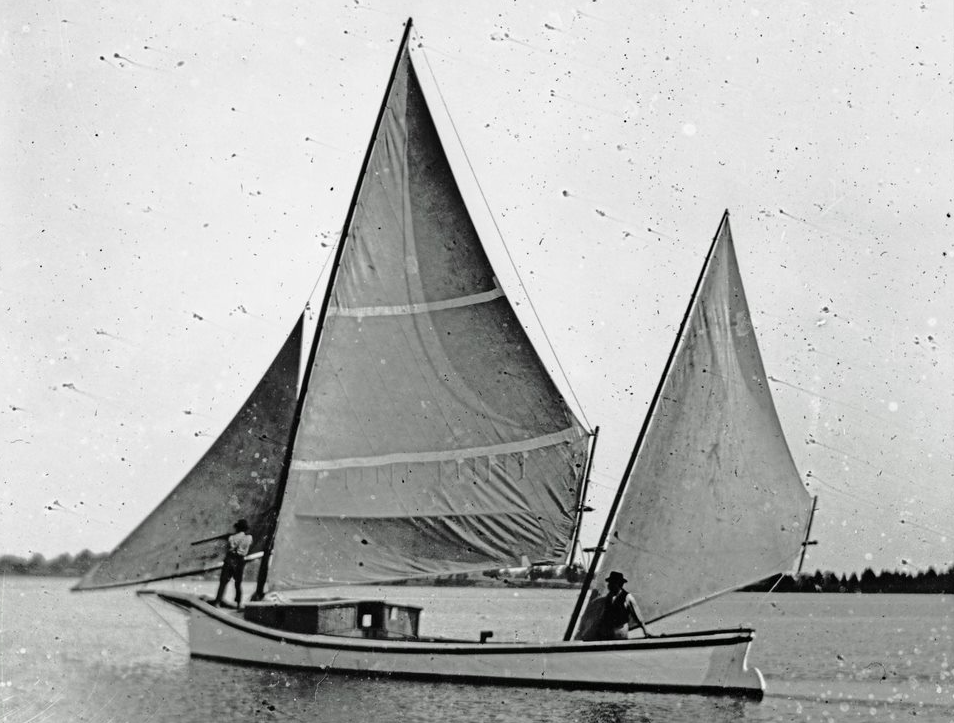
Captain Dave Reed’s cabin skiff under full sail, 1904.
Reed is at the helm while Game Warden Weems Souther stands on the foredeck with a gun.
Photo: C. Lowndes Johnson, courtesy estate of John G. Earle and CBMM.
Chapelle & Brewington
In Chesapeake Bay, A Pictorial Maritime History (1953), Brewington wrote briefly about the cabin skiff:
Native to the Bay but very different from all other skiff types was the cabin skiff of Talbot County. At a short distance it could easily be mistaken for a brogan since it was a double-ender, half decked with a cuddy forward and a two masted canoe rig. But there the similarity ended for the sides were of plank bent around a full V-bottom made of very heavy sawed lumber running fore-and-aft, the pieces edge-bolted together.
Brewington 's book provides a very small rendition of the cabin skiff Doctor Johnson shown above.
In The Migrations of an American Boat Type (1961), Chapelle added some detail:
The "cabin skiff," a double-ended, half-decked, trunk-cabin boat with a long head and a cuddy forward, was also in use on the Bay in the 1880's. This boat, which was rigged like a bugeye, had a bottom of planks that were over 3 inches thick, laid fore-and-aft, and edge-bolted. The entire bottom was made on two blocks or "sleepers" placed near the ends. The sides were bevelled, and heavy stones were placed amidships to give a slight fore-and-aft camber to the bottom. The sides, washboards, and end decks were then built, the stones removed, and the centerboard case fitted. In spite of its slightly cambered flat bottom, this boat, though truly a flatiron skiff in midsection form, had no real relation to the New Haven sharpie; it probably owed its origin to the Chesapeake log canoe, for which it was an inexpensive substitute.
The Lesher Article
Pete Lesher, Curator of the Chesapeake Bay Maritime Museum (CBMM), provided a great deal more in his article that first appeared in the museum’s magazine, The Weather Gage, Fall 1991. It was expanded by the author and republished in The Ash Breeze, Winter 1993. The text presented below is from the latter article in the CBMM collection and is re-published with permission from CBMM.
Along the eastern shore of Maryland, a great variety of small craft developed for use in seafood harvesting. Except for the remaining skipjacks, working sailboats are no longer used on the Chesapeake, and several of the old types have disappeared entirely. Among these is the cabin skiff. The cabin skiff originated in Talbot County, MD, and remained largely restricted to the Miles River. Little trace remains.
As demands for oysters grew in the nineteenth century, the watermen who harvested them turned to log canoes, boats that offered several distinct advantages to the oystermen. Log canoes, constructed of several logs fastened side by side with wooden trunnels or iron drift pins, were durable and capable of withstanding many winters of rough handling. Unlike traditional plank-on-frame boats, log canoes did not require frames, so no ceiling had to be installed to provide an even bottom in the boat, important for shoveling out the catch of oysters. Furthermore, the simplicity of log construction made these boats affordable to the watermen, so log, canoes proliferated. Construction was simple; in fact, many watermen learned how to build their own.
The decline of the log canoe in the late nineteenth century can be attributed to two factors: the increasing scarcity of large logs and the introduction of an acceptable alternative to logs. Toward the end of the nineteenth century, the large logs disappeared with the primeval forests of the region. This caused builders to use more logs for a canoe of the same beam. In the mid-nineteenth century three-log canoes became the standard, but by the end of the century five-log canoes were common.
In the 1880's V-bottom or "deadrise" construction appeared in the region and spread rapidly. Deadrise boats, like the log canoes, offered the advantage of relatively simple construction; they were inexpensive and could potentially be built by the men who used them. The transition from log canoes to deadrise boats took place over several decades. Robert Lambdin of St. Michaels, MD, did not stop building log canoes until 1893, and working log canoes were built in decreasing numbers until powered workboats displaced their sailing counterparts around World War I. The handful of log canoes built after 1920 were for power only or specifically for racing.
This summary of the transition from log-built to deadrise workboats on the Chesapeake leaves out at least one regional development on the Miles River: the cabin skiff. The Miles should not be ignored in the development of log canoes. The old shipbuilding town of St. Michaels became one of the centers of Tilghman log canoe building in the late nineteenth century. What, then, of the cabin skiff?
The cabin skiff was a double-ended sailing workboat that appeared on the Miles river in the late nineteenth century. Longer than the typical log canoe, it featured a cuddy cabin forward long enough to accommodate two bunks. The Easton Gazette carried this announcement on 18 December 1886:
Mr. Rob' t D. Lambdin is building two large skiffs 32 feet long and 7 feet wide sharp at both ends with cabins on. They will he used to oyster in. The parties having them built often go a long distance from home and remain overnight. These boats are very roomy and comfortable and are fast sailers. [1]
Marion Brewington believed this to be the earliest printed reference to a cabin skiff. [2] It provides a rationale for the design of these craft: The increased capacity and cabin allowed them to venture well into the Eastern Bay beyond the reach of sailing workboats that returned to St. Michaels every evening. Although 32 feet is a moderate length for modern Chesapeake Bay workboats, apparently it was longer than the typical log canoe of the day.
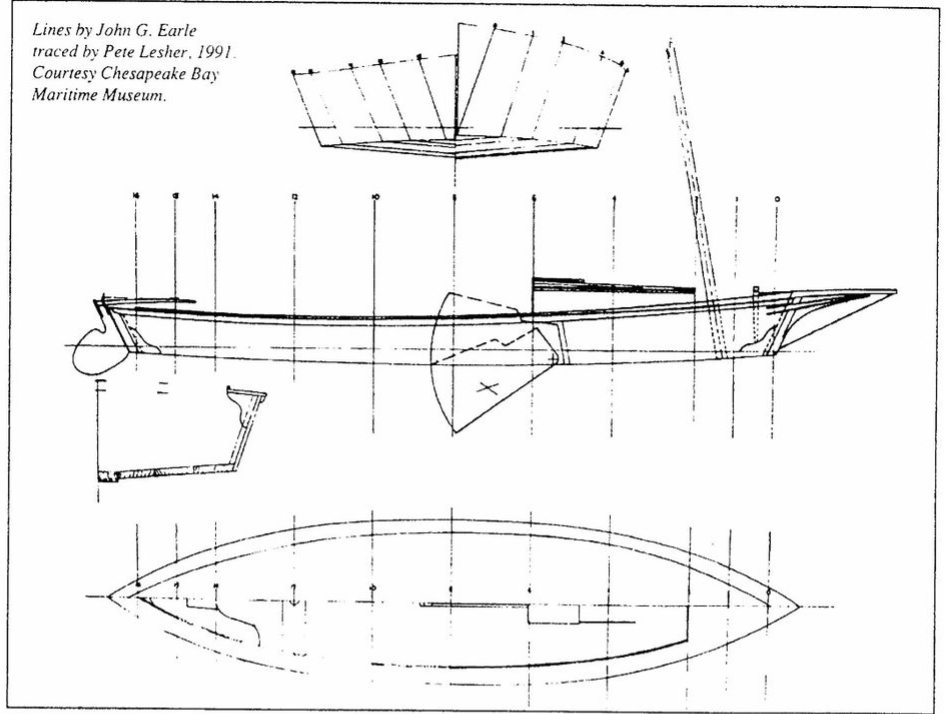
Lines by John G. Earle traced by Pete Lesher, 1991.
Courtesy of CBMM.
The first skiff (or "skift" as Lambdin spelled and probably pronounced it) was built for Jonathan Wagon and Hicks Fairbank. The contract, signed on 15 November1886, called for "a skift 31 ft. long and 7 ft. wide for two dollars and twenty-five cents a foot finished by Jan 1. 1887." The skiff was not completed until 29 January, but Lambdin was paid the full $70. Georg Laramore and Edward Fairbank requested a skiff of identical dimensions. Lambdin charged the same rate. This skiff was finished on 31 January in time for the contracted date, 1 February 1887. [3]
Robert Lambdin was able to charge considerably less for cabin skiffs than log canoes of comparable length. On 17 November 1887. Charles M. Bailey requested a log canoe "29 ft. long and 5-1/2 ft. wide complete with sails and oars and rowlocks for $175.00." Even the price of a smaller canoe exceeded that of the cabin skiff. In 1886 Lambdin charged George R. Vickers. Jr., of Baltimore $125 for a canoe 25 feet long and 5 feet wide. [4] If other builders followed suit, this suggests that the demise of the log canoe can be attributed to economic considerations as well as the dwindling supply of large pine logs.
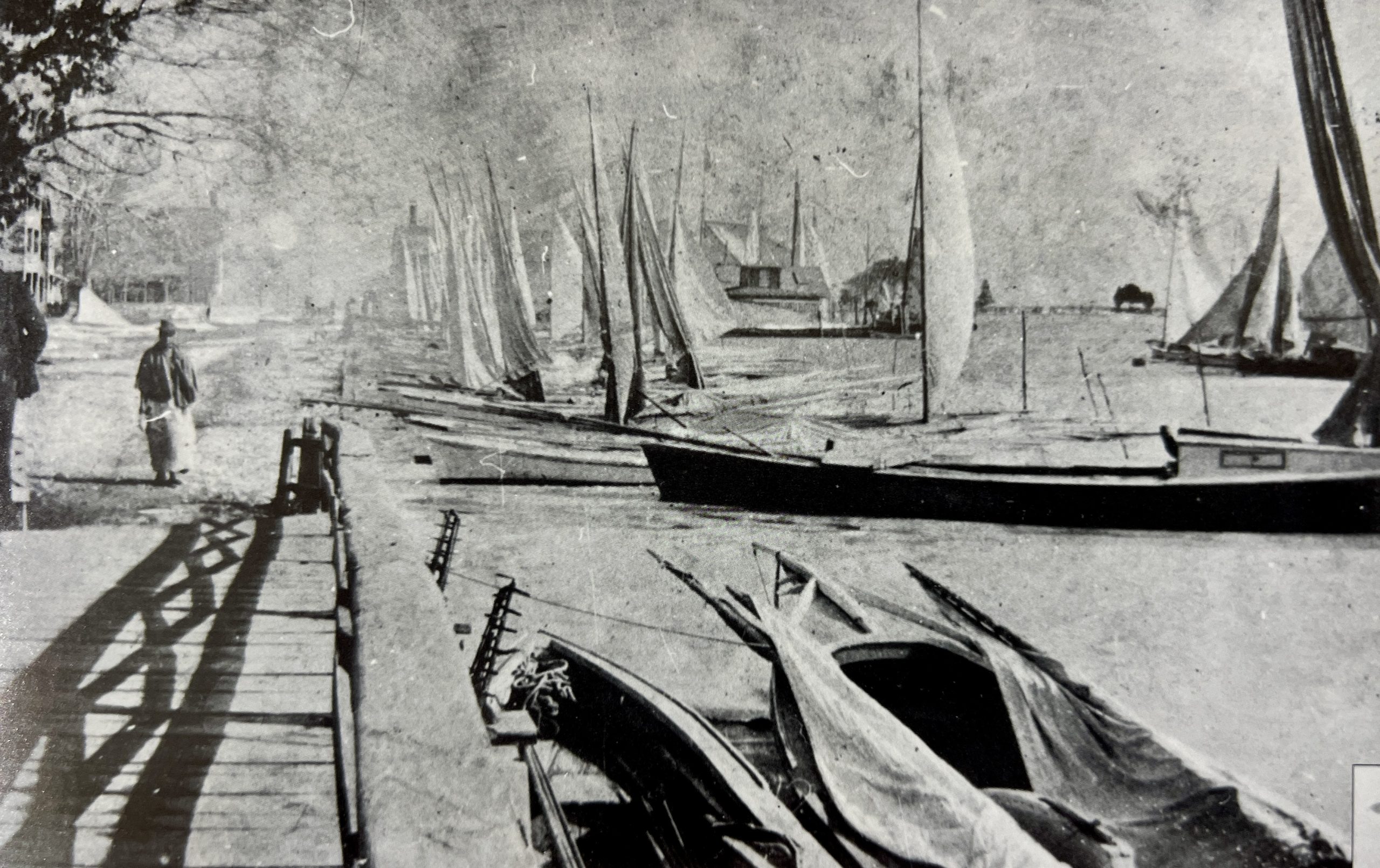
A cabin skiff moored with other oyster tonging boats in St. Michaels harbor. A culling board is laid across the deck, and handles of oyster tongs extend from the stern.
Photo: M. D. B. Bielaski, ca. 1890. Courtesy Chesapeake Bay Maritime Museum.
Catalog #: 0000.0531.0001.00
Object Name : negatives
Title : FOOTBRIDGE - LOOKING TO NAVY POINT, WITH MANY SAIL
Artist-Maker : Bielaski, M D B Photographer
Date Made : Range,Circ 01/01/1890 - 12/31/1890
Description : FOOTBRIDGE - LOOKING TO NAVY POINT, WITH MANY SAILING SKIFFS, MAN AND WOMAN CROSSING FOOTBRIDGE FOOT OF CHERRY STREET
The construction of the cabin skiff resembles that of a lightly built log boat, but the lines -- the actual shape of the hull -- look more like a double-ended deadrise skiff. Cabin skiffs had a hard chine and a plank, usually just one, forming each side. The bottom was formed with heavy sawn timbers laid fore-and-aft and edge nailed with iron drifts. [5] The heavy planks were set on trestles and weighted in the center with stones to bend them to shape. The manner of fastening was taken from log canoe construction methods, and it had the advantage of leaving the bottom smooth and unobstructed without the installation of a ceiling. Oysters could be culled into the bottom of the skiff and easily shoveled out.
This construction differed from log canoe methods in the use of sawn timbers instead of logs shaped by adze. This wasted less wood and required less labor which explains the lower cost of building a cabin skiff. Like the canoes of the day, these were shallow-draft, centerboard craft. Cabin skiffs also tended to be constructed of multiple heavy planks, more than the three or five logs generally used to build log canoes at that time. Log canoes and other Chesapeake Bay working craft were typically built by "rack of eye," or without plans, and it is probable that the same was true for the cabin skiffs.
The cabin skiff probably appeared on the Miles River about the same time as the deadrise skiff during the 1880's. Although the cabin skiff might appear to be a transitional type. it is more likely that it was a hybrid between the log canoe and the deadrise skiff. V-bottom boats were introduced to the Chesapeake from the outside, probably from New England. [6] The Miles River builders presumably saw the economy of the new deadrise boats and adapted their log canoe construction to the new design.
The cabin and the greater length of the cabin skiff speak of the condition of the oyster industry at the time. Some tongers found better fishing by venturing farther away from St. Michaels: the oyster beds were apparently already suffering from over-harvesting. The cabin ski ff could venture far into Eastern Bay, returning to St. Michaels the following day. This advantage was eroded twenty years later with the appearance of the gasoline engine, and the cabin skiffs promptly disappeared.
The rapid disappearance of the cabin skiffs can he attributed to two factors. First. when gasoline engines became available to the watermen, it was no longer necessary to outfit oystering boats for overnight trips. Engines increased the range of the workboats as they decreased their dependence on the wind. Second, cabin skiffs failed to gain widespread distribution, remaining largely restricted to the Miles River. So when these workboats faded from use on the Miles River, they disappeared entirely.
Other areas, however, had also felt the need for oystering boats with larger capacity and longer range. On the lower half of the Chesapeake. the coasting canoe and the brogan appeared, essentially larger log canoes fitted with cabins. Built principally in the first half of the nineteenth century, the coasting canoes bore many similarities to the later cabin skiffs. They were 35 to 40 feet long with a small cabin forward, 6 feet long and set just abaft the foremast. The coasting canoes had two bunks and a small wood stove. [7] It appears that the cabin skiffs differed from the coasting canoes below the waterline only.
The cabin skiffs did not disappear entirely without notice. A colorful account of a sailing party appeared in the St. Michaels Comet around the turn of the century:
Capt. David Reed sailed out of our town' s harbor on last Monday morning in his clipper skiff Dr. Johnson. The skipper's craft is in apple pie order, having just undergone a through renovation under the hands of the owner. (Captain Dave Reed kept his skiff at Tunis Mills on Leeds Creek, a tributary of the Miles River whose mouth lies directly across from St. Michaels.) Well, our skipper beat dead to windward out Leeds River in clipper-ship time; ran well beyond Second Point (Fairview Point); then "throwed about" on the port tack and "fetched" Long Point. From thence up Miles River to Col. Chipley' s mansion (the anchorage located at the Miles River Neck end of Miles River Bridge); to Mr. Bailey's; to Dr. Chas. Lowndes' (Sunnyside Fam), taking on a party of ladies and gentlemen at the places designated; seventeen in all, said the Capt. Down the river, then the skipper steered his craft, making a long track into St. Michaels harbor; from thence to Herring island and return to Long Point. Here the party disembarked at about 9 o'clock pm and a lunch followed the landing. A most delicious one too, as per report. A charming moonlight sail followed by a sumptuous lunch under the shimmering rays of the orb of night is a dual pleasure that comes not often in a single night. The navigator of the Dr. Johnson landed the party safely at their respective homes, and then set sail for our town's harbor, arriving here after the village chanticleers proclaimed the midnight hour. [8]
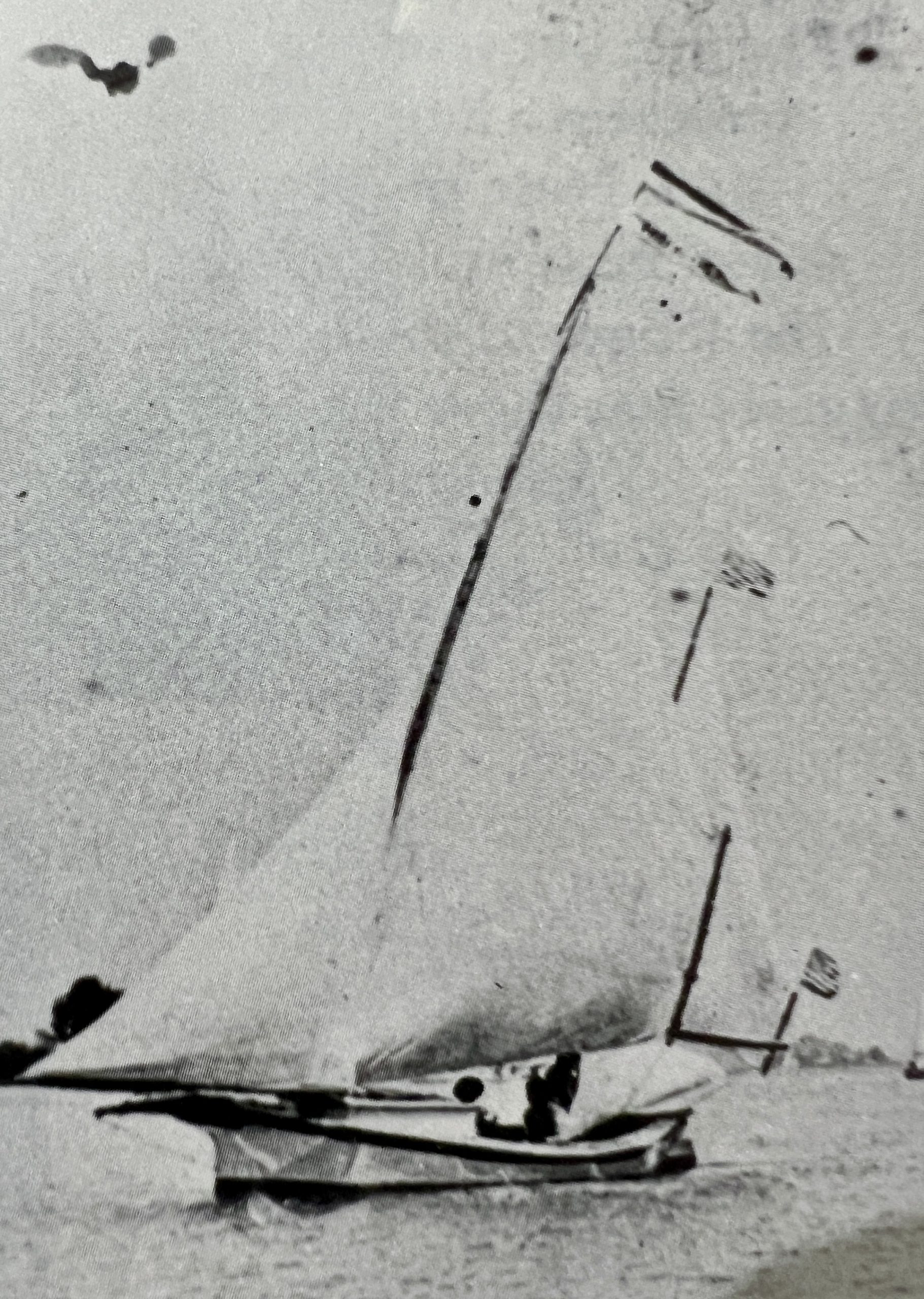
Captain Dave Reed's cabin skiff dressed for pleasure sail. The lower pennant on the foremast reads "Pride of the Bay."
Courtesy estate of John G. Earle.
Captain David Reed may have had the above article printed as a sort of advertisement, as his passengers were carried for hire. He apparently found more use for his large skiff than oystering. His skiff had an unusual name for a Chesapeake Bay workboat. She was named for Dr. Julius A. Johnson of Easton, MD, who apparently advanced Reed the necessary funds to either build or refurbish the boat.
Captain Dave Reed's cabin skiff was rigged in the fashion now associated with the Tilghman log canoe. He carried two leg-of-mutton sails on unstayed raking masts and a long-footed swinging boom. The foresail and mainsail each had a club at the clew end, making the rig identical in design to that used on the racing log canoes. When moored or to reduce the rig in heavy weather, the mainmast was unstepped. This was the typical rig carried by the cabin skiffs, although some may have had only a single mast.
Many of the cabin skiffs, including Reed's Dr. Johnson and one named Bateman, were built by John Jackson of St. Michaels. Jackson also built one named Eva for a Captain Ned Watkins. Between roughly 1888 and 1892, Alfred Trieby in nearby Tunis Mills built several others, including Ella B. Alfred T. Barbary, Three Brothers. King William, and the Green Boat.9 Others were built by a Mr. Redmond, whose given name is lost.
The cabin skiffs disappeared early in this century; none are known to have survived past World War I. Because they were only in use for a brief period -- 20 or 25 years -- and because they never spread beyond the Miles River, the cabin skiffs are largely forgotten today. They are yet another of the countless varieties of small craft that once worked the Chesapeake Bay.
Sources
- Easton Gazette, 18 December 1886
- Brewington, Marion V., Letter to John G. Earle, 30 Jan. 1950.
- Robert Lambdin's account book, Chesapeake Bay Maritime Museum 87.36.1.
- Lambdin account book.
- Brewington, Marion V., Chesapeake Bay: A Pictorial Maritime History (2nd ed., New York: Bonanza Books, 1956) pg. 6.
- Chapelle, Howard I., American Small Sailing Craft (New York: W.W. Norton & Co., 1951), pp. 305-309.
- Brewington, Marion V., Chesapeake Bay Log Canoes and Bugeyes (Cambridge, MD: Cornell Maritime Press, 1963), pg. 37.
- St. Michaels Comet, undated clipping, (c. 1900).
- Interview with Nicholas R. Tucker of St. Michaels by C. Lowndes Johnson and John G. Earle, Nov. 4, 1933.
More about CBMM Collections
Items that are not exhibited around the CBMM campus are kept in the Norman & Ellen Plummer Center for Museum Collections. This is a climate-controlled facility that was expanded and modernized in 2023.
You can search all the collections online here. Look for the links at lower left to search these collections separately:
- Objects, Photographs, Manuscripts, Ships Plans
- Regional Oral History Database
- Books and Periodicals
See my CBMM Collections Search Tips.
The collections and library are accessible only by appointment. Email collections@cbmm.org or visit the Library and Research page.
Voile-Aviron | Sail & Oar
I also write about sail-and-oar cruising in small open boats on the Chesapeake and its tributaries at Sail+Oar - Chesapeake Log.
Archived Comments
These comments are preserved from the original WordPress site as read-only text.
Another great one Don!!