
 Maryland
Lark Model by Edward R. Thieler at the Chesapeake Bay Maritime Museum
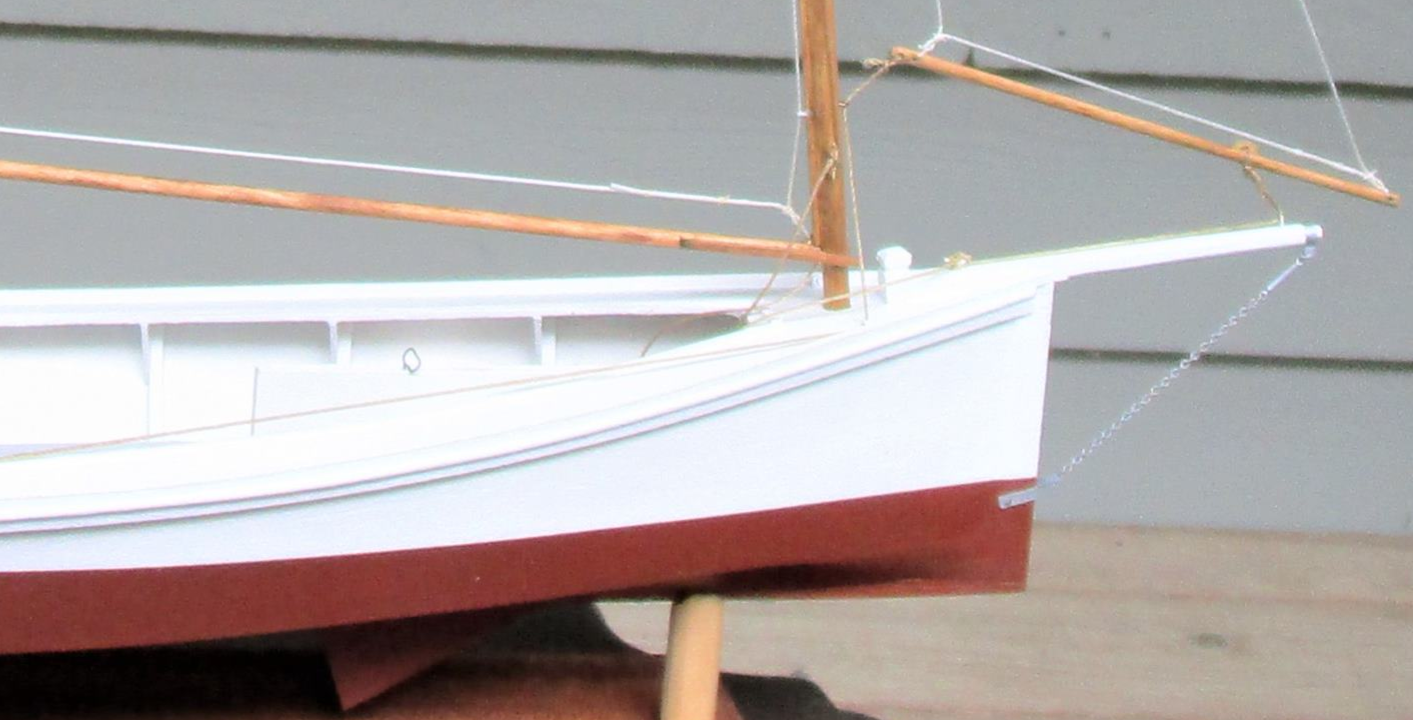
Artist-Maker : Thieler, Edward R
Date Made : c 2018-2019
Dimensions : [H]21 x [W]6.5 x [L]21
Gift of Dr. Edward R. Thieler III
The Chesapeake Bay workboat models in Edward R. Thieler III Collection at CBMM are historically accurate and are a valuable resource for the traditional builder and historian.
Text and photos are published here with permission from CBMM and Ed Thieler.
Lark - A Brief History and Description
The Lark model is sold as a kit in the CBMM Museum Store with this description and history :
Lark is a sailing skiff similar to many early Chesapeake Bay crabbing skiffs. The boat has been in the collections of the Museum since 1986.
Dozens of types of crabbing skiffs appeared along the creeks and rivers of the Chesapeake Bay in the late 19th century. A smaller predecessor of the bateau and skipjack, the crabbing skiff typically had a deadrise (V-bottom) hull, diagonally cross-planked in "herringbone" fashion. The narrow washboards and decks provided suitable work surfaces and ample space in the cockpit.
Lark's rig consists of a leg-of-mutton mainsail and club-footed jib on a single unstayed mast – typical of Chesapeake Bay workboats, large and small. She is 20 feet long and 5 feet, 10 inches in beam. Narrower than most working skiffs, she was used mostly for pleasure, including recreational fishing, crabbing, and oystering.
Built about 1918-1920 on the shores of the West River in Anne Arundel County, Maryland, she originally may have been equipped with an engine and later converted to sail. Although her builder is unknown, she was probably built for yacht captain, Charles Kerr of Rock Hall, Maryland.
Selected Photos of the Lark Model
Large format images to the completed Lark model photos are here.
Notes on Rigging and Sailing Lark
Ed Thieler notes for Lark model builders
On starboard tack, the skipper would sit on the starboard washboard, tiller in his left hand. The main sheet leads from the boom, down and around the end of the belaying pin protruding under the port washboard, then across the cockpit to the skipper's right hand. The friction of the sheet on the pin works great to make holding the sheet against the pull of the sail easier. A figure-8 belay would be used around the belaying pin.
Swivel cleats had not been invented yet, and watermen would not have spent the money. Port and starboard belaying pins in the washboards came down from the log canoe days. Also you would not sheet these sails in hard. They liked the boom not to come inside the transom corner so sheeting to the rail was the way it was done. They sailed a little off the wind and kept the boat flat.
Because the jib has a full club it only needs one jib sheet. Once you get on course and set the jib you need not touch it as you tack.
The main thwart was meant for passengers and to stiffen the hull. The small thwart was meant to support the trunk, and as a seat for a very skinny passenger.
The sculling or "shoving" paddle was usually made of oak and was 8'-10' long. It tapered from a round handle end about 1 ¼" diameter to an oar-like blade about 4"- 6" wide and ¾" thick. Used for sculling in deep water, a pad of wet burlap is placed over the transom to serve as a stabilizing fulcrum as there is no sculling notch.
When it is well done by a practiced skipper, sculling (moving the angled blade side-to-side) is an efficient mode of propulsion. When used for shoving (poling, pushing) in shallow water, the paddle is pushed against the bay bottom. In this way, Islanders of all ages go "shovin'" in skiffs; fishing, crabbing, and "proggin' ", exploring in their local waters, guts, and marshes.
Questions About Lark's Original Sailing Rig
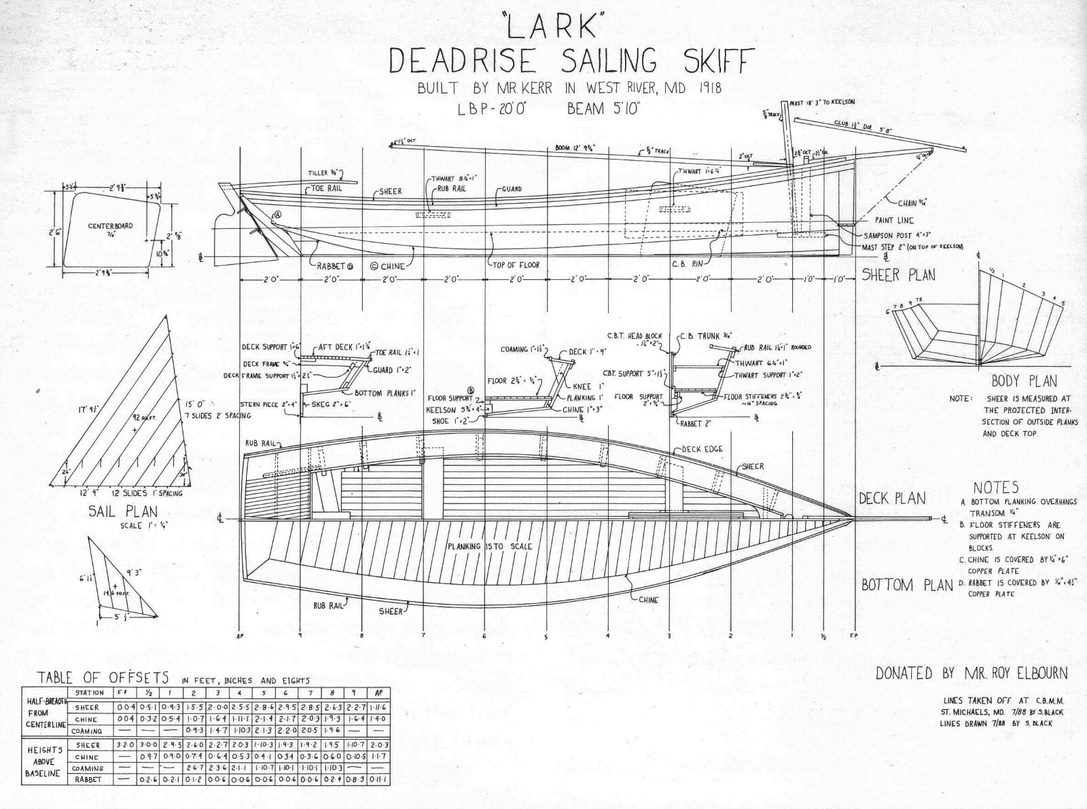
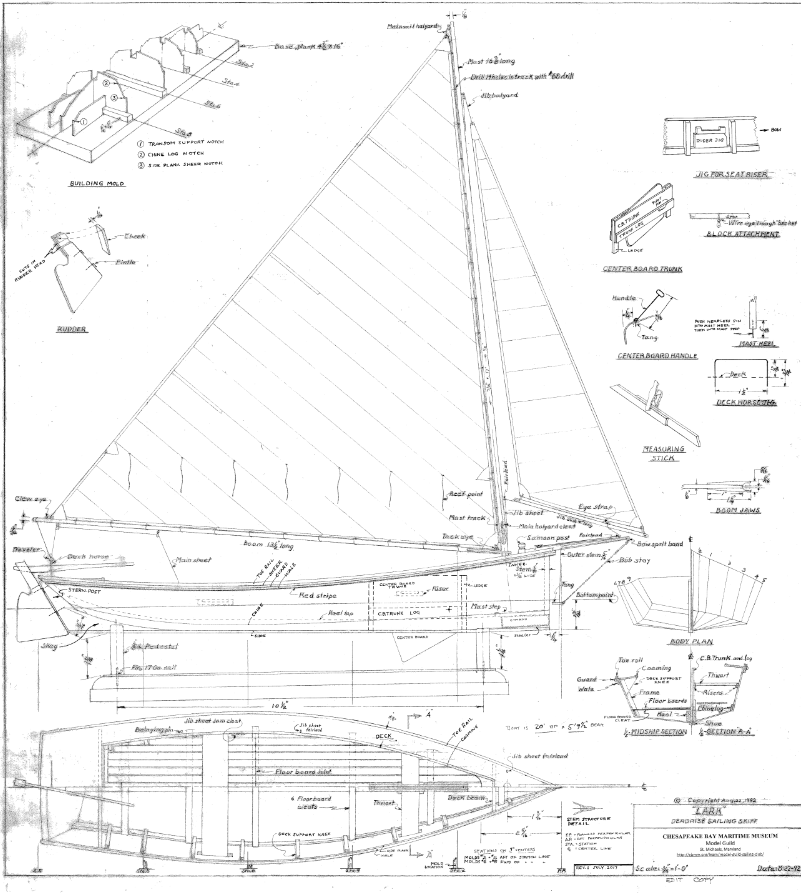
In October 2021, Ed Thieler discussed Lark's original sailing with CBMM curator, Pete Lesher. Thieler pointed out that the CBMM publication, A Heritage in Wood says on page 60, "The mainsail is like that of the log canoes, with a club at the clew held out by a sprit....." Yet the drawing that accompanes the text shows a different rig. (See the plans above.) Thieler asked if Lark had the sprit rig mentioned here at an earlier time but was donated with the clew-less boomed rig.
Lesher noted that Lark had been donated to CBMM without a rig, so when Lark was chosen as the centerpiece of the Bay Boat Room at CBMM (in the 1990s), a new suit of sails was commissioned. The mast height was limited by the ceiling height, and this influenced the rig and sail design that was finally used on Lark for the exhibition.
Lesher had written the Lark description for A Heritage in Wood 30 years ago. So he opened the accession file once again to review the history of Lark's rig. He found the evidence to be somewhat contradictory. Maynard Lowery and Mrs. Harrison, who were connected with the donation, seemed convinced that the sprit rig, after the manner of a log canoe, was correct. Boatbuilder Joe Liener, who advised Lesher in drafting the Lark entry and many others in A Heritage in Wood, denigrated the rig that was used in the exhibit and, according to Lesher, probably steered him to write that description, which Thieler cited as not supported by the drawing.
Based on testimony from a descendant of the Kerr family that originally owned the boat, and from the son of Charles Christ, who bought the boat in 1950, Lesher concluded that a sloop rig with a boom and a mast track is likely how Lark was rigged. But the rig installed by CBMM and documented in Scott Black’s drawing [in A Heritage in Wood] is likely undersized.
Lark Plans
Large format images of these Lark plans are here.
Lark Plan in CBMM's A Heritage in Wood
Lark Half Model by Ed Thieler
Large format images to the "Lark" half hull are here.
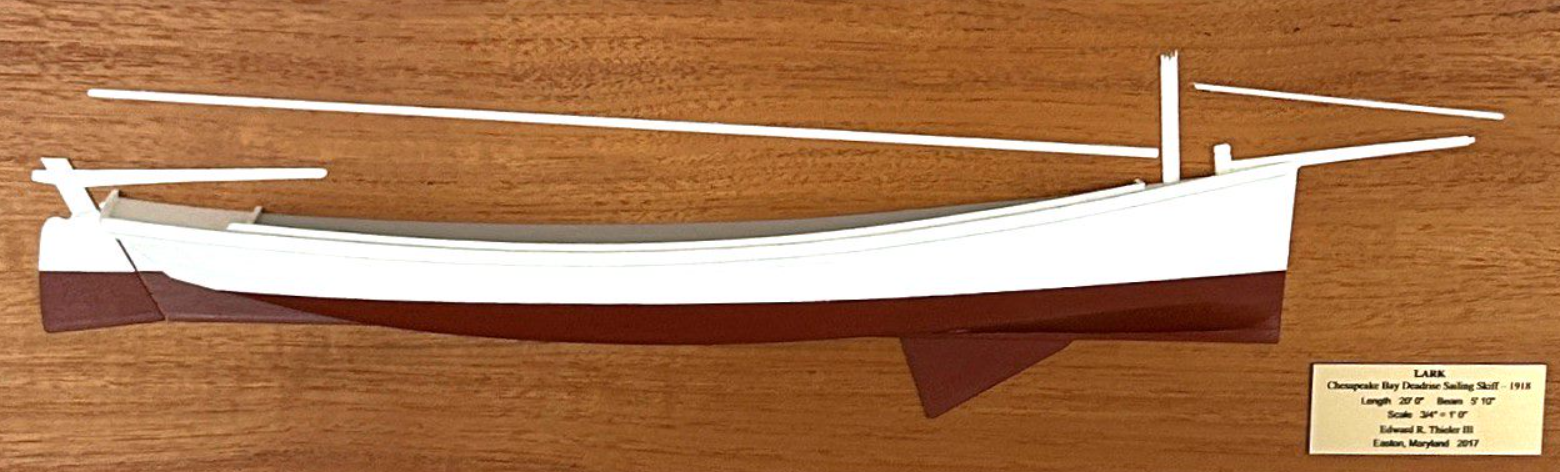
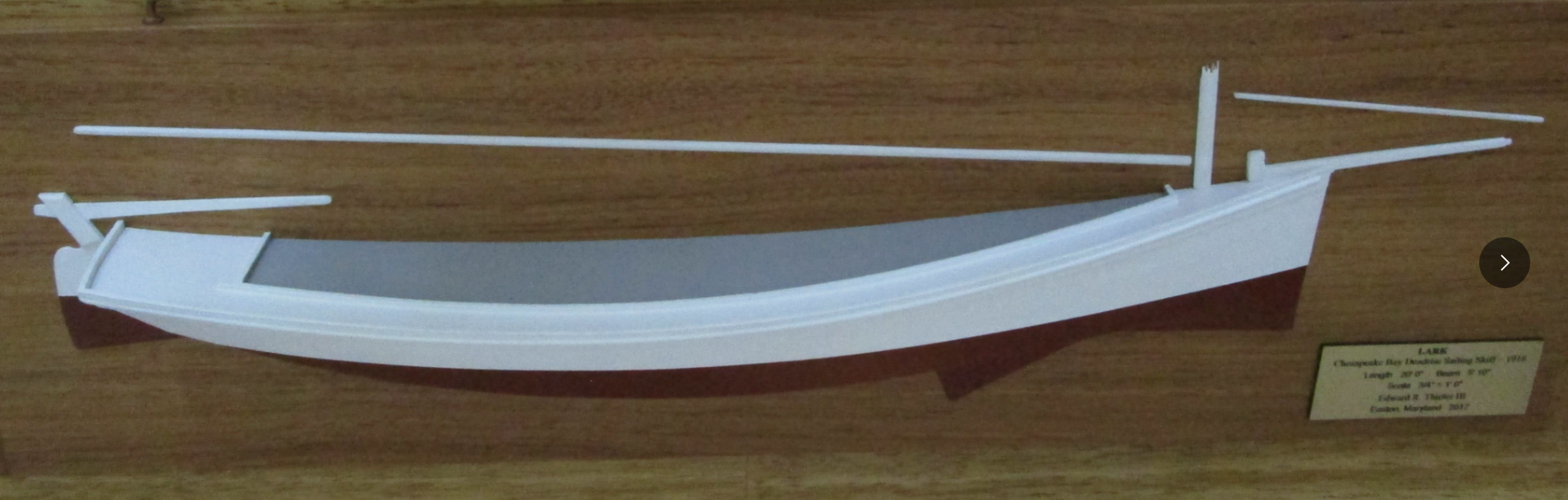
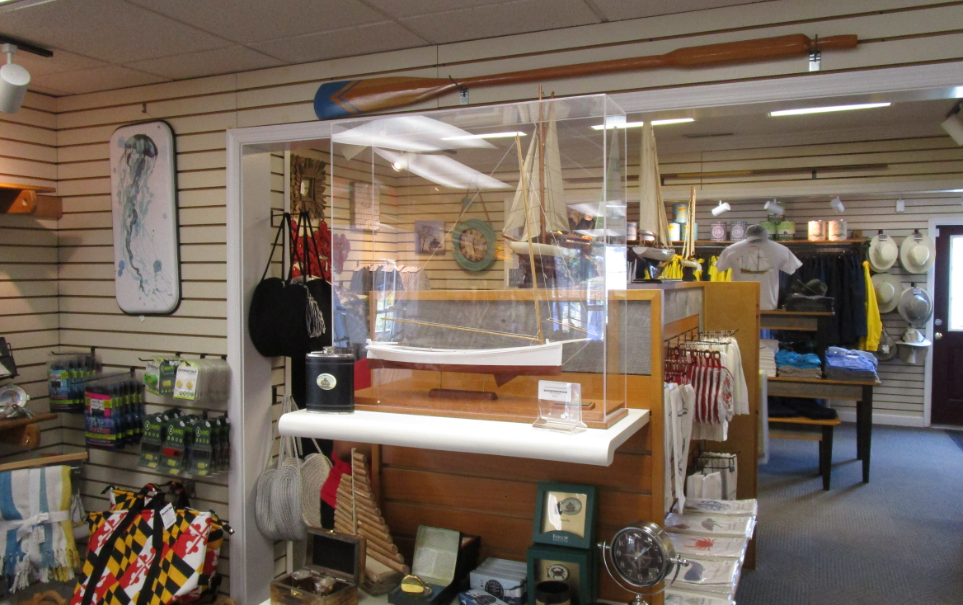
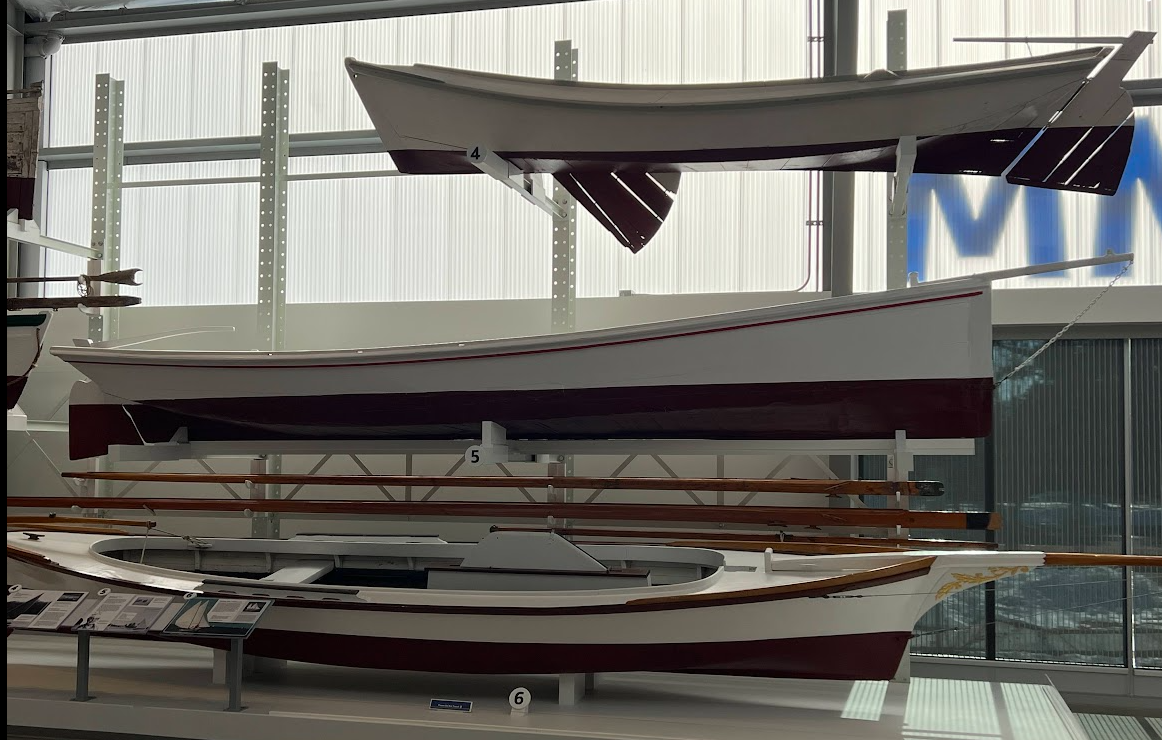
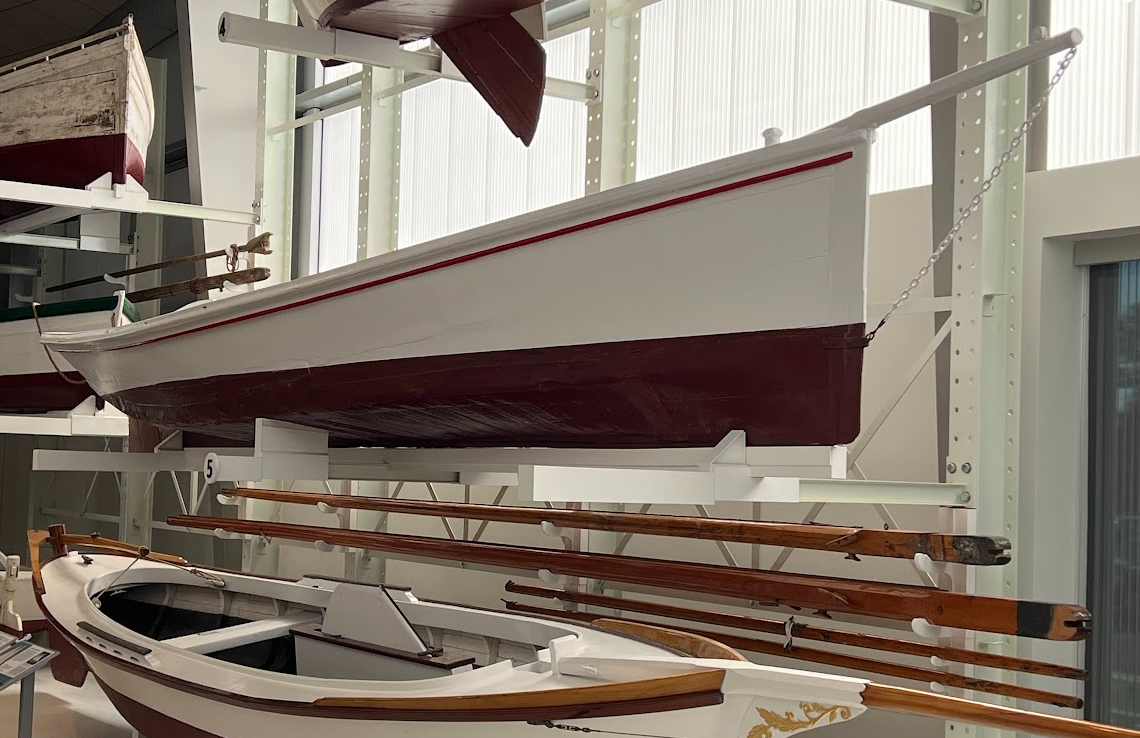
Lark on exhibit in the CBMM Welcome Center, 2025
The Edward R. Thieler Collection at the Chesapeake Bay Maritime Museum
The Edward R. Thieler III Collection of workboat models at the Chesapeake Bay Maritime Museum (CBMM) is a valuable resource for historians, builders, and owners of sailing and power workboats and gunning and recreational skiffs of the Chesapeake and Delaware Bays and the New Jersey coast.
Thieler built most of his models at a scale of 1:12 (one inch = one foot), large enough to display fine detail in both the boat design and constuction, and in the watermen's tools and implements which show the working context of each boat.
Thieler’s models are historically accurate in the smallest detail. His careful research and detailed plans and notes reveal many aspects of the history and traditional use of each boat type. In many cases, he interviewed watermen who used these boats themselves, or whose fathers and grandfathers did. From them he learned about building materials and methods, sail rig, handling and working under sail, and tools and methods for oystering, crabbing, and fishing.
Thieler’s photos of the model building process are a valuable resource for the traditional builder who wishes to build an authentic full-size reproduction of any one of these workboats.
Text and photos are published here with permission from CBMM and Ed Thieler.
More in this Website About Ed Thieler Models
Catalog of Models in the Edward R. Thieler Collection at CBMM
Eastern Shore Sailing Workboats – “Thieler” search in this website
More about CBMM Collections
Items that are not exhibited around the CBMM campus are kept in the Norman & Ellen Plummer Center for Museum Collections. This is a climate-controlled facility that was expanded and modernized in 2023.
You can search all the collections online here. Look for the links at lower left to search these collections separately:
- Objects, Photographs, Manuscripts, Ships Plans
- Regional Oral History Database
- Books and Periodicals
See my CBMM Collections Search Tips.
The collections and library are accessible only by appointment. Email collections@cbmm.org or visit the Library and Research page.
More about Small Boats
I also write about
- Volunteer work in small boat conservation at the Chesapeake Bay Maritime Museum: Small Boat Shed Volunteers
- Sail-and-oar cruising in small open boats on the Chesapeake and its tributaries: Sail+Oar – Chesapeake Log.
- Building another crabbing skiff.
Archived Comments
These comments are preserved from the original WordPress site as read-only text.
I emailed Ed Thieler to let him know that this article had dozens of visitors this week from the WoodenBoat forum, TSCA Facebook group, and other referrers. He replied:
"I do hope no one tries to build and sail Lark. The centers of effort and lateral resistance are horribly out of balance ;-) "