
 Maryland
Anna Virginia - Cabin Skiff Model by Edward R. Thieler
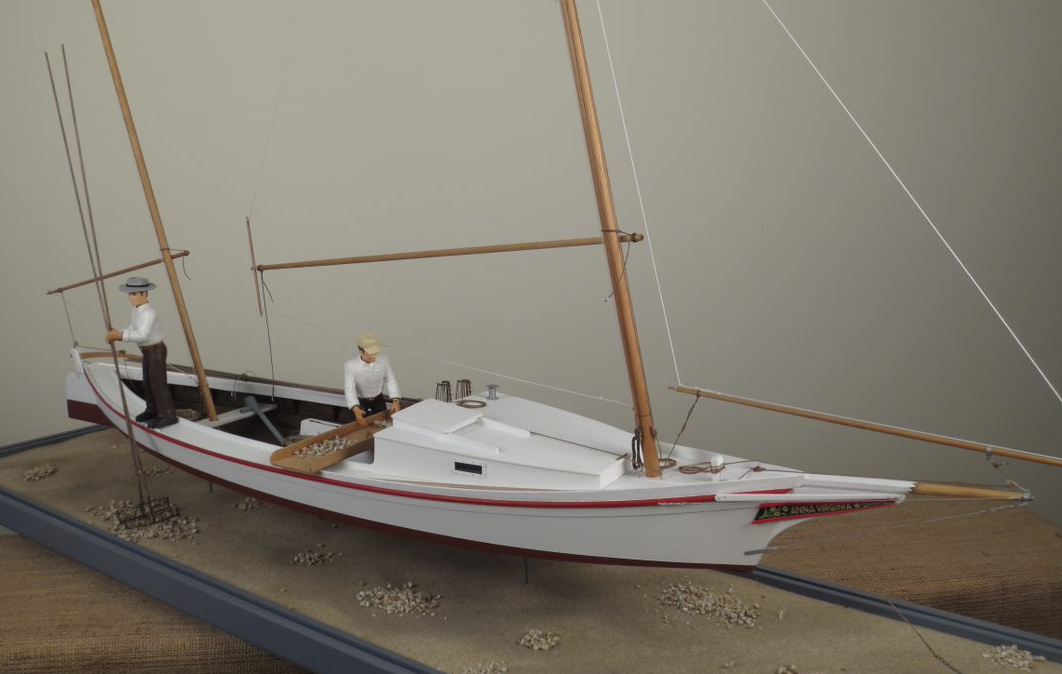
1:12 Scale Model by Edward R. Thieler
CBMM Catalog No.: 2022.0004.0020
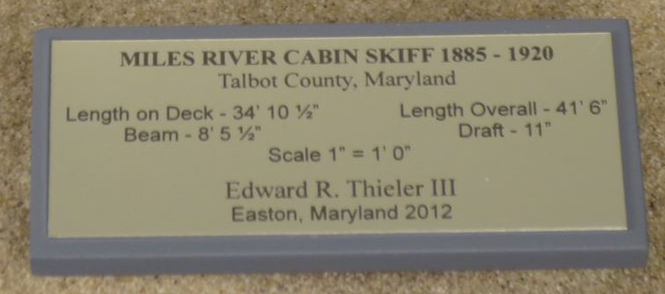
Talbot County, Maryland
Length on Deck - 34’ 10 ½” Length Overall – 41’ 6”
Beam – 8’ 5 ½” Draft – 11”
Scale 1” = 1’ 0”
Edward R. Thieler III
Easton, Maryland 2012
MILES RIVER CABIN SKIFF 1885 - 1920
These double ended sailing workboats, rigged with two leg-of-mutton sprit sails and jib, originated in the St. Michaels region of Talbot County, Maryland.
Heavily built with edge-bolted, fore-and-aft bottom planks that were over 3 inches thick, they required no internal floor frames.
Larger than a typical log canoe, and having a heated cuddy cabin, cabin skiffs allowed two men to stay overnight on the richer more distant oyster beds.
Based on lines drawn by John G. Earle, Chesapeake Bay Maritime Museum Collection
The Edward R. Thieler Collection at the Chesapeake Bay Maritime Museum
The Edward R. Thieler III Collection of workboat models at the Chesapeake Bay Maritime Museum (CBMM) is a valuable resource for historians, builders, and owners of sailing and power workboats and gunning and recreational skiffs of the Chesapeake and Delaware Bays and the New Jersey coast.
Thieler built most of his models at a scale of 1:12 (one inch = one foot), large enough to display fine detail in both the boat design and constuction, and in the watermen's tools and implements which show the working context of each boat.
Thieler’s models are historically accurate in the smallest detail. His careful research and detailed plans and notes reveal many aspects of the history and traditional use of each boat type. In many cases, he interviewed watermen who used these boats themselves, or whose fathers and grandfathers did. From them he learned about building materials and methods, sail rig, handling and working under sail, and tools and methods for oystering, crabbing, and fishing.
Thieler’s photos of the model building process are a valuable resource for the traditional builder who wishes to build an authentic full-size reproduction of any one of these workboats.
Text and photos are published here with permission from CBMM and Ed Thieler.
More About the Edward Thieler Collection
Catalog of Models in the Edward R. Thieler Collection at CBMM
Eastern Shore Sailing Workboats – “Thieler” search in this website
Selected Photos of the Anna Virginia Model
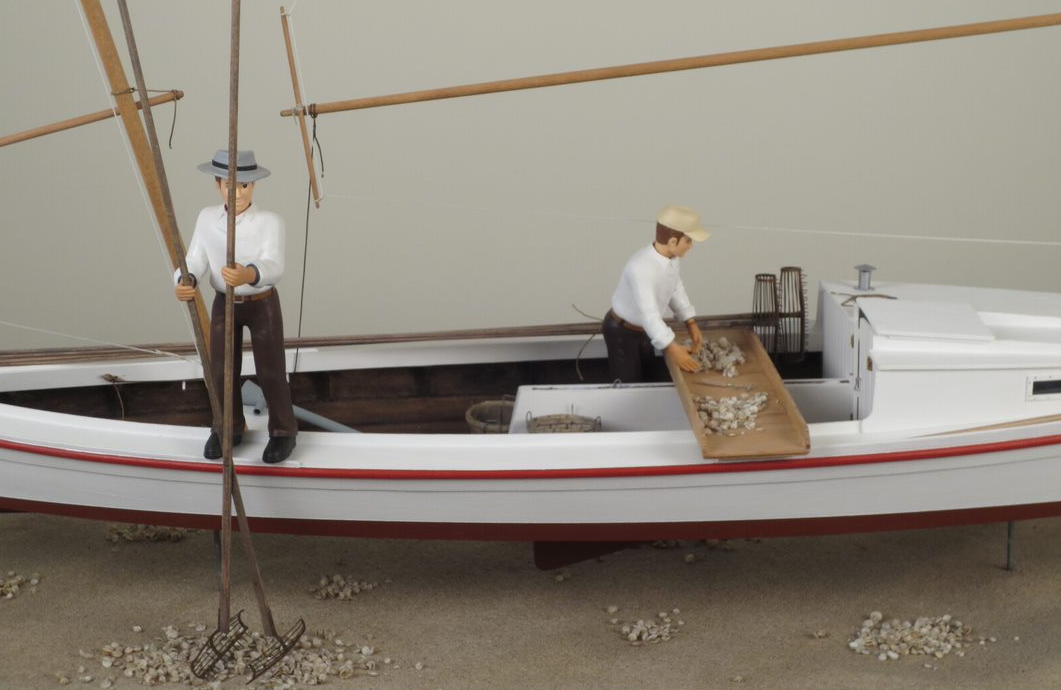
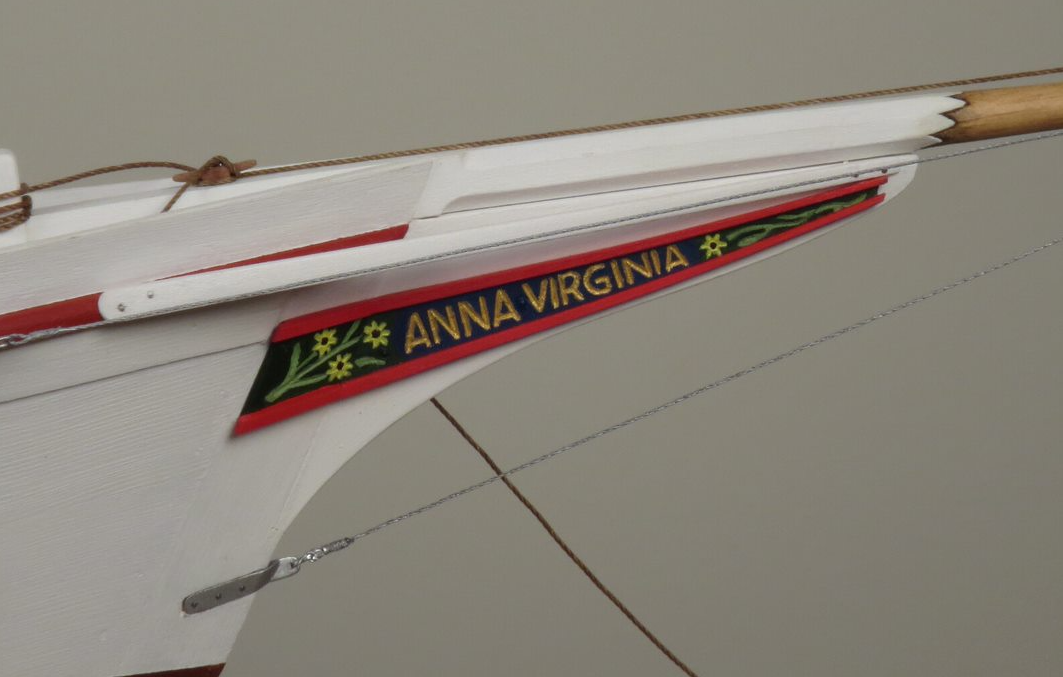
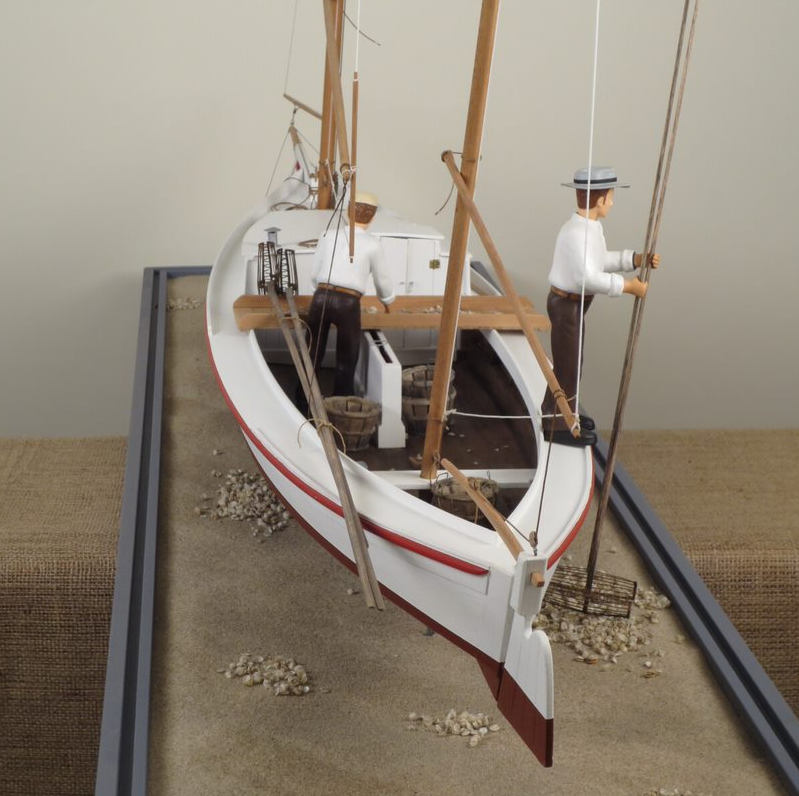
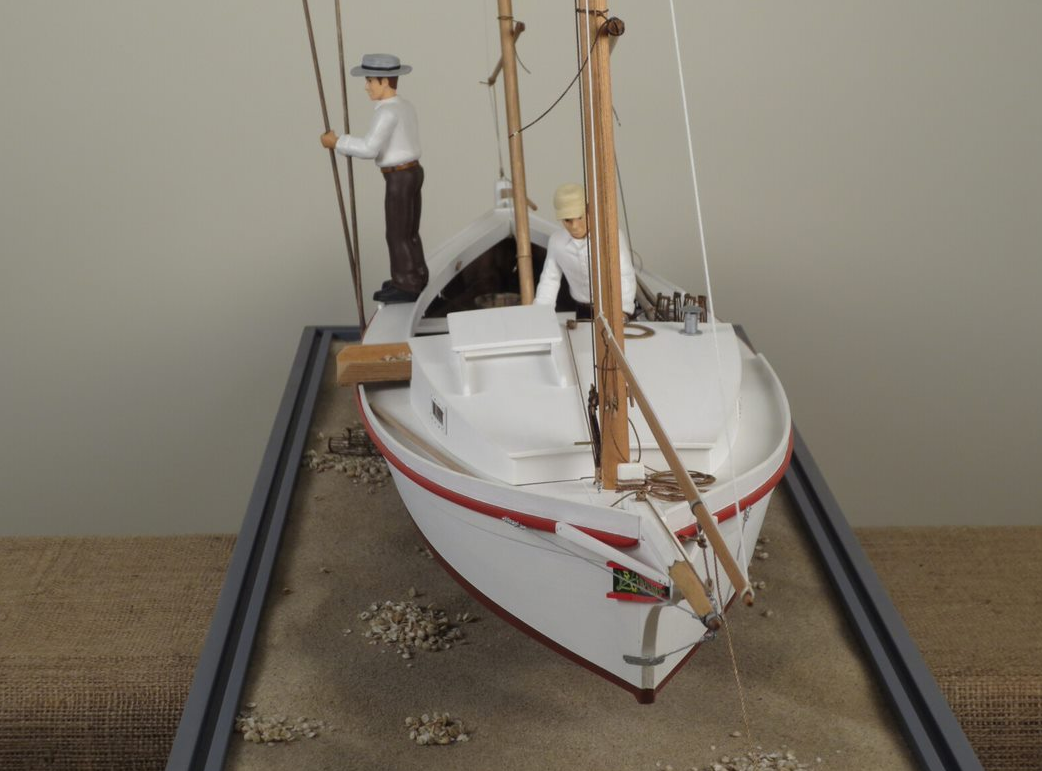
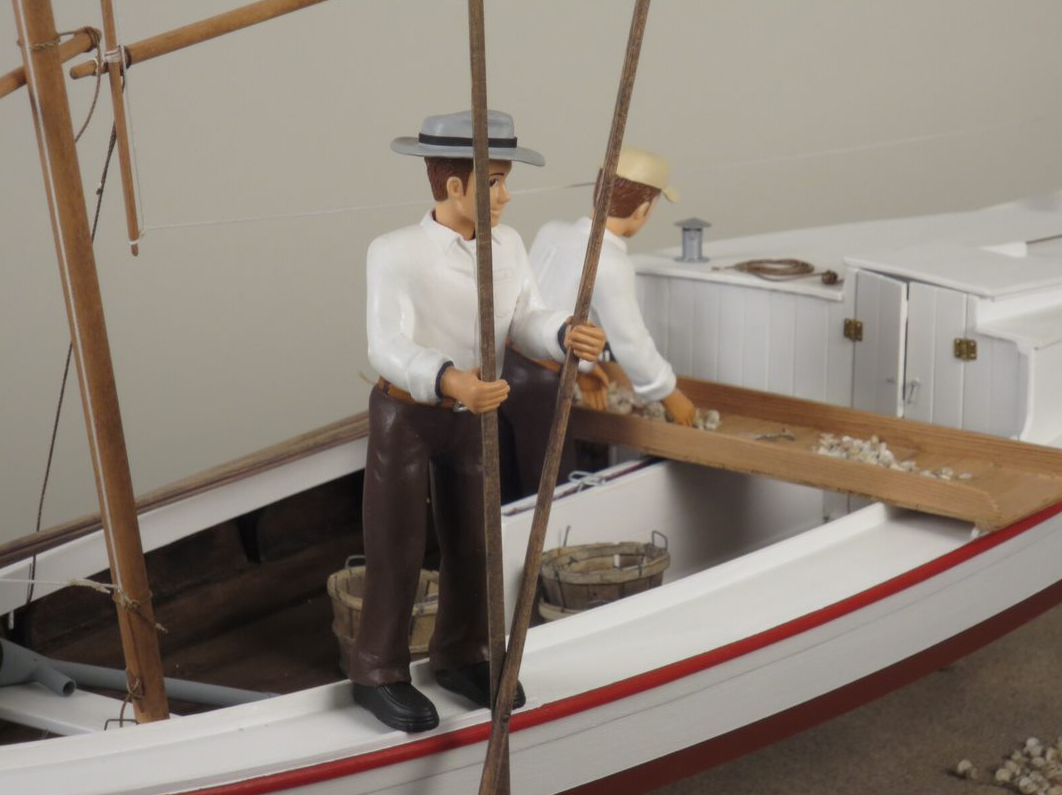
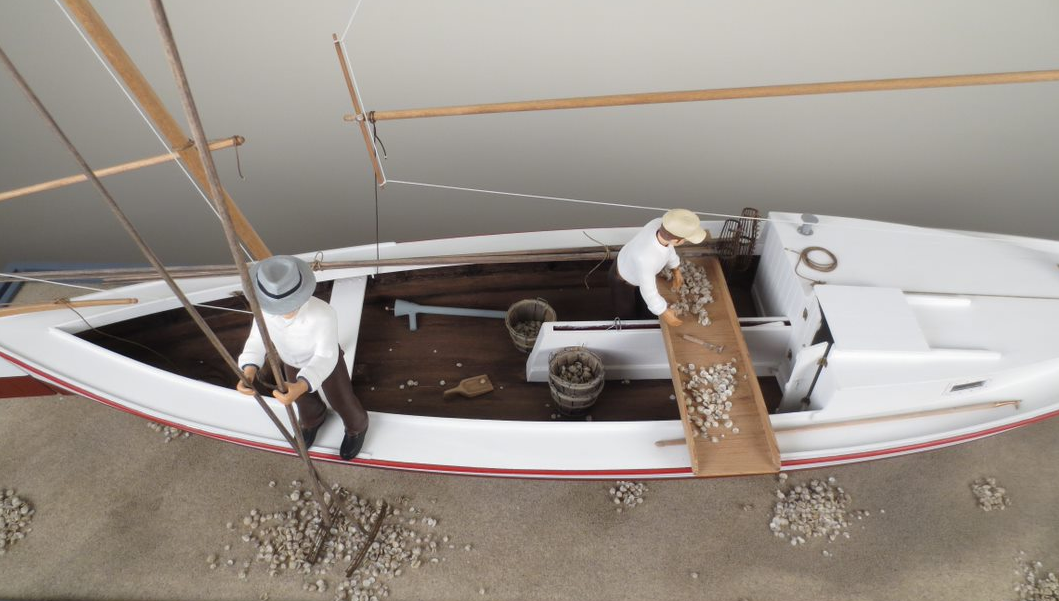
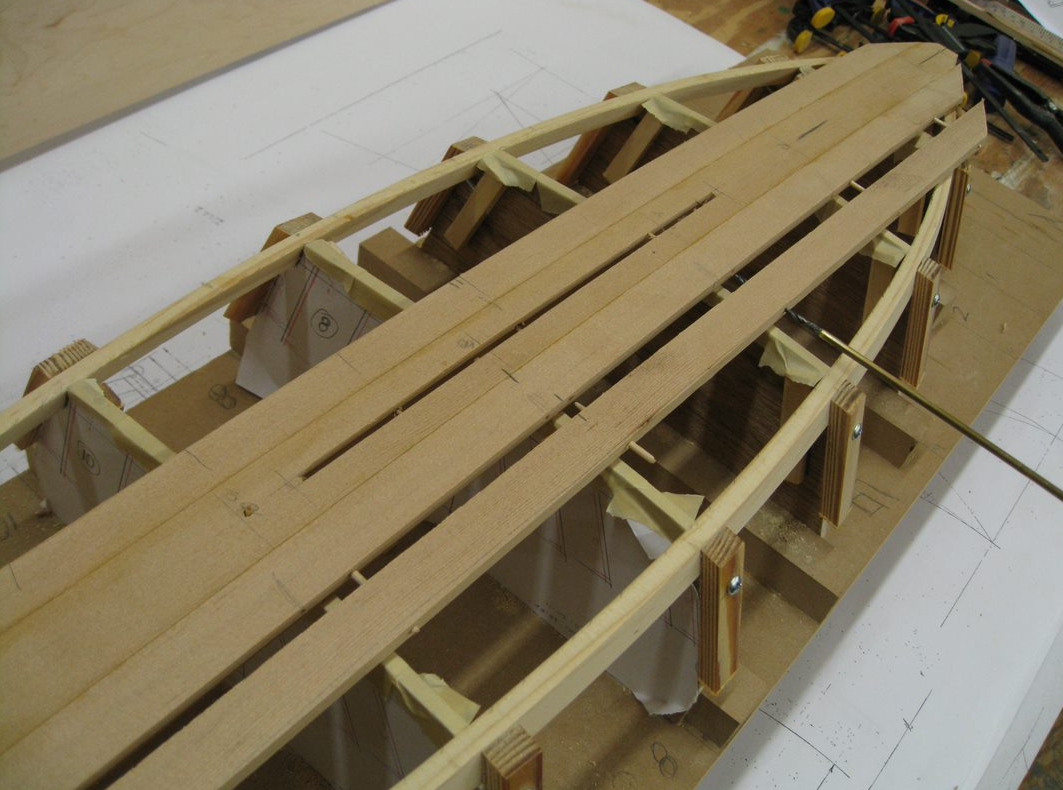
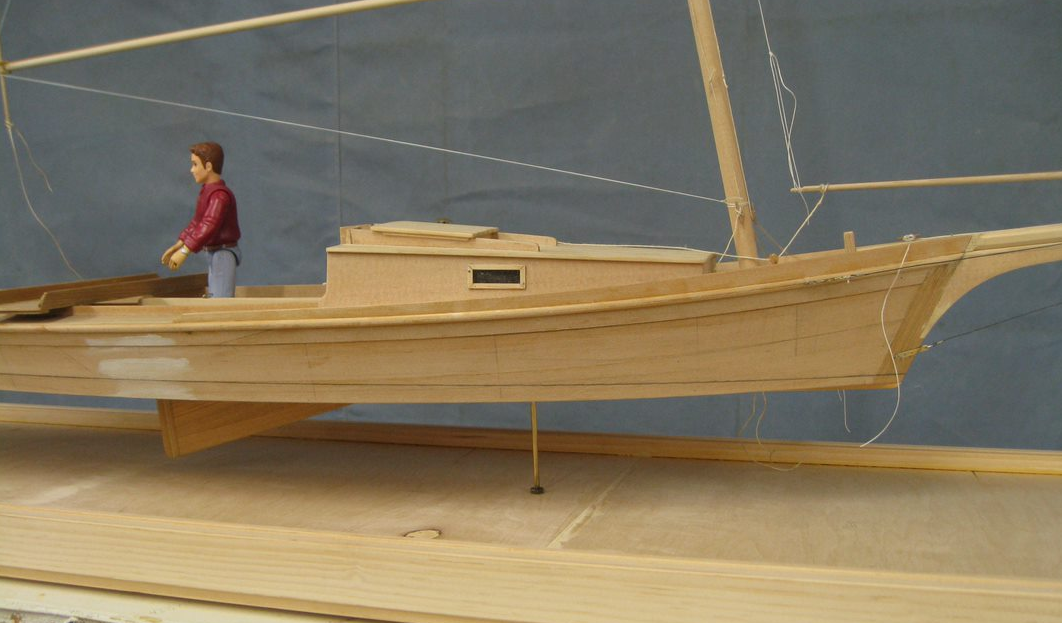
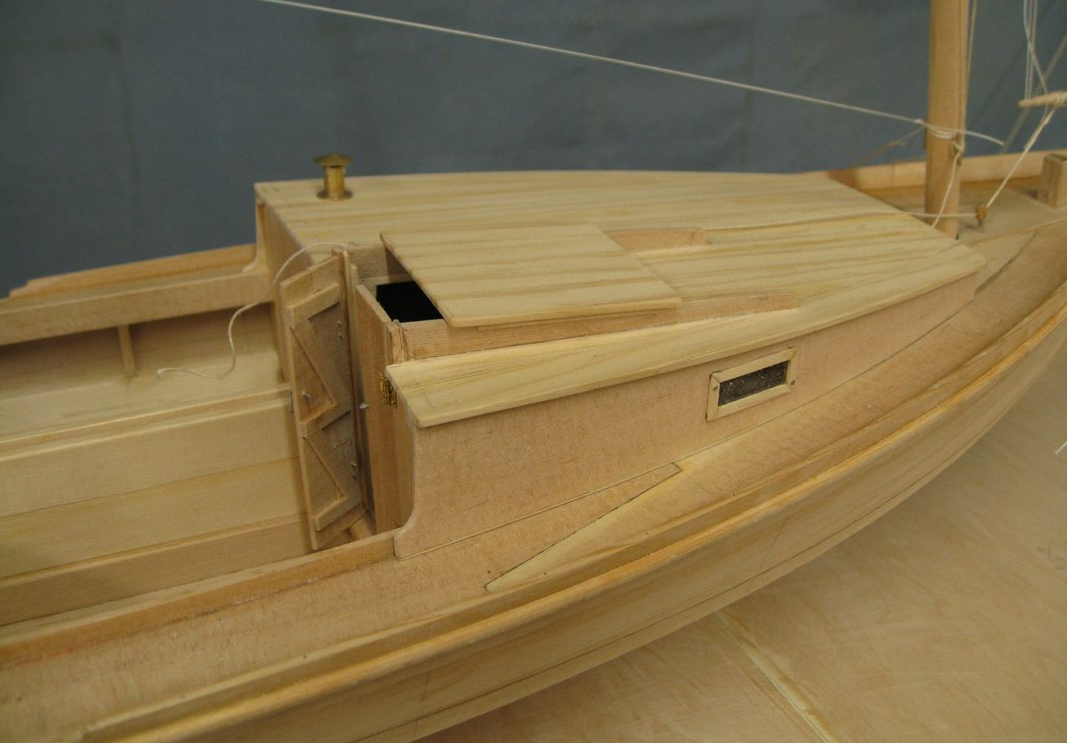
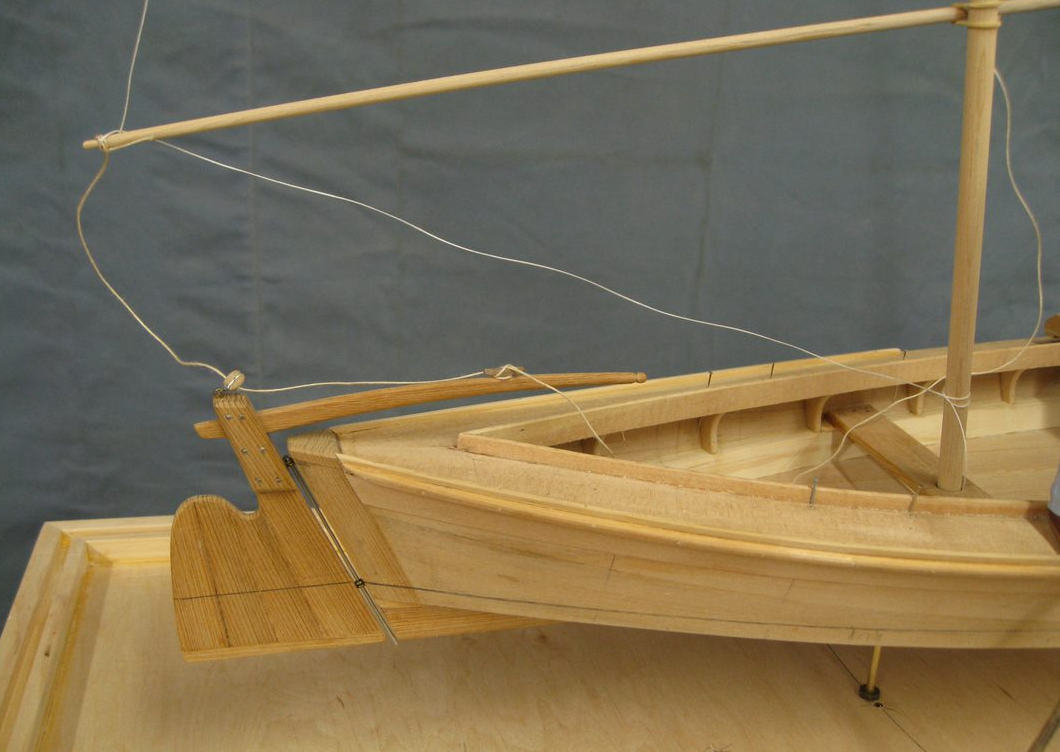
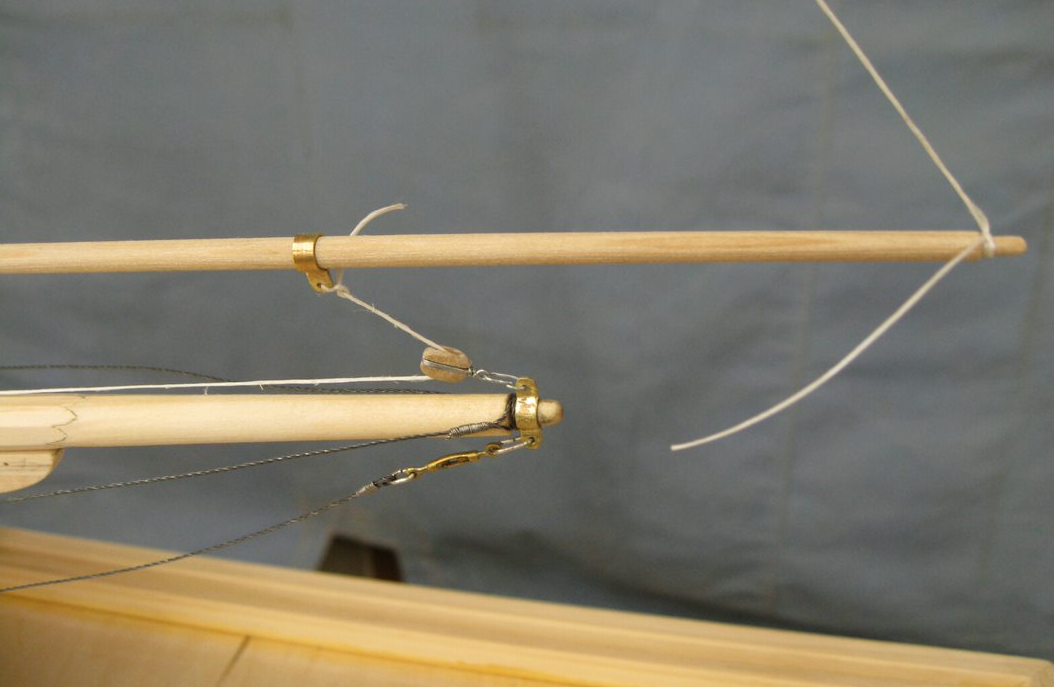
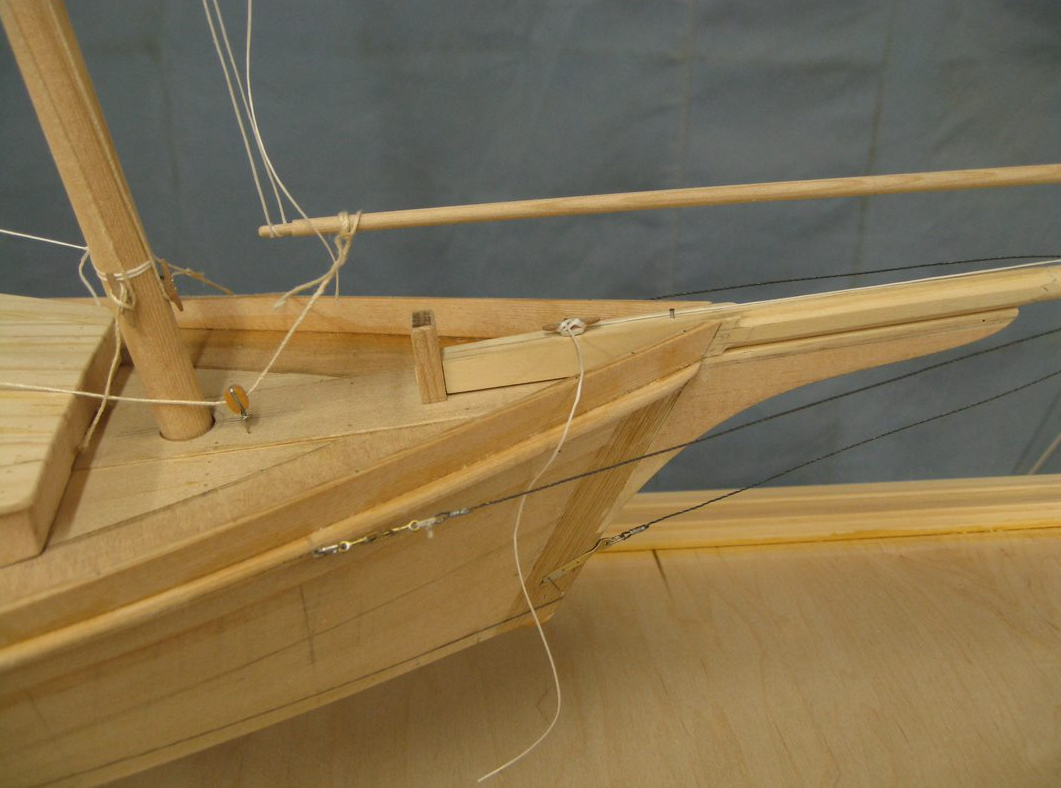
Ed Thieler's Notes on the Design and History of the Miles River Cabin Skiff
[ Written March 26, 2013 for the NRG Photo Competition – 2013. Rev 10-7-2013. Awarded blue ribbon October 19, 2013. ]
Miles River Cabin Skiff 1885 – 1920
Historical background
Two conditions evolved over two centuries that gave rise to the Miles River Cabin Skiff.
In Talbot County on Maryland’s Eastern Shore oyster quantities were diminishing and large trees suitable for log canoe building had became less available.
From the mid 1600s when the area was first settled, until the mid 1800s, oysters were harvested in the Miles River by men using shaft tongs standing in log canoes.
By the late 1800s easy availability of local oysters on one day trips out of St. Michaels harbor had diminished. A larger vessel would be needed to journey farther out the river to harvest as yet un-tapped oyster beds.
During this same period the large trees needed to build log canoes, hewn using broad ax and adze, were becoming scarce. But, saw mills were coming to the region capable of producing lumber suitable for construction of the large two masted vessels required for these longer trips.
First built in the 1880s, two-masted “cabin skiffs” had a small cabin behind the foremast equipped with two bunks and a small wood stove, allowing two men to stay overnight on the more distant oyster beds and return the next day with a larger oyster harvest.
Cabin skiffs were about 30’ long on deck, about 10’ longer than the usual log canoe in use at the time. Like the smaller log canoes they were doubled–ended, but in place of a hewn-log bottom they had a thick sawn-plank bottom. These heavy planks were edge-bolted side-to-side with iron drift pins. As in log canoes this method of construction eliminated the need for internal floor frames making it easier to manage shovels full of oysters.
The sailing rig was typical of other large workboats on the Bay; two masts and a bow sprit. The bow sprit supported a club footed jib; behind that a tall fore-mast carried a large leg-of-mutton sprit sail, usually having a clew club, and aft of that was a shorter main-mast with a smaller leg-of-mutton sprit sail.
By the end of WWI (1918) gasoline marine engines had made travel to and from the distant oyster beds more reliable and rapid. Sailing workboats had had their day and all disappeared from the Bay.
Plans and Lofting
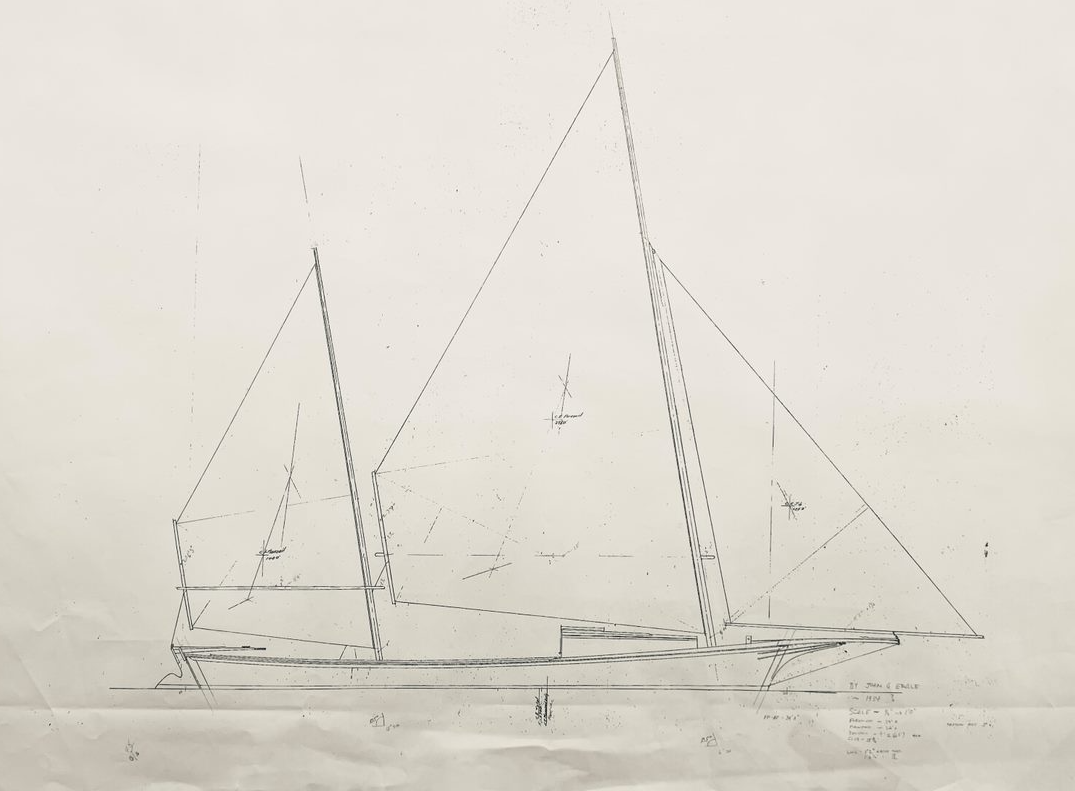
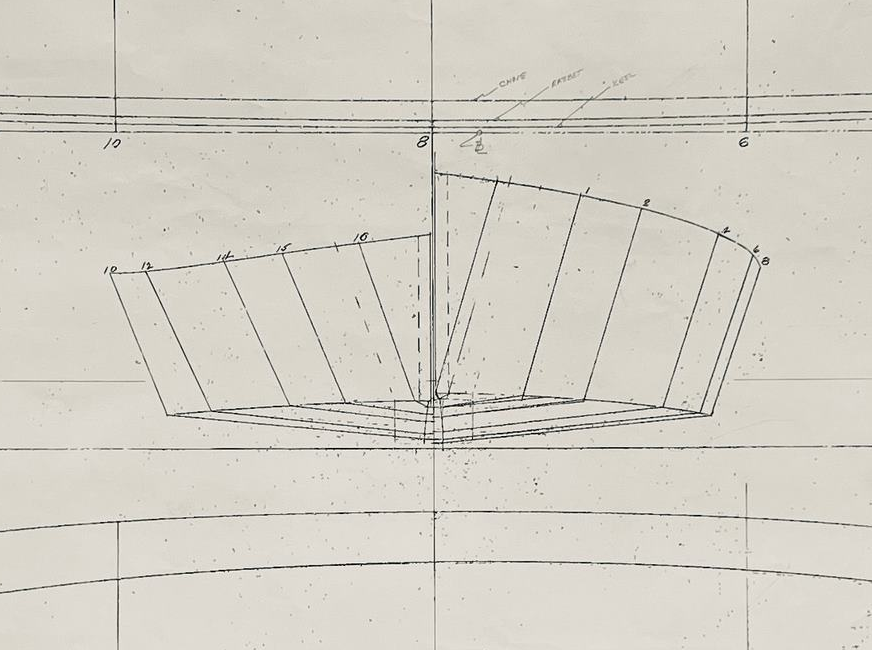
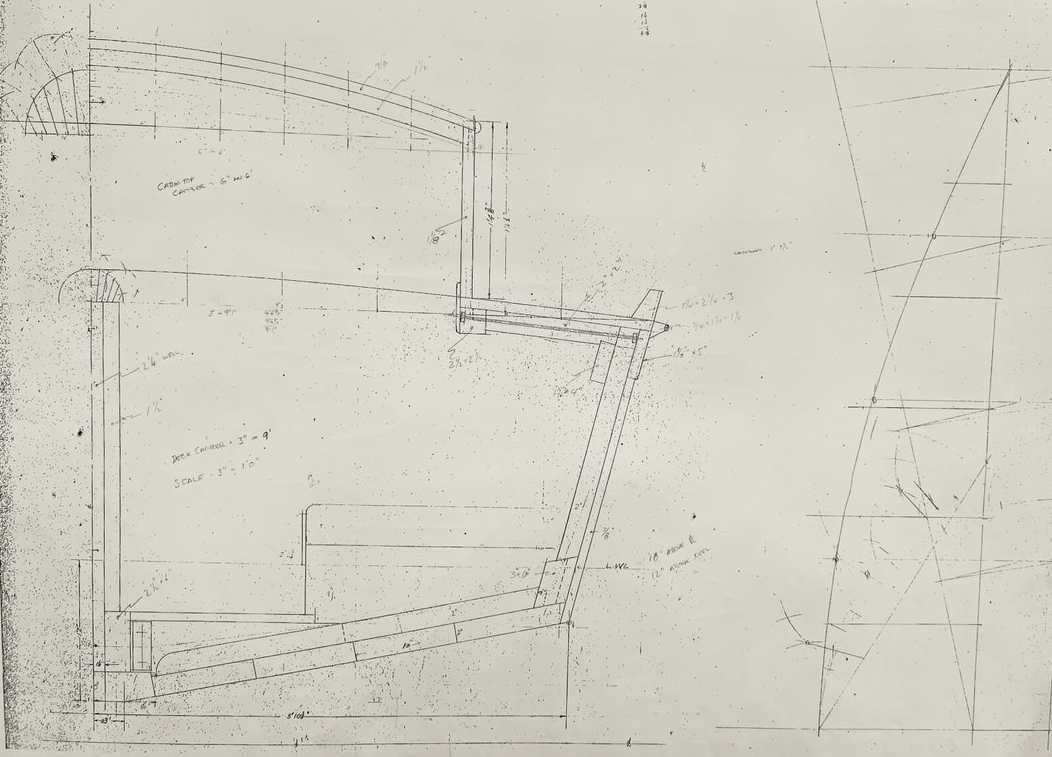
Ed Thieler Lofting 2011
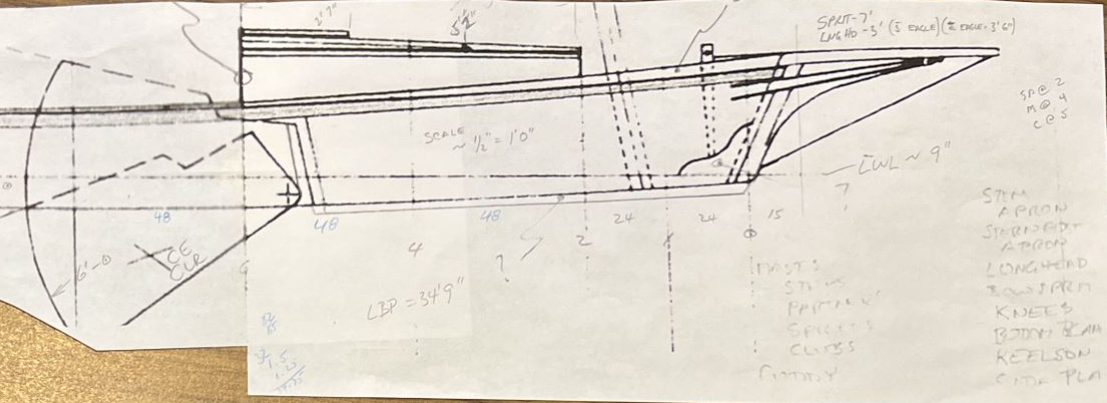
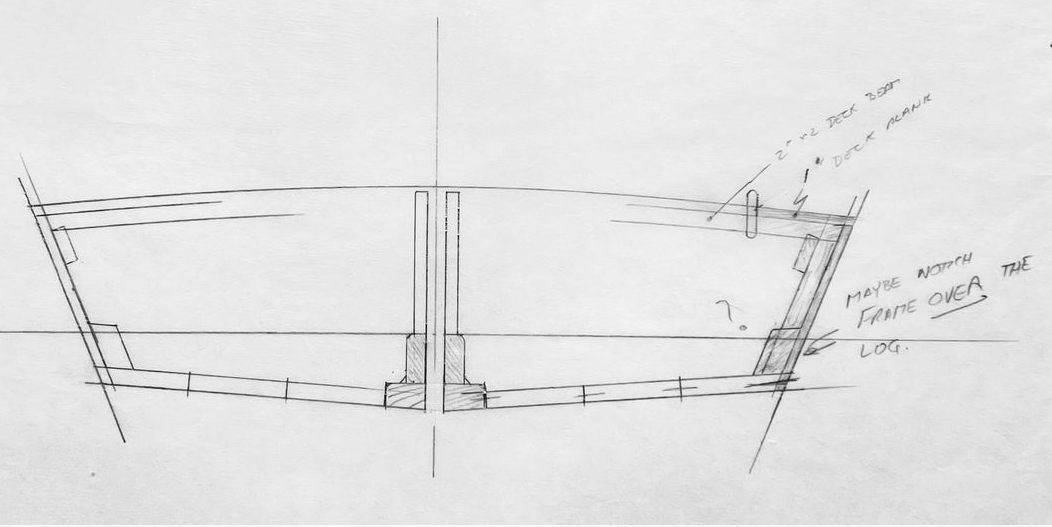
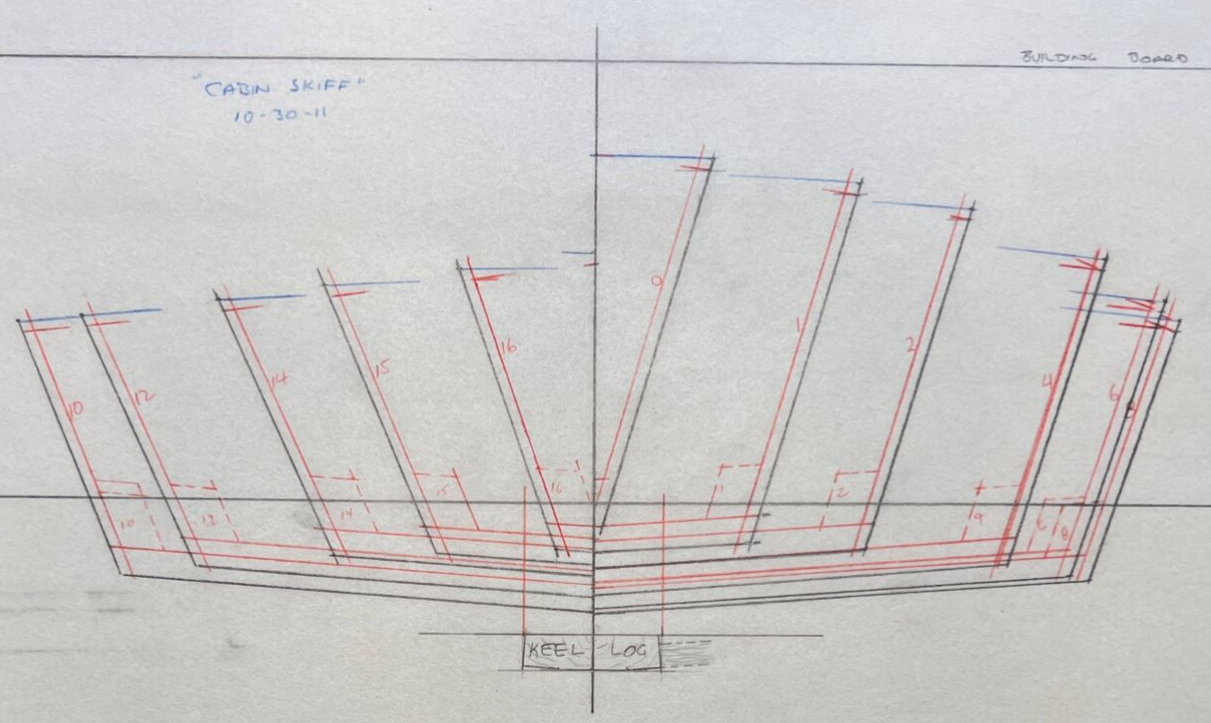
Ed Thieler's Notes on Lofting and Building the Miles River Cabin Skiff Model
Plans, Lofting, and Scaling
Naval architect John G. Earle drew plans, with some construction details, for a recreational cabin skiff. Those are now in the Chesapeake Bay Maritime Museum library in St. Michaels, Maryland. [1]
Chesapeake Bay historian M. V. Brewington documented a number of similarly sized workboat log canoes, brogans, and bugeyes with photographs, lines drawings (some done by Earle), and descriptive commentary.
For this workboat cabin skiff model I reduced the freeboard and shortened the masts, longhead, and bowsprit to more workboat-like proportions. I determined these by scaling from the plans and by interpreting Brewington’s written comments on sizes of structures, especially spars. Appropriate photographs were consulted for miscellaneous details. [4, 5]
Length on deck is 34’ 10 ½”, length overall is 41’ 6”, beam is 8’ 5 ½”, draft is 11”.
I then lofted plans to 1” = 1’ 0” (1:12).
Modeling Process, Materials, and Components
Building the model over molds was straight forward; the major difference being to “edge-bolt” the fore-and-aft bottom planks with birch tree-nails. Most other glue joints are also supported with tree-nails or wire pins.
Woods – fine grained soft woods (pine, hemlock, cypress), quarter-sawn so the grain would mimic the grain of the local loblolly pine used in construction of the original skiffs.
Glue – Titebond II throughout.
Oyster tongs, bilge pump, anchor, boat hook, bailing scoop - were all modeled after period originals found and measured in local museums.
Board bottom veneer bushel baskets – modeled using dimensions taken from an original.
Trailboards – carved holly.
Oysters – as baby oysters this size are just barely visible even to a trained eye, I represented them with baby hard clams (Mercenaria sp.) from an aqua-culture source.
Watermen – Mattel Toy “Loving Family” plastic doll house figures reconfigured using various orthopaedic osteotomies, arthroplasties, and arthrodeses, glued with cyanoacrylic glue, filled with West System epoxy, and painted with Liquitex Artist’s Acrylic colors.
Hats – paper towel mache with Titebond II.
References
1 – Earle, John G. – Drafts of a proposed recreational cabin skiff in the Chesapeake Bay Maritime Museum manuscripts collection. (MS 77)
(1) Lines of Cabin Skiff – November 4, 1954.
(2) Construction section drawing at about station 6 – undated.
(3) Sail plan – undated.
Earle, a native of Easton, Maryland and a Lehigh University educated naval architect, extensively studied and documented the sailing working watercraft of the Chesapeake Bay. Sharing Chapelle’s idea that locally derived workboats should make good recreational craft, Earle drew several variations of a cabin skiff in yacht configuration featuring higher freeboard, more dead-rise, interior accommodations, taller masts, and several underbody appendage ideas (rudder styles, keel with attached rudder, etc.).
2 – Lesher, Pete. “Cabin Skiffs of the Miles River.“ The Weather Gauge, XXVII, Number 2. (Fall 1991): 6-10. Chesapeake Bay Maritime Museum, St. Michaels, Maryland.
A history of the cabin skiff, photos, plans.
3 – Lesher, Pete. “Cabin Skiffs of the Miles River.“ The Ash Breeze. Winter (1993): 8-11.
To the original article (2-above) Lesher added a paragraph listing several builders and their cabin skiff output. [Altogether he listed 4 builders and about 12+/- skiffs.]
4 – Brewington, M. V. Chesapeake Bay Log Canoes and Bugeyes. Centreville, Maryland: Tidewater Publishers, 1963.
Combines Chesapeake Bay Log Canoes 1937 and Chesapeake Bay Bugeyes 1941. Excellent descriptions and discussions, and 25 plates of lines drawings.
5 – Brewington, M. V. Chesapeake Bay, A Pictorial History. Cambridge, Maryland: Cornell Maritime Press, 1953: 66-67.
On pg 66 MVB mentions the idea that there were 14 crab skiff designs on the Bay, “All but two are commonly called ‘batteau’ locally…. The exceptions are the cabin skiff (pronounced ‘skift’) of Talbot County and the gilling net skiff of the extreme upper Bay.” On pg 67 MVB continues, “Native to the Bay but very different from all other skiff types was the cabin skiff of Talbot County. At a short distance it could be easily mistaken for a brogan [a larger version of log canoe] since it was a double-ender, half-decked with a cuddy forward and a two masted canoe rig. But there the similarity ended for the sides were of plank bent around a full V-bottom made of very heavy sawed lumber running fore-and–aft, the pieces edge-bolted together.”
6 – Chapelle, Howard I. “The Migrations of an American Boat Type.” Contributions from The Museum of History and Technology – Paper 25. United States National Museum Bulletin 228, (1961): 133-154. <www.gutenberg.org>. file29285.
This paper contains a history of the New Haven sharpie and its regional variations. On pg 153, under a discussion of “Double-Ended Sharpies” he describes the characteristics and building of cabin skiffs:
The “cabin skiff,” a double-ended, half-decked, trunk-cabin boat with a long head and a cuddy forward, was also in use on the Bay in the 1880’s. This boat, which was rigged like a bugeye, had a bottom of planks that were over 3 inches thick, laid fore-and-aft, and edge-bolted. The entire bottom was made on two blocks or “sleepers” placed near the ends. The sides were beveled, and heavy stones were placed amidships to give a slight fore-and-aft camber to the bottom. The sides, washboards, and end decks were then built, the stones removed, and the centerboard case fitted. In spite of its slightly cambered flat bottom, this boat, though truly a flatiron skiff in midsection form, had no real relation to the New Haven sharpie; it probably owed its origin to the Chesapeake log canoe, for which it was an inexpensive substitute.
7 – The cabin skiff photo – taken by C. Lowndes Johnson, brother-in-law of Earle, 1904.
Chesapeake Bay Maritime Museum manuscripts collection. (MS 77)
The photo shows Capt Dave Reed at the helm of his cabin skiff. His crew, standing at the bow and holding a gun to his shoulder, is Weems Southern. The photo was taken by C. Lowndes Johnson and is dated 1904. It was certainly taken on the Miles River, although it is probably not possible to be more specific than that. I have the original 4×5″ glass plate negative. [Email from Pete Lesher]
—-
Note 1- Earle, Brewington, and Chapelle were born within a year of one another, 1901-02. They lived in adjacent counties and knew and corresponded extensively with one another.
Note 2- The model is named for Anna Virginia Lesher, the great-granddaughter of J. G. Earle.
How the Cabin Skiff Model Project Began
October 2011 – I was chatting with Pete Lesher when he asked what my next vessel might be. I told him that I had made models of most the boats I was interested in from ASSC and CBCS. I mentioned that it was unfortunate that HIC did not seem to have prowled Talbot County as much as he had Dorchester and Somerset Counties. Pete immediately pulled out a copy of the CBMM magazine, turned to his article and suggested that a cabin skiff might be a good subject.
October 18, 2011
Met with Lesher at CBMM – went over plans drawn by his maternal grandfather, John G. Earle. Earle was a Lehigh U. educated naval architect and mechanical engineer.
Chapelle, Earle, and Brewington were born within a year of one another, 1900-1901.
Earle, influenced by Chapelle, in 1938 -1939 drew several variations of a cabin skiff in yacht configuration – higher freeboard, more dead-rise, interior accommodations, taller masts, underbody appendage ideas (rudder styles, keel with attached rudder, etc.)
Brewington and Chapelle had a falling out over a Delaware River “tuck-up” MVB owned and would not allow HIC access to for inclusion in ASSC.
---
Via email 3-14-2013 in response to questions from me on 3-13-3013.
Ed:
I talked to my grandfather specifically about these questions. He did not recall seeing any cabin skiffs in his youth, but he learned about them from C. Lowndes Johnson, who lived just down the Miles River from where my grandfather was raised. My great-grandfather disappeared in 1907, when my grandfather was 6 years old, and his mother moved the family in to her sister's country house--the Anchorage farm, right next to Miles River Bridge. That meant that my grandfather had the opportunity to grow up on the waterfront, and he gained Lowndes Johnson as a sort of surrogate father figure. Johnson, 20 years his senior, taught him to sail and interested him in local maritime history.
Lowndes had seen and presumably had even sailed at some point on cabin skiffs--probably aboard Capt. Dave Reed's cabin skiff. Lowndes, as a keen observer, gave my grandfather all of the characteristics of the local cabin skiffs, and it was with this information that my grandfather drafted the plan.
I recall my grandfather telling me that Dave Reed was a sailor, and was generally handy around boats. When Lowndes' father, Dr. Julius Johnson, built the family house on Miles River Neck in 1895, apparently Reed provided occasional assistance or advice on boats, perhaps especially when Dr. Johnson bought the log canoe Mayflower (later renamed Margaret P. Hall and documented in Brewington's book under that name) for his sons. This squares with the 1900 Census record, which lists David Reed, white male, aged 38 years, with his wife, Martha, living in the Easton District and listing "sailor" as his profession.
I found my grandfather's research notes under a tab for "cabin skiffs" in a looseleaf notebook that also had notes on pungies, bugeyes, schooners, etc. It was from these notes, which included copies or quotations from newspaper articles, that I composed my article on cabin skiffs.
On the photograph [of the Capt. Dave Reed's cabin skiff], you have my permission to submit it for publication to NRG. This is the information I have on it. The photo shows Capt Dave Reed at the helm of his cabin skiff. His crew, standing at the bow and holding a gun to his shoulder, is Weems Southern. The photo was taken by C. Lowndes Johnson and is dated 1904. It was certainly taken on the Miles River, although it is probably not possible to be more specific than that. I have the original 4x5" glass plate negative.
Pete Lesher
Chief Curator
Chesapeake Bay Maritime Museum
3-14-2013
More About the Miles River Cabin Skiff
Everything Written About the Miles River Cabin Skiff
More about CBMM Collections
Items that are not exhibited around the CBMM campus are kept in the Norman & Ellen Plummer Center for Museum Collections. This is a climate-controlled facility that was expanded and modernized in 2023.
You can search all the collections online here. Look for the links at lower left to search these collections separately:
- Objects, Photographs, Manuscripts, Ships Plans
- Regional Oral History Database
- Books and Periodicals
See my CBMM Collections Search Tips.
The collections and library are accessible only by appointment. Email collections@cbmm.org or visit the Library and Research page.
More about Small Boats
I also write about volunteer work in small boat conservation at the Chesapeake Bay Maritime Museum: Small Boat Shed Volunteers
And about sail-and-oar cruising in small open boats on the Chesapeake and its tributaries: Sail+Oar – Chesapeake Log.