
 Maryland
The Edward R. Thieler Model at CBMM
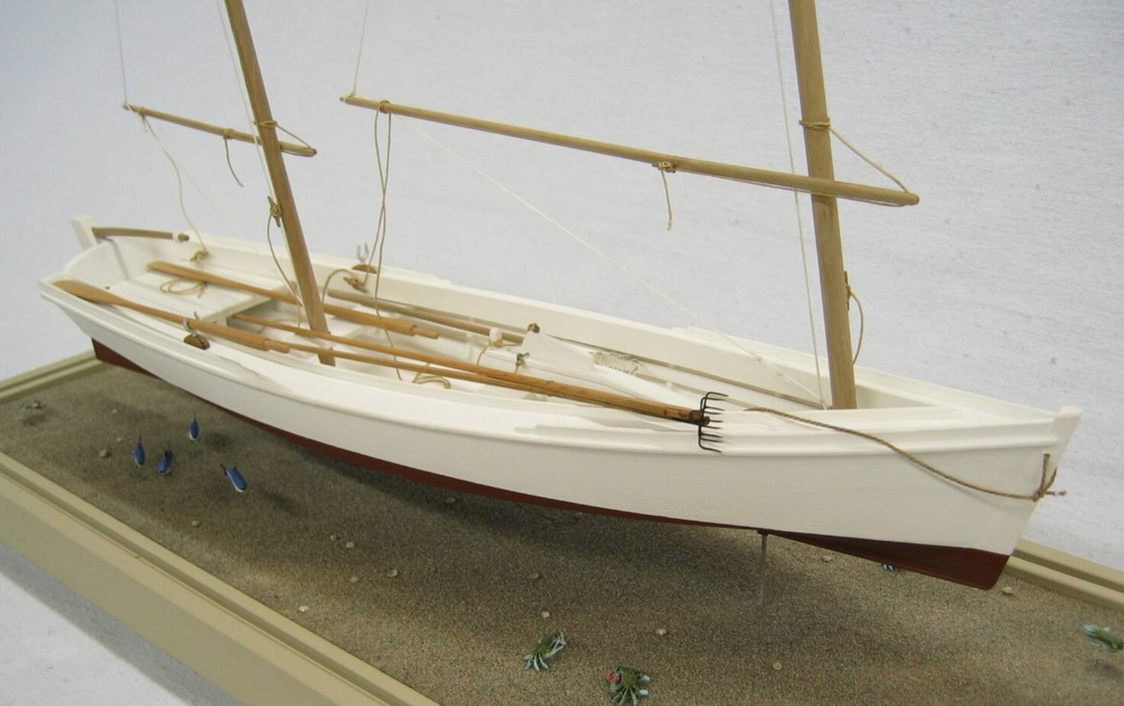
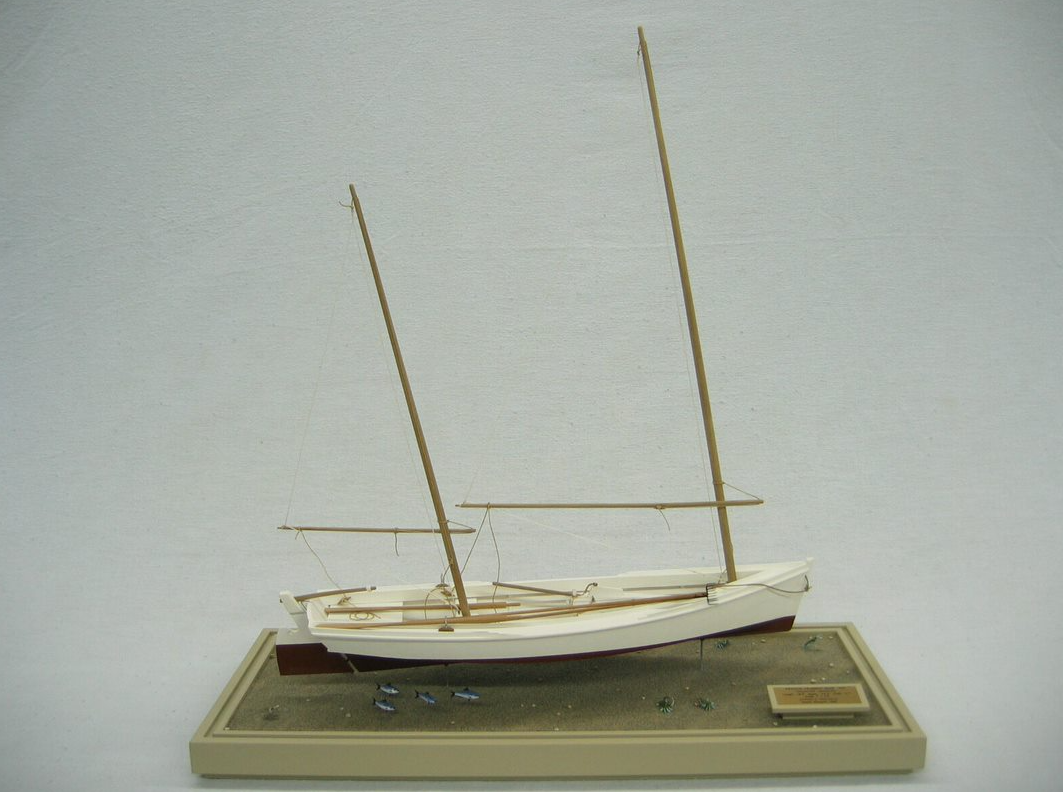
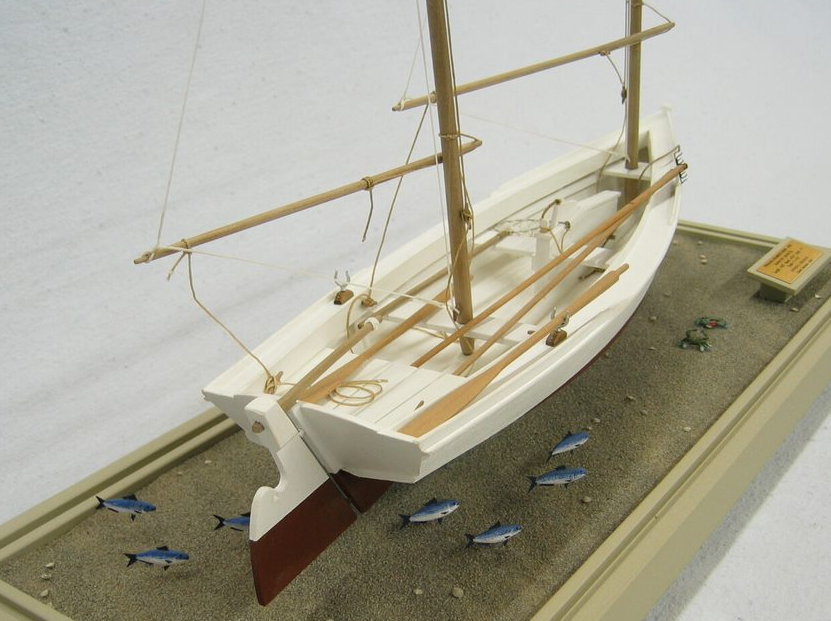
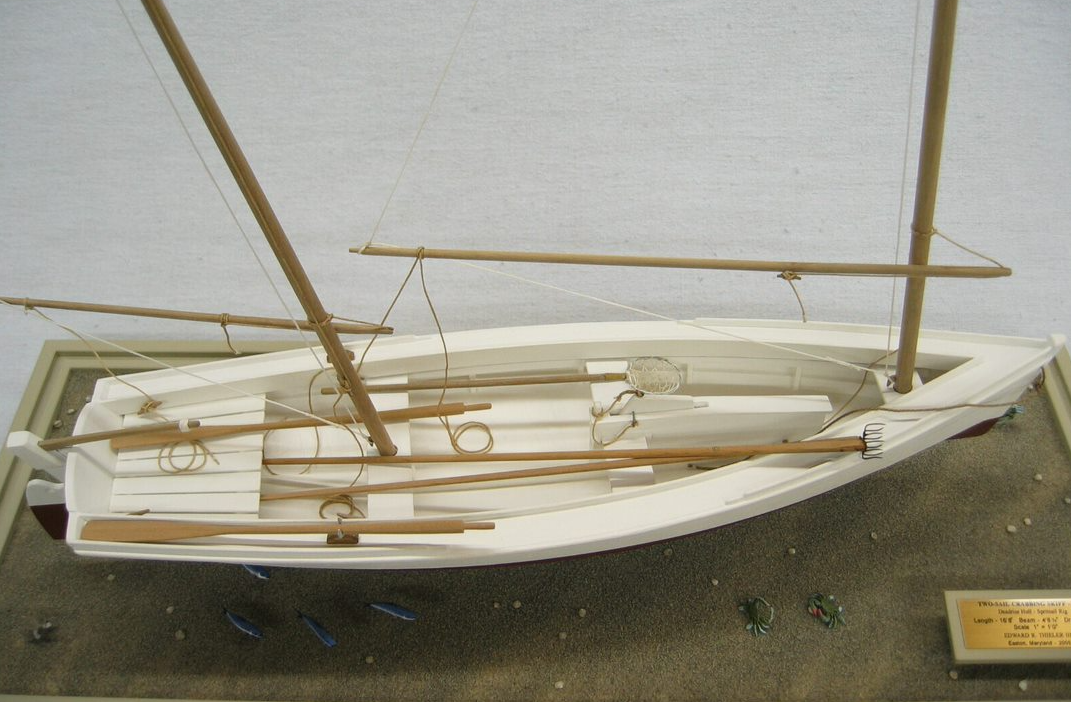
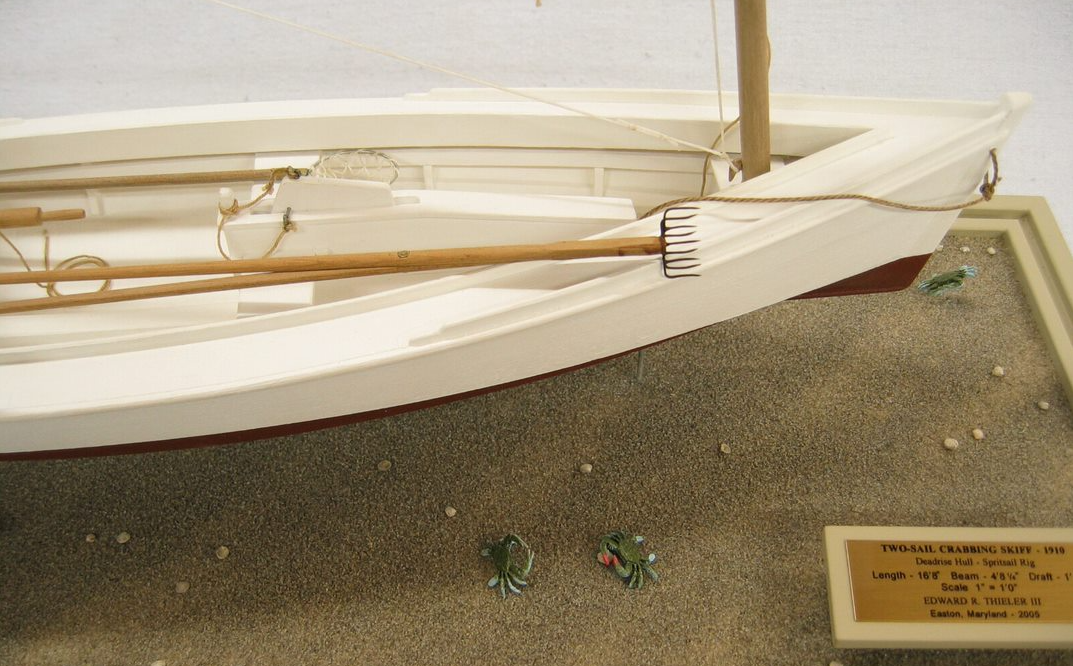
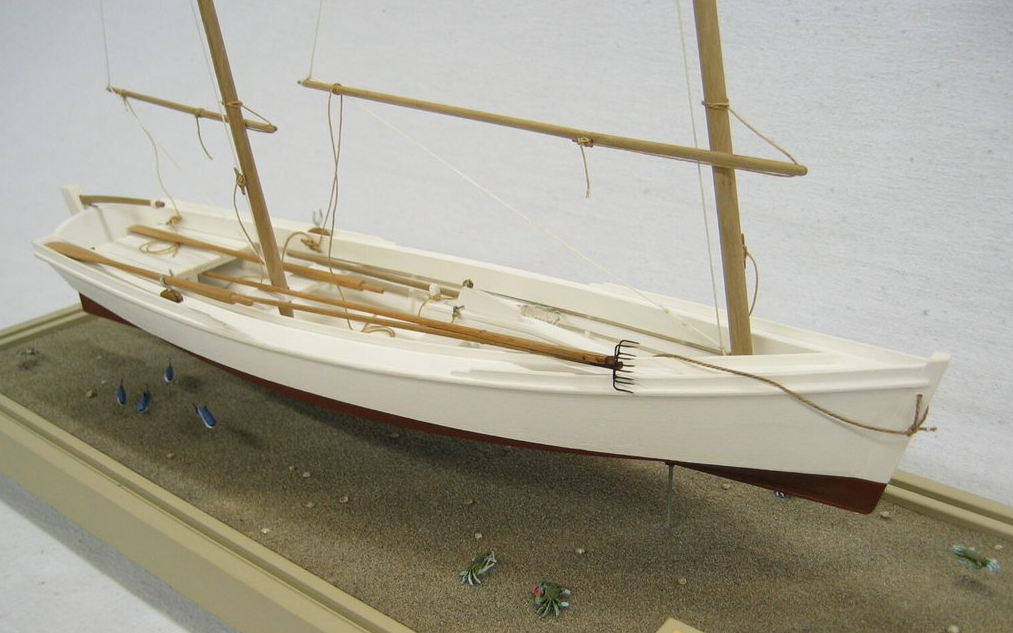
Two-Sail Crabbing Skiff
1:12 Scale Model by Edward R. Thieler III
CBMM Catalog No.: 2022.0004.0001
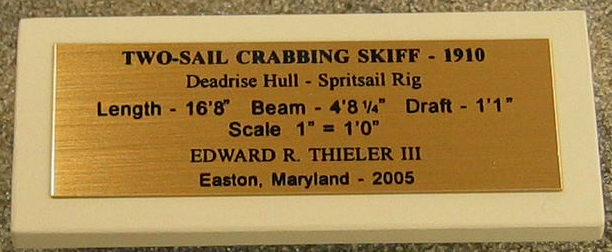
Deadrise Hull – Spritsail Rig
Length - 16’8” Beam - 4’8 ¼” Draft - 1’1”
Scale - 1” = 1’0”
EDWARD R. THIELER III
Easton, Maryland - 2005
Before the gasoline engine came to the Eastern shore in the 1920’s, the two-mast rig was popular on the workboats used in the “water business”.
The hull of this skiff has the V-shaped, “deadrise” bottom still used in the watermen’s workboats of today.
The masts carry the “leg-of-mutton” sprit sail developed on the Chesapeake Bay and most commonly used on these small workboats.
This kind of skiff would have been set up for oyster tonging in the winter and trotlining for crabs in the summer.
The Edward R. Thieler Collection at the Chesapeake Bay Maritime Museum
The Edward R. Thieler III Collection of workboat models at the Chesapeake Bay Maritime Museum (CBMM) is a valuable resource for historians, builders, and owners of sailing and power workboats and gunning and recreational skiffs of the Chesapeake and Delaware Bays and the New Jersey coast.
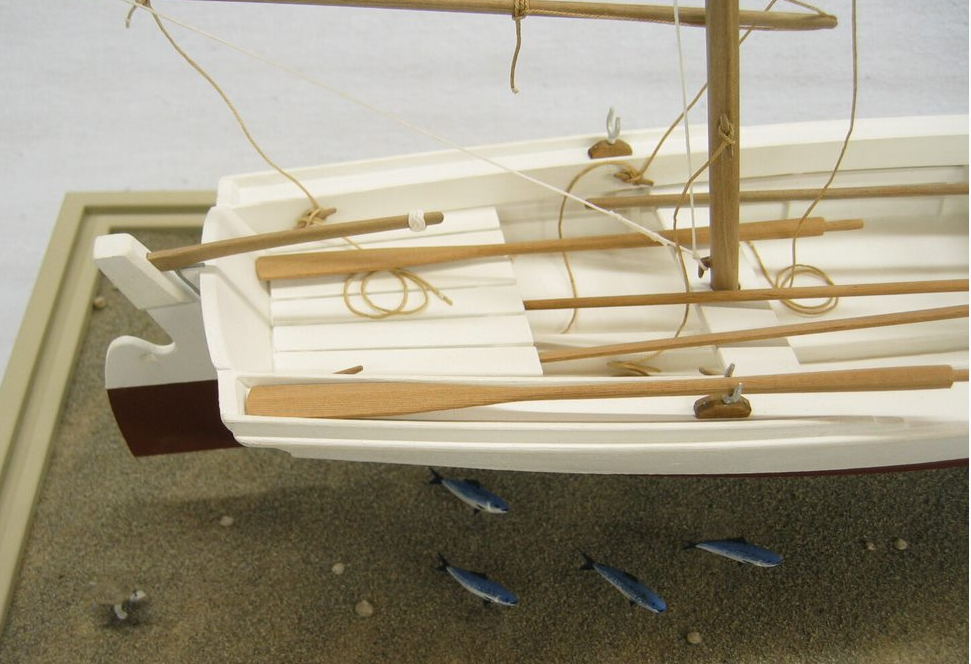
Thieler built most of his models at a scale of 1:12 (one inch = one foot), large enough to display fine detail in both the boat design and constuction, and in the watermen's tools and implements which show the working context of each boat.
Thieler’s models are historically accurate in the smallest detail. His careful research and detailed plans and notes reveal many aspects of the history and traditional use of each boat type. In many cases, he interviewed watermen who used these boats themselves, or whose fathers and grandfathers did. From them he learned about building materials and methods, sail rig, handling and working under sail, and tools and methods for oystering, crabbing, and fishing.
Thieler’s photos of the model building process are a valuable resource for the traditional builder who wishes to build an authentic full-size reproduction of any one of these workboats.
Text and photos are published here with permission from CBMM and Ed Thieler.
More About the Edward Thieler Collection
Catalog of Models in the Edward R. Thieler Collection at CBMM
Eastern Shore Sailing Workboats – “Thieler” search in this website
Selected Photos of the Two-Sail Crabbing Skiff Model
...
...
Ed Thieler's Notes on the Design and History of the Two-Sail Crabbing Skiff
The Plans
The plans are Figure 4 in Chesapeake Bay Crabbing Skiffs by Howard I. Chapelle.
This article was first published in Yachting, June and October, 1943, then published as a monograph by the Chesapeake Bay Maritime Museum in January, 1979.
On the plans Chapelle has written:
“Lines taken off at Cambridge, MD, September 11, 1942.
Built by Simmons, Cambridge, MD, 1910.”
Length – 16’8” Beam – 4’8¼” Keelson 3 ¾” x 3 ¼”
Transom 1 ½”
Scale - ¾” = 1’0” Plank 1”
Chine, Clamps, etc. 1”
White Topsides, Red Bottom
The Hull
This boat has a “skipjack” type of hull construction. That is, it is a deadrise, V-bottom; herring-bone planked, from the transom forward. In the bow it has a “forefoot” between the foregripe/keel rabbet and the chine, where these two join the stem. The forefoot was constructed either by “staving” using thick planks “dubbed” to shape, or by using blocks of wood, called “chunks”, hewn to shape. I used staving in the model as it presents certain challenges – if there is a next time I will chunk build the forefoot – it is easier.
The Rig
On the page preceding fig. 4 Chapelle said of the rig:
"Though the sloop-rigged skiff was common, the two-masted rig was popular in some localities, particularly around Cambridge [MD]. The rig [as is seen in this model] was usually the two leg-of-muttons, with the larger sail forward, used at one time in log canoes. A few skiffs had a bowsprit and balance jib but these were usually racing or pleasure boats. The hulls were much alike in appearance, varying in dimensions and in amount of deadrise. All seem to have had raking ends and strong sheer; there was usually a good deal of flare to the sides. This model of skiff is one of the most seaworthy of the Crabbers, owing, no doubt to the need of an able boat in the rough water at the mouth of the Choptank [River]. "
Plans and Lofting
Large format images of plans and lofting are here.
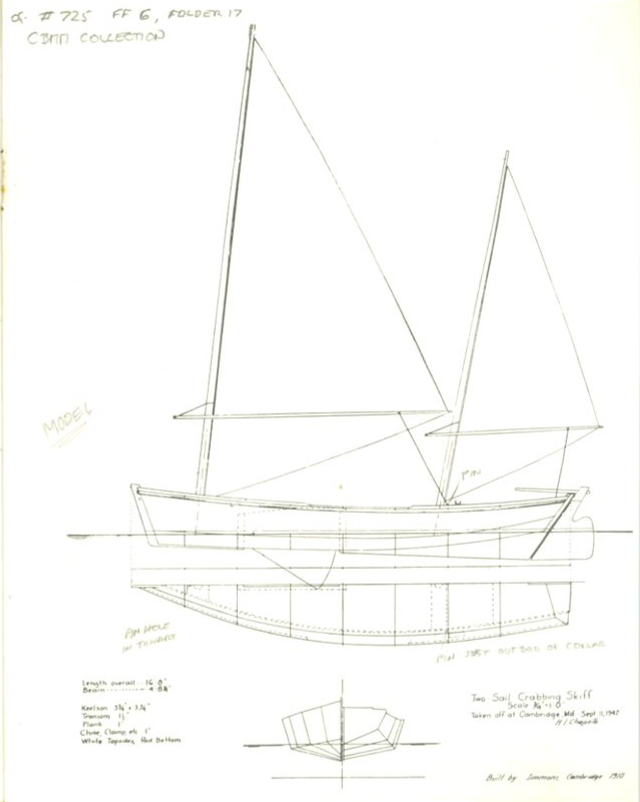
Ed's photocopy of Chesapeake Bay Crabbing Skiffs, Figure 4.
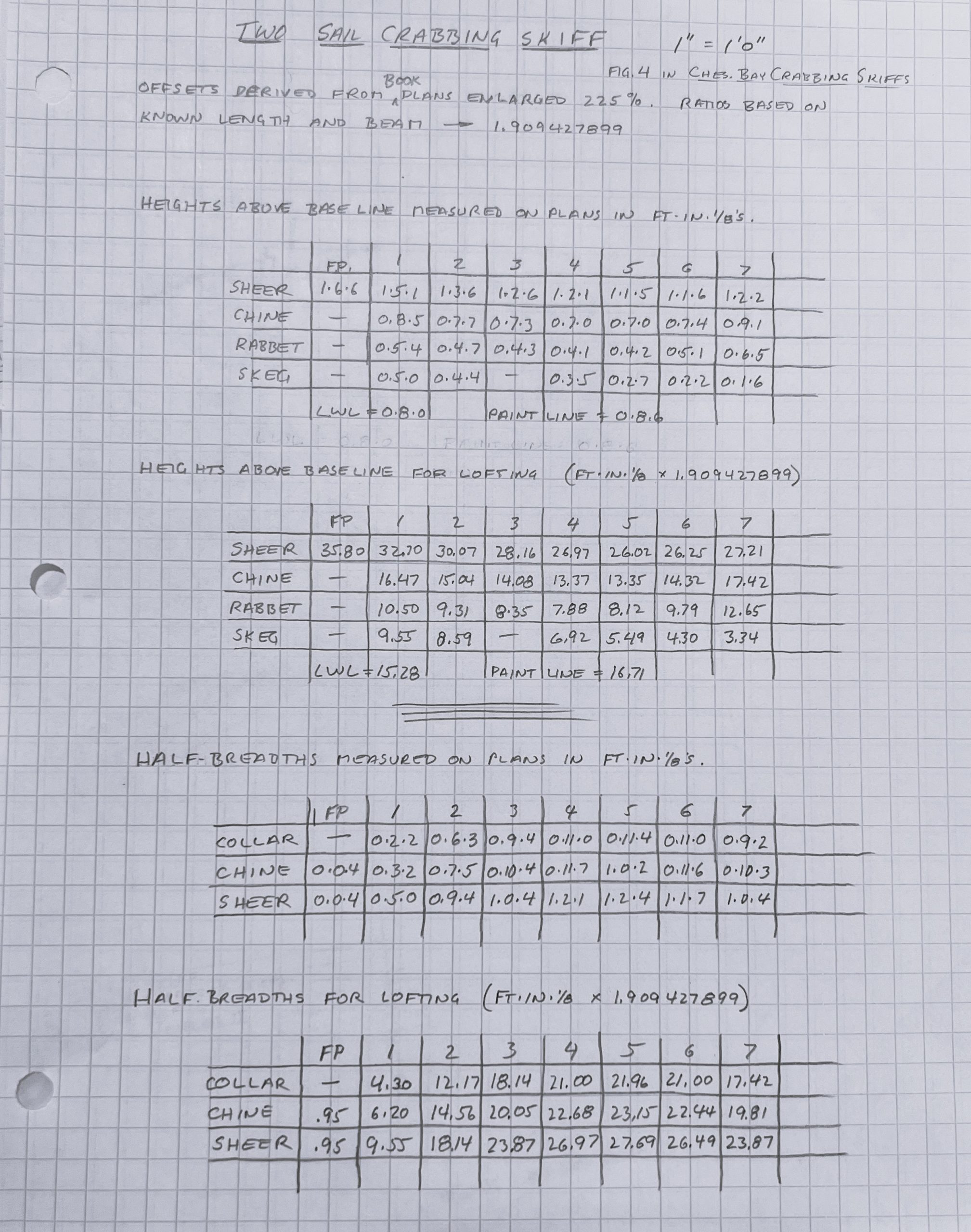
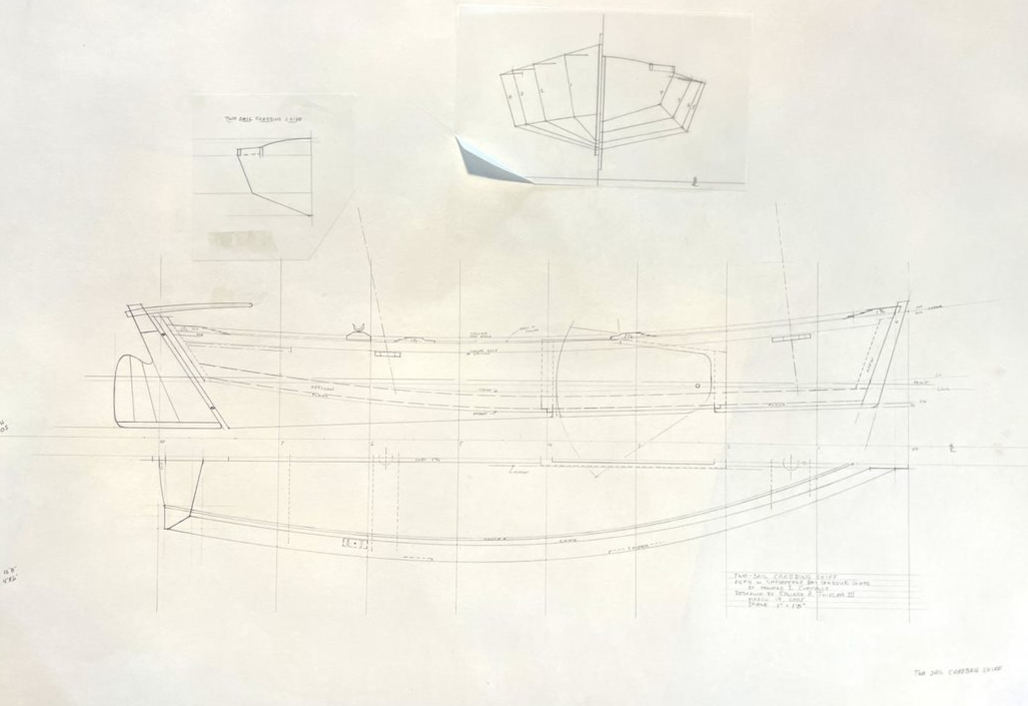
Ed Thieler drew his own plans at 1:12 scale.
[ View large or download ]
Ed Thieler's Notes on Lofting and Building the Two-Sail Crabbing Skiff
The Model
Built during March - June 2005.
Keelson, stem, knees, collar, toe rails are Douglas Fir from the rebuilding of Old Point at the Chesapeake Bay Maritime Museum in 2004.
The spars, oarlock pads, and tiller are Sweetgum from my backyard.
The rest of the model is common Fir – all quarter sawn.
Glue – Franklin’s Titebond II
Almost all joints are fastened with treenails.
Paint – Liquitex acrylic – titanium white #432
- burnt sienna #127
Oarlocks – carved from aluminum sheet – I hope they look like galvanized iron.
Oars – from old Cedar shingles saved from the dumpster when the Chesapeake Bay Maritime Museum rebuilt their historic houses in 2004.
Crab dip-net has a sweetgum handle. The net was made in the traditional way using a gauge stick.
Lines are polyester whipping twine. [Marlow #4] [MCP#3]
Fish – are meant to be American Shad, Alosa sapidissima, but you can think of them as any kind you wish. I carved the bodies from Tupelo; the fins are architect’s Mylar.
Crabs and the Maryland Terrapin -- are from silver-plated pewter bracelets.
Clams are Mercenaria sp. from an aqua culture facility. They were not sure if the clams are M. mercenaria or M. notata.
Sand is from a small beach just up the Tred Avon River from Oxford, Maryland.
Base is White Pine frame, and Birch plywood platform, glued with Titebond II and painted with Benjamin Moore - Regal Matte Finish – medium base 221-2B – Clarkesville Gray – HC-102.
Case is Lucite-Tuf acrylic sheet cemented with Weld-on #3.
I put the oyster tong “nippers” on board after Mary Parks Harding, Bronza Parks’ daughter told me that when the men were out on the Bugeye and Skipjack dredge boats the women and children at home used nippers, often from a small skiff, to gather enough oysters for the family table.
Lumber List
Keelson 3 ¾” x 3 ¾”
Transom 1 ½”
Planking
Sides and bottom 1”
Chine 1” x 3”
Clamp 1” x 2 ¼”
Toe Rails ¾”
Rub Rails 1 ¼” x 1 ¼”
Thwarts 1 ¼”
Apron 3 ¾” x 3 ¾”
Stem 3 ¾” x 3 ¾”
Centerboard 1 ¼”
Slot 1 ½”
Trunk 1”
Ledges 1 ½” x 3”
Cap ¾”
Rudder 1 ¼”
Washboard ¾”
Frames 1”
on 24” centers
Skeg 1 ½”
Sternpost 1 ½”
Spars
Foremast 19’7” 3 ½” – 1 ¾”
Sprit 10’8” 1 ½” – 1”
Mainmast 15’0” 3” -- 1 ½”
Sprit 6’9 ½” 1 ¼” – ¾”
(Masts in the Chesapeake Bay are named "schooner" fashion – even though it is taller, the forward mast is the foremast; even though it is shorter, the after mast is the mainmast.)
Lofting and Scaling
I enlarged the booklet figure 225%. A constant was calculated using the ratio between the real measurements [in ft.-in.] given on the plan and the plan measurement [in scale ft.-in.]. Multiplying the constant by the plan dimension [in scale ft.-in.] gave the full size dimension [in ft.-in.] to be inserted into the table of offsets. Working plans were then drawn to 1” = 1’0”.
Given dimension of length/beam [ft-in] = Constant
Measured plan dimension of length/beam [scale ft-in]
Constant x plan dimensions [scale ft-in] = full size dimensions [ft-in-eighths] for table of offsets.
More About the Two-Sail Crabbing Bateau
Chapelle Blueprint for CBCS Figure 4, Two-Sail Bateau by Simmons Cambridge 1910 [CBMM 1994.0027.0097.00]
Josef W. Liener Plans for the Two-Sail Crabbing Skiff with Offsets [CBMM 2004.0028.0152.01]
Ship Plans for 17' Two-Sail Crabbing Skiff with Modifications for Power [CBMM 1994.0060.0001.00]
Two-Sail Crabbing Bateau by Simmons 1910 – Three Plan Tracings
Cinnamon Girl - Two-Sail Crabbing Bateau at CBMM
Kevin Brennan's Cinnamon Girl Build [1995]
My Two-Sail Crabbing Skiff Build [2024+]
More about CBMM Collections
Items that are not exhibited around the CBMM campus are kept in the Norman & Ellen Plummer Center for Museum Collections. This is a climate-controlled facility that was expanded and modernized in 2023.
You can search all the collections online here. Look for the links at lower left to search these collections separately:
- Objects, Photographs, Manuscripts, Ships Plans
- Regional Oral History Database
- Books and Periodicals
See my CBMM Collections Search Tips.
The collections and library are accessible only by appointment. Email collections@cbmm.org or visit the Library and Research page.
More about Small Boats
I also write about
- Volunteer work in small boat conservation at the Chesapeake Bay Maritime Museum: Small Boat Shed Volunteers
- Sail-and-oar cruising in small open boats on the Chesapeake and its tributaries: Sail+Oar – Chesapeake Log.
- Building another crabbing skiff.