
 Maryland
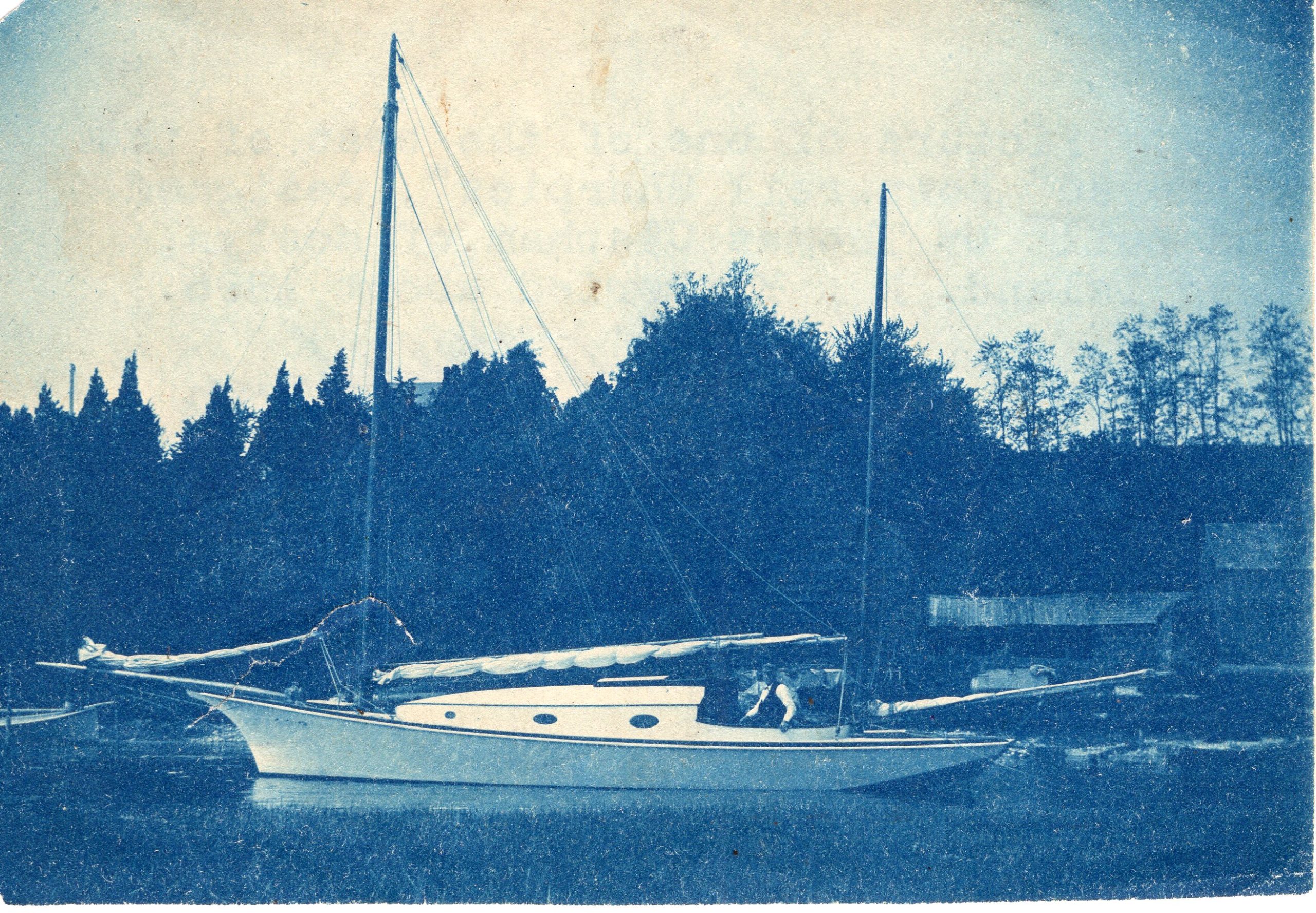
CBMM Catalog #: 0000.0901.1794.00
Title : NONPAREIL SHARPIE
Chapelle's "Modified Sharpies"
When I came across this photo from the Howard Chapelle Photo Collection at the Chesapeake Bay Maritime Museum, I recognized Thomas Clapham's Nonpareil sharpie.
I remembered the Nonpareil sharpie from studying Reuel Parker's The Sharpie Book 30 years ago. At that time, my son and I were building a crabbing skiff from one of the plans in Parker's book. It was his adaptation of Figure 115 in Chapelle's American Small Sailing Craft. Chapelle called the design a "Chesapeake Bay Skiff - Modified Sharpie".
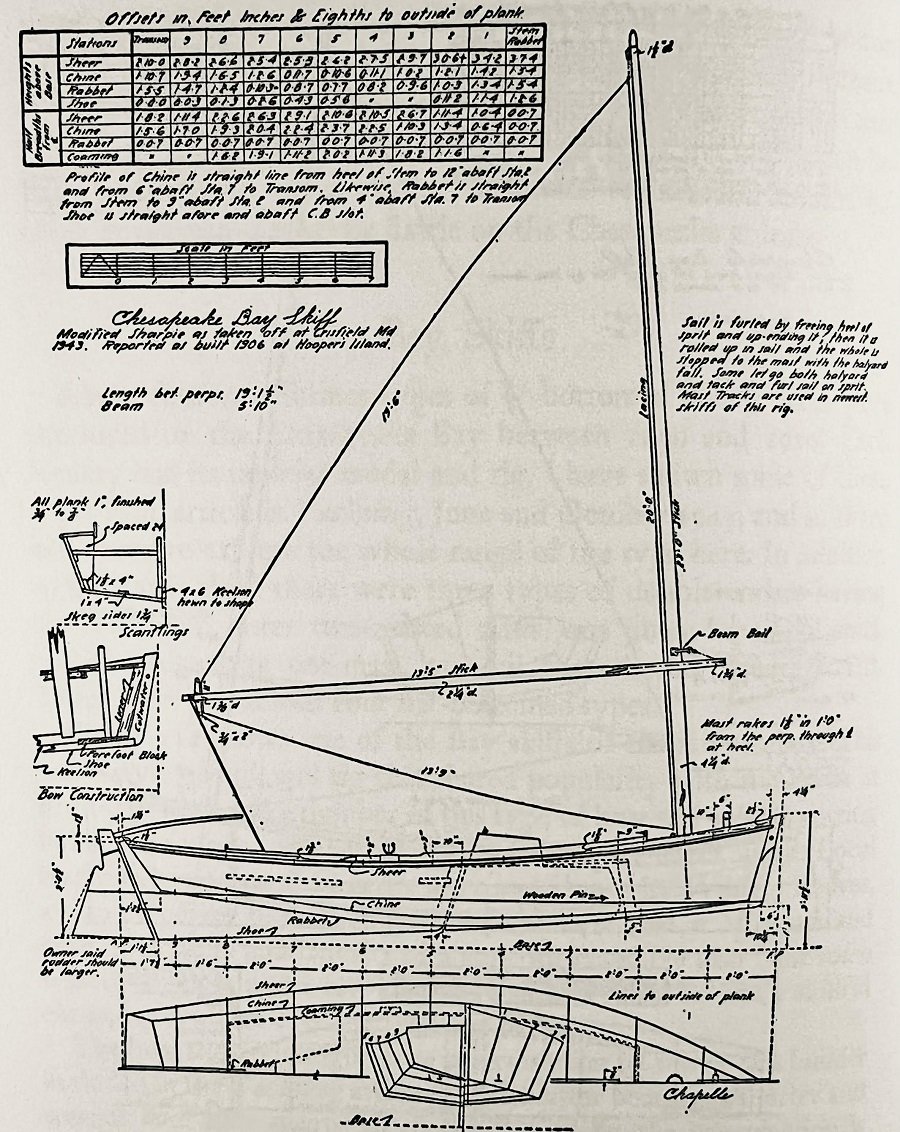
When this crabbing skiff was built back in 1906, watermen would have called it a "bateau" or "deadrise skiff". Only Chapelle - the marine historian - would draw a connection between this Chesapeake deadrise skiff and the sharpies of New England.
And by calling it a "modified" sharpie, he was pointing specifically to the v-bottom sharpies designed by Thomas Clapham on Long Island Sound in the 1890s. He drew the Clapham design and called it a "modified sharpie" in Boatbuilding, Plate 2:
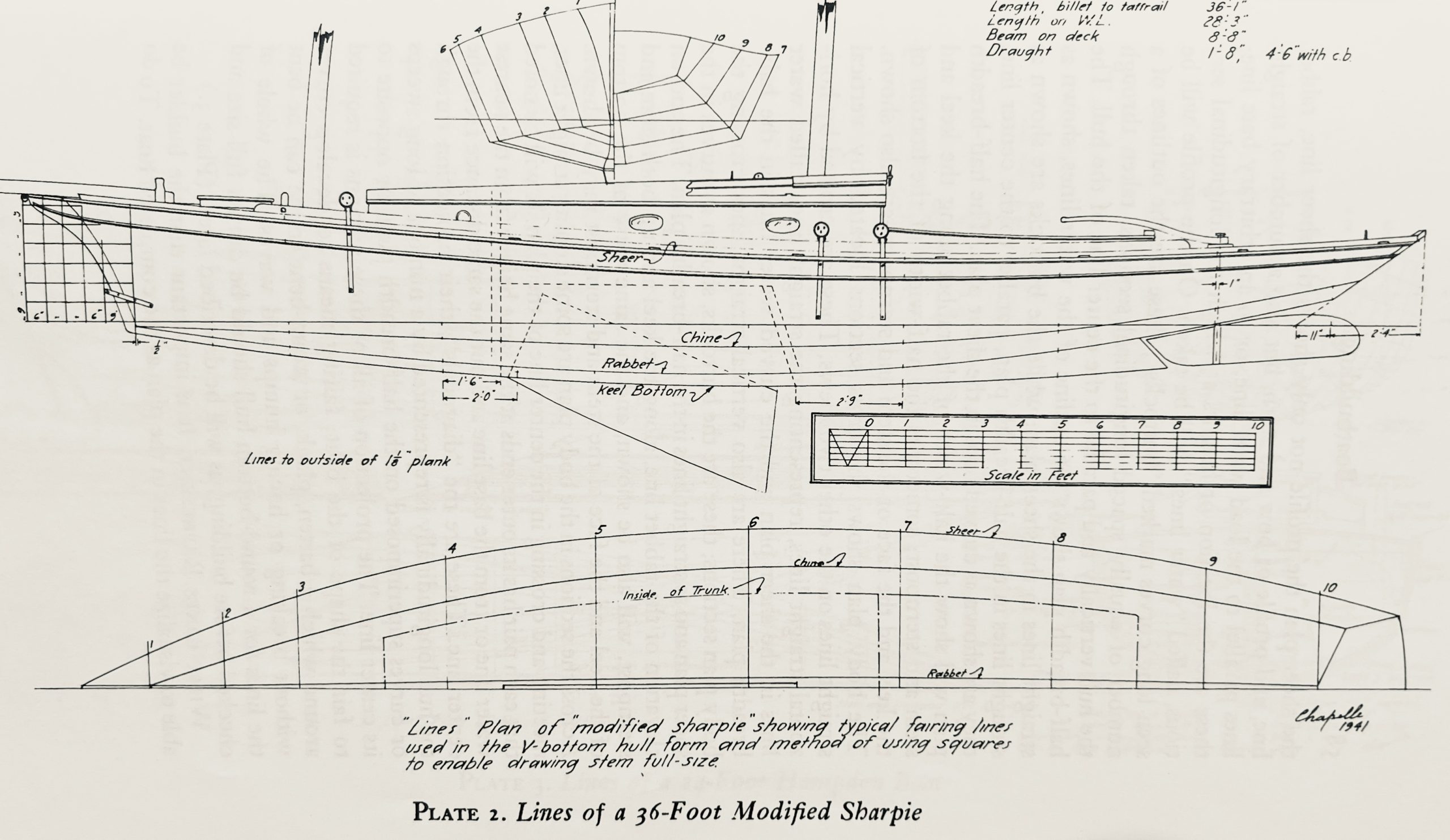
Chapelle didn't name the design or the designer. He was merely using this drawing to illustrate how the section view in a boat plan relates to the plan view and profile view.
But this is clearly a Clapham Nonpareil sharpie like the one in the photo above. Chapelle's date for this "modified sharpie" plan is 1941. He measured the Hooper's Island "modified sharpie" in 1943. He applied the term to these two designs and to no others that I'm aware of.
In his writings, Chapelle didn't explicitly describe a connection between the Clapham Nonpareil sharpie and the Chesapeake deadrise skiff. But Parker did. He wrote this about the Chapelle's "modified sharpie" in Figure 115:
This excellent small craft represents the highest stage of evolution of the sharpie into the deadrise skiff. The type is very close to the Nonpareil sharpies developed by Thomas Clapham. Just prior to this modified sharpie skiff was the flattie type, with deadrise (V) in the stern only; the types that followed were the skipjack and bateau. (The Sharpie Book, p. 108)
The Chapelle-Clapham Family Connection
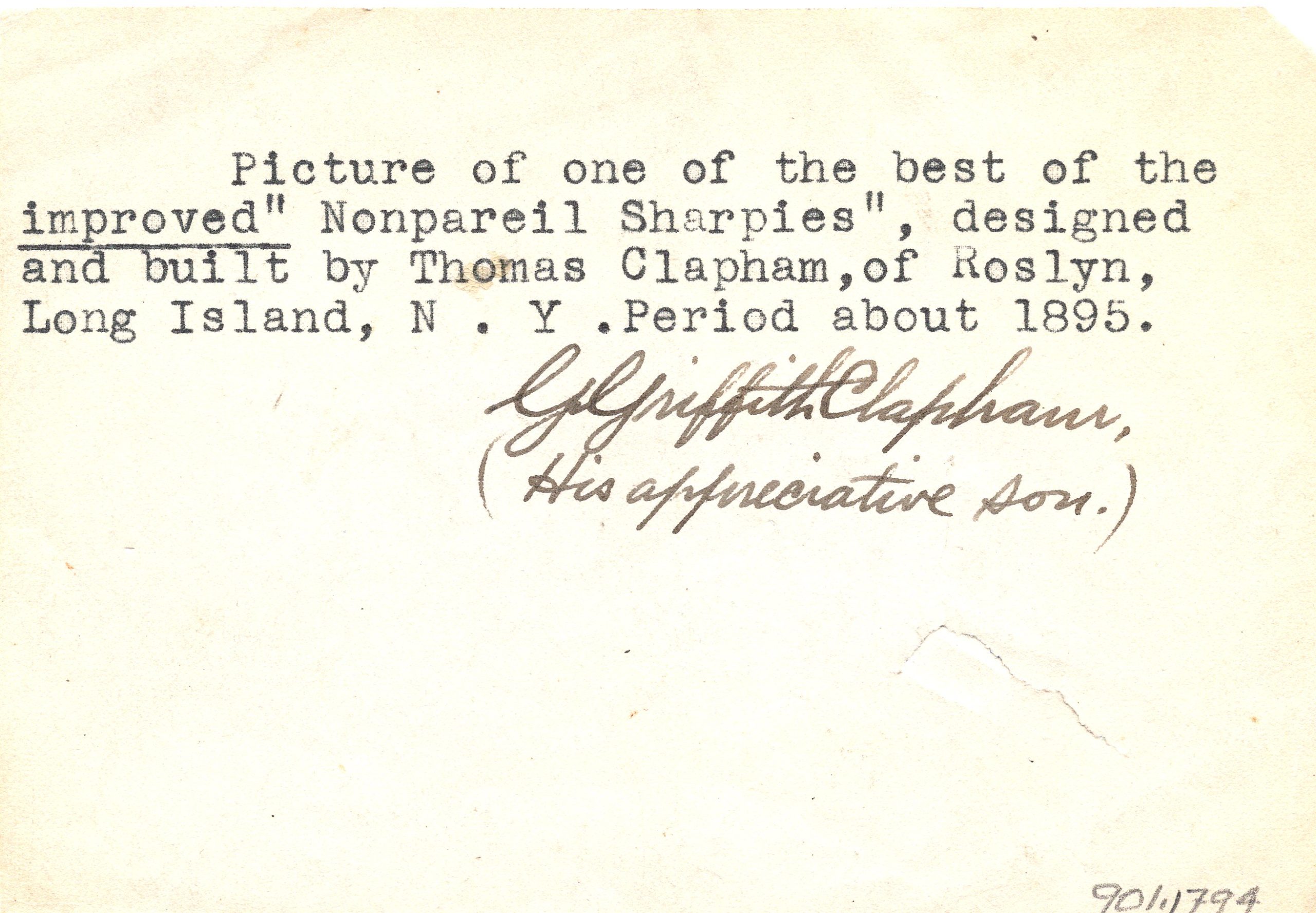
This note is on the back of the Nonpareil Sharpie photo also caught my attention. It shows that the photo was a gift from Thomas Clapham's son, G. Griffith Clapham.
What had Chapelle done to earn Clapham's gratitude?
Parker offers a clue. In The Sharpie Book (pages 148-151), he reproduced plans for the Clapham Nonpareil sharpie Minocqua and wrote:
The drawing I have traced is from Yachting magazine, December 1938. [Three years before the date on Plate 2.] Minocqua has classic sharpie form and proportions with a deadrise, or V bottom, and an outside keel with integrated iron ballast. ... Evidently no detailed plans remain for Minocqua. ... Judging by the drawing style, I am certain that the Yachting plan was made by Chapelle, and that it and possibly others may still exist in his estate or in the Library of Congress collection. ...
The Yachting article was written by Clapham's son, who had considerable experience sailing his father's yachts as well as a thorough understanding of design, construction, and handling of sailing vessels.
Parker's excerpt from the Yachting article make it clear that the son deeply respected his father's design legacy and was eager to preserve it:
If so good a yacht as, say, Ducat or Minocqua can be produced at a greatly reduced cost as compared with the conventional type, it seems too bad to have such a worthwhile model forgotten. Knowing how thoroughly my father worked to develop the sharpie type of yacht to bring it as near to perfection as possible, and having helped to build and sail them, both as a boy and also when much older, I doubt that even today Ducat and Minocqua could be much improved upon for a safe, fast and comfortable cruising yacht, particularly when low cost of construction is an important item. I do not know of any model easier or less costly to build.
G. Griffith Clapham was grateful to Chapelle for drawing the plans for his 1938 article, helping to ensure that this "worthwhile model" and his father's legacy would not be forgotten.
More about CBMM Collections
Items that are not exhibited around the CBMM campus are kept in the Norman & Ellen Plummer Center for Museum Collections. This is a climate-controlled facility that was expanded and modernized in 2023.
You can search all the collections online here. Look for the links at lower left to search these collections separately:
- Objects, Photographs, Manuscripts, Ships Plans
- Regional Oral History Database
- Books and Periodicals
See my CBMM Collections Search Tips.
The collections and library are accessible only by appointment. Email collections@cbmm.org or visit the Library and Research page.
I also write
Sail+Oar - Chesapeake Log - Cruising in small open boats on the Chesapeake and its tributaries.
Small Boat Shed - Working with other volunteers to restore and conserve small craft at the Chesapeake Bay Maritime Center.