
 Maryland
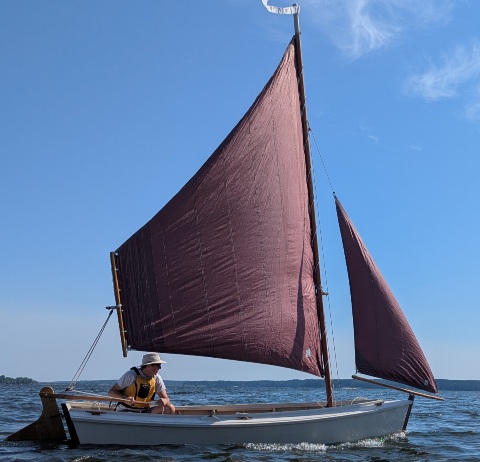
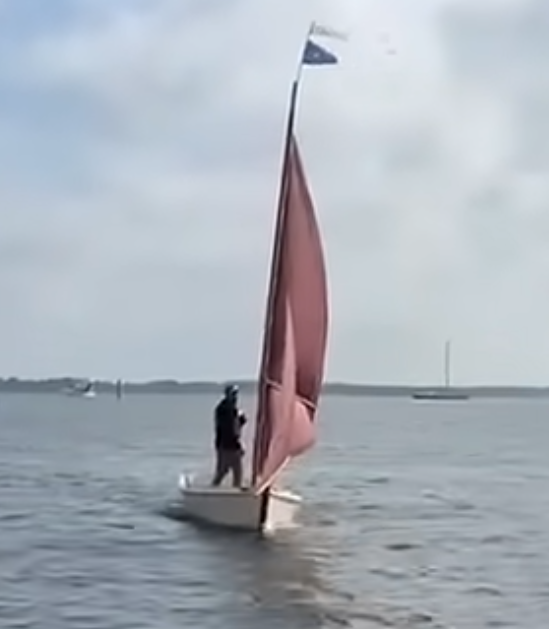
The Chesapeake flattie Opal was built by Chesapeake Bay Maritime Museum
shipyard apprentices circa 1995
from the "Uncle Gabe's Flattie" design
Gabriel Moses was an African-American boatbuilder working on Bodkin Creek, near the mouth of the Patapsco River and Baltimore, until the 1930s. Moses built Chesapeake flattie sailing and rowing workboats using traditional methods and materials.
Hundreds of "Uncle Gabe's flatties" and its derivatives have been built by students, families, and amateur builders in dozens of countries since plans for his flattie design were first published in 1946. Uncle Gabe's flattie design is discussed in dozens of articles and small boat online forum posts. But almost nothing has been published online about Gabriel Moses. His legacy was preserved by marine architect Sam Rabl, who valued the traditional designs and methods of Moses and other small boat yard operators. Biographical notes on Gabriel Moses presented here are taken mostly from Rabl's book.
How Uncle Gabe's Flattie Went Global
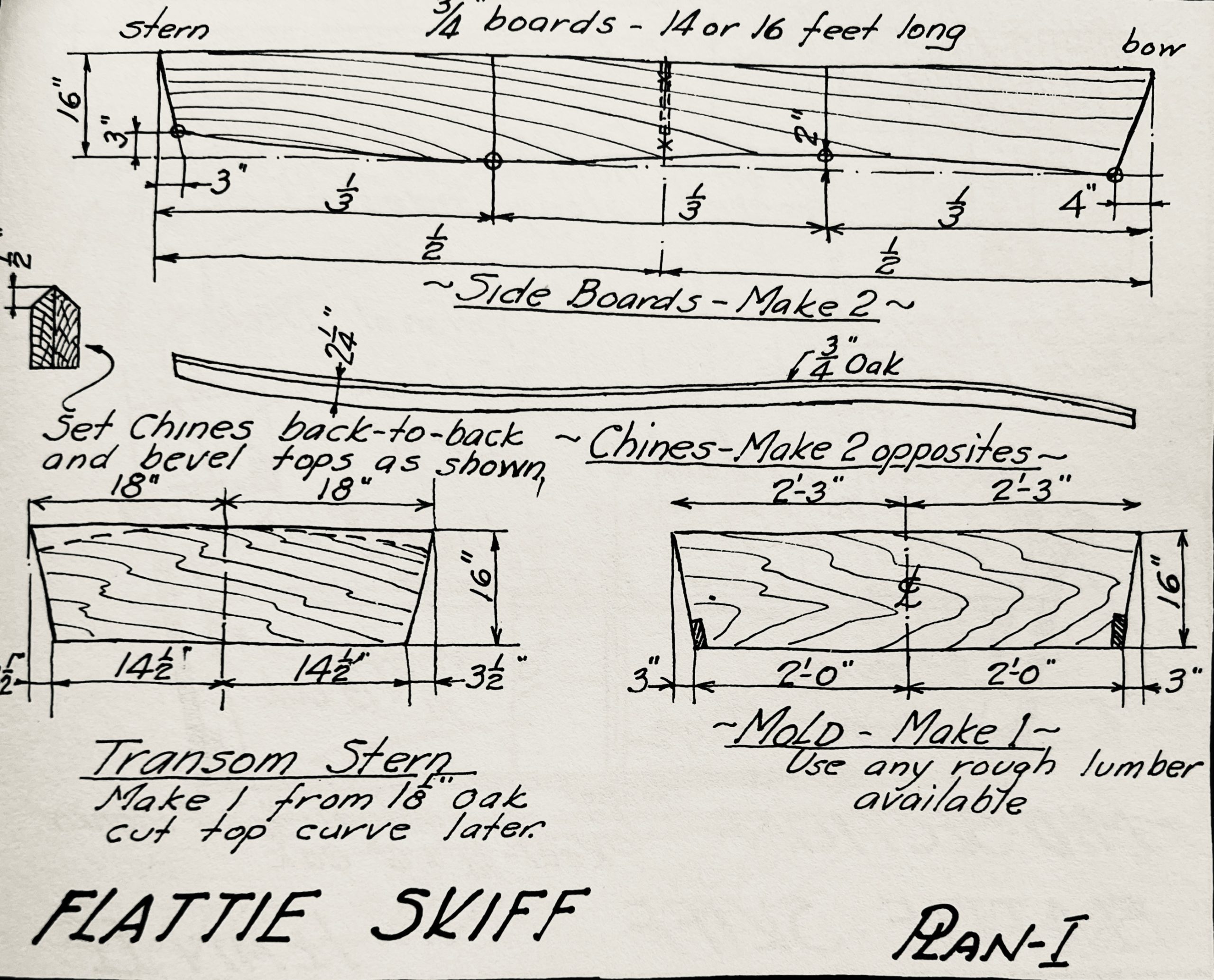
Plans for Uncle Gabe’s Flattie Skiff first appeared in Samuel S. Rabl's book, Boatbuilding in Your Own Backyard, in 1947. [Amazon here. Full text online here.] Rabl highlighted the Chesapeake flattie's ease of construction and exceptional rowing characteristics. Most important for the home builder, Rabl provided dimensions and layout to shape the side planks without tables of offsets, lofting, or a strongback and station molds. The flattie could be built on sawhorses with a few handtools or portable power tools. Although his plans and instructions were for traditional plank construction - the way Uncle Gabe had built his flatties in the early 1900s - Rabl also discussed plywood and epoxy/fiberglas methods and products that were appearing on the market before WWII, and he included other plans in his book specifically for plywood construction.
Joe Youcha, founder and director of Building to Teach, and co-founder of Teaching with Small Boats Alliance, popularized the design in the late 1990s. His "Bevin's Skiff" combined elements of Rabl's plan and the traditional Westport skiff plans of by Bob Baker. More than a thousand of the Bevin's Skiff derivative have been built by programs and individuals in nearly all 50 US states and in a dozen countries. [Small Boats Monthly here.]
Leaders and volunteers at museum shipyards and community boatbuilding programs recognized the value of Rabl's plans, along with plywood as a simple approach for teaching young students and adult novices to build a functional boat quickly and economically. The Chesapeake heritage of Uncle Gabe's flattie was a bonus for teaching programs that emphasized maritime history and traditions.
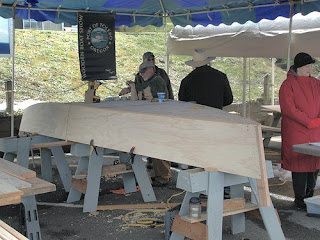
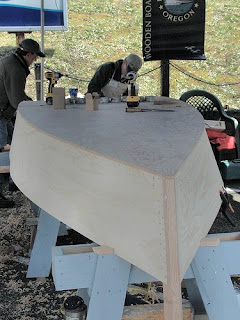
One example is Uncle Gabe's skiff built by volunteers for the Port of Toledo Community Boathouse in 2008. [Documented here.] The build was done at the Depoe Bay Wooden Boat Show to demonstrate the potential of backyard boatbuilding much as Gabriel Moses had built his boats on Bodkin Creek - cutting and assembling the hull on sawhorses out in the open, or under a simple shelter.
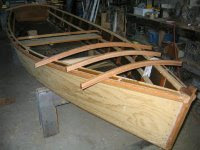
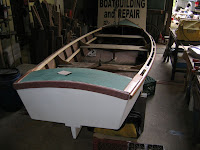
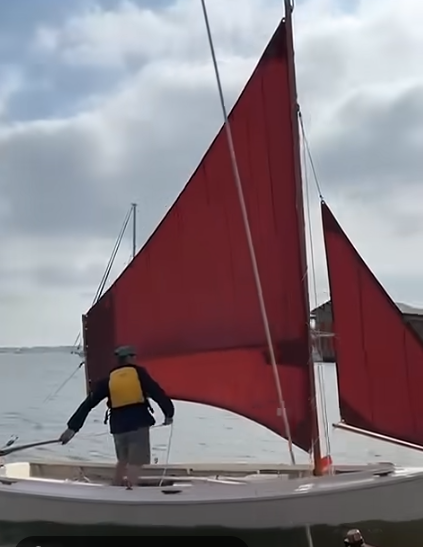
Another Uncle Gabe's Flattie was built by the Chesapeake Bay Maritime Museum apprentice program around 1996 under the direction of shipwright John Swain. It was sold by CBMM in 2023 and refinished and refitted by Don Dill of Spar-Time Boatworks in Raleigh, NC. [Text and photos in The Ash Breeze, Summer 2024, p. 13 here . Opal is shown under sail at the head of my article, above. Dill sold Opal in 2025.]
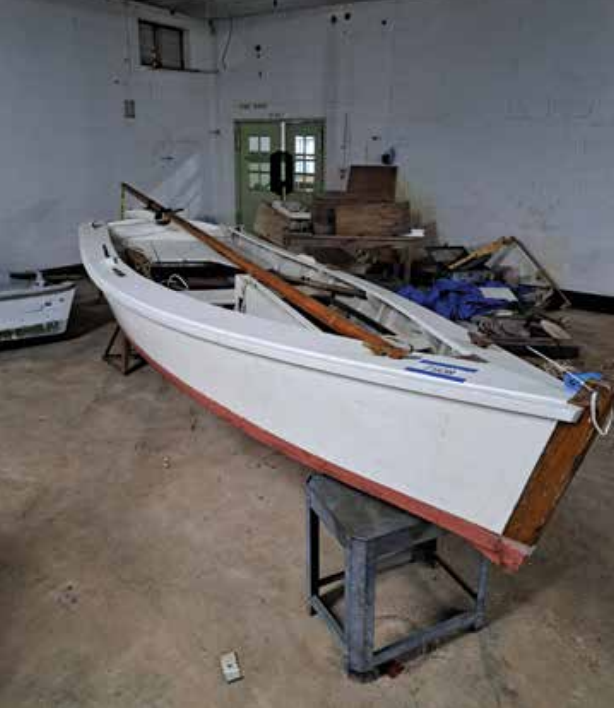
Opal as she waited in the CBMM boat warehouse in 2023.
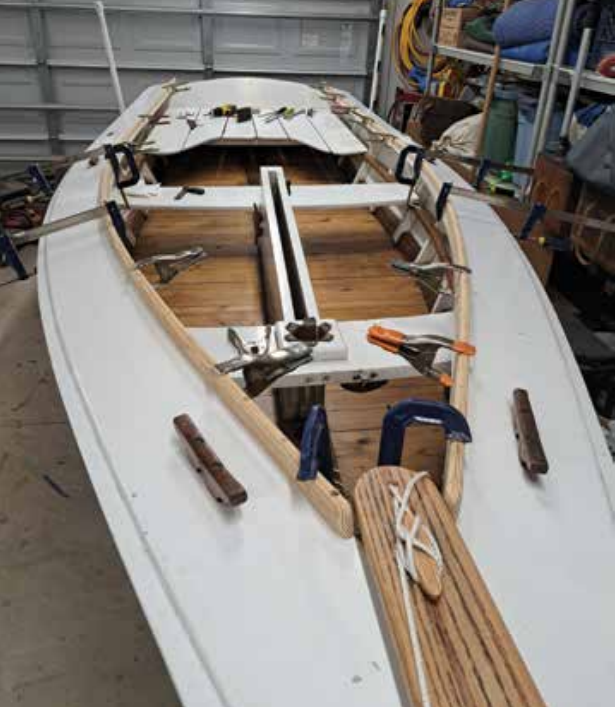
Opal at her new home in Raleigh.
Gabriel Moses's Apprentice: Sam Rabl from Baltimore's Ward 6
Magazine articles and online forums that describe Uncle Gabe's Flattie perpetuate the name but nothing about the black boatbuilder. We would know nothing about Gabriel Moses if he had not mentored and passed his knowledge and skills to Sam Rabl, an apprentice marine draftsman working in Baltimore.
Sam Rabl was the son of German immigrants who was raised in Baltimore's Ward 6, home to large numbers of Jewish, Italian, and Eastern European families. Sam was still living there when he met Gabriel Moses on Bodkin Creek in the 1920s or 30s. [US Census 1910 and 1930, here.]
Sam's father, Franz Rabl, was "in charge of maintenance and construction for all the fortifications on Chesapeake Bay, and young Sam grew up around the small fleet of boats that carried supplies and equipment to the forts. The U.S. Army Corps of Engineers maintained their own boat shop to service the fleet, and it was here that Sam Rabl learned at a very early age just what made boats tick." [Rabl Boatbuilding, 1958 edition, dust jacket back flap.]
Franz Rabl employed other immigrants in the government boat ship, including a black shipwright who tutored young Sam:
"To this day I can well remember the instructions that were given me at the tender age of fourteen when I first learned to use an adz, much against my father’s orders. My tutor on the adz was a giant Bahama negro employed by my dad, and his words still remain fresh in my memory. In an accent quite different than our Maryland negroes, Bob told me. 'Boy, when de day come dat you no longer be afeered of datair aides, dats de day when it’s gonna bite yuh.' While the adz is one of my favorite tools, I am still afraid of it and, as yet, haven’t ever been 'bit.' "
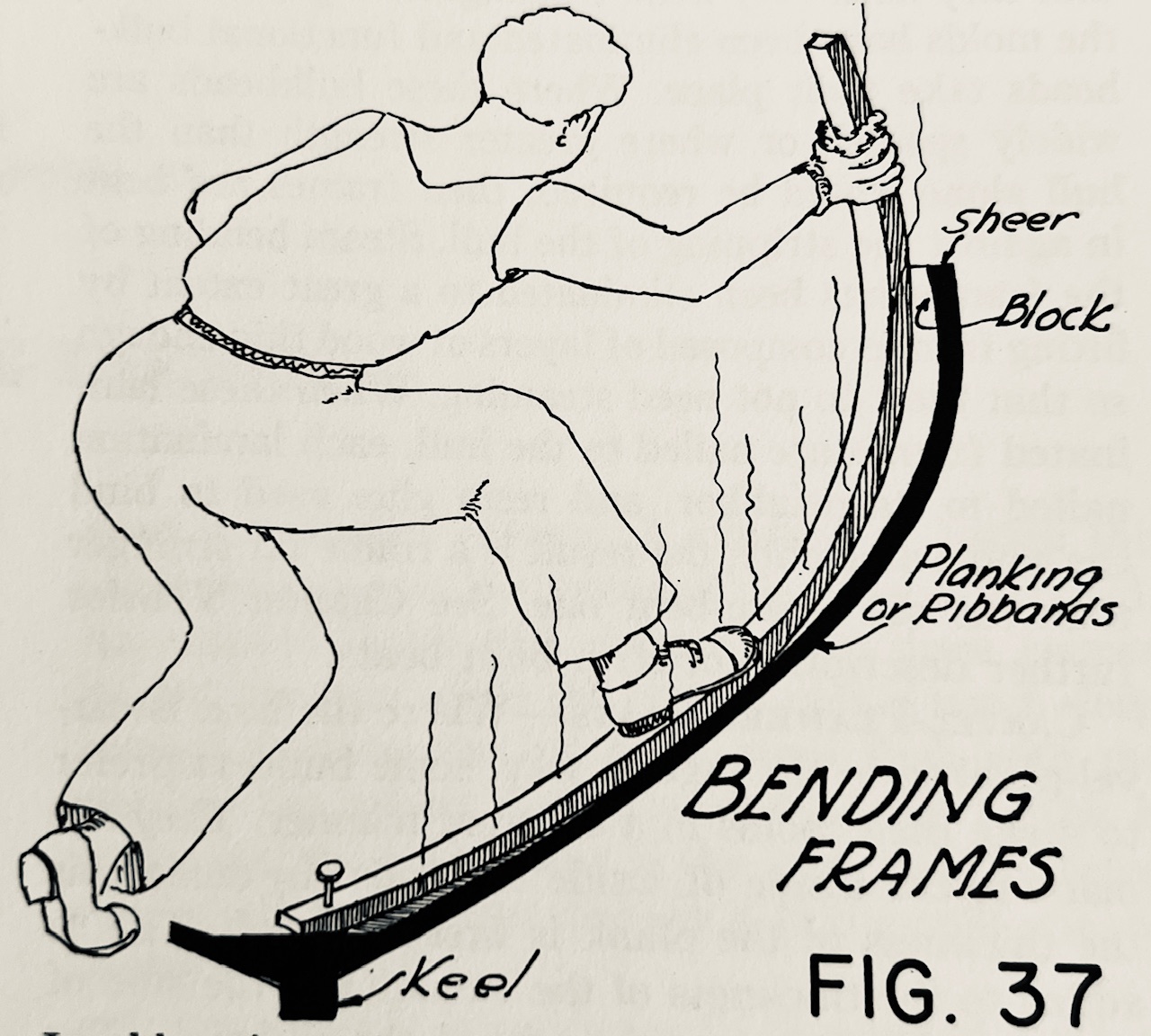
Perhaps Bob the giant Bahamian was the model for Rabl's illustration (his own drawing) of frame steaming and bending [Fig. 37 in Rabl's Boatbuilding book].
While still an adolescent before 1920, Rabl read boatbuilding books and "haunted the boatyards". He spent time in big yards that used advanced technology and complex joinery. Acording to Rabl, "the professional yacht builders would have no patience with you and more than once threatened to kick you from the yard." He was attracted instead to the smaller yards where he "found men who were building boats that anyone capable of wielding hand tools could build. Here there were men who would stop work at the least provocation to sit and spin yarns to a likely youngster of how a boat should be built 'proper like.' Here were men whose boats were out on the bay working for the fishermen and crabbers. These boats stood storm and waves as well as, if not better than, the best of the highly painted yachts."
Sam Rabl wrote that he "sat at the feet of old Till Price and learned how a keel should be cut; and from Uncle Gabe Moses, an old darky who built skiffs over in Bodkin Creek, I learned that the best way to allow a calking seam was to lay a saw in the joints as the planks were fitted. These men were humble and if they did not agree with your opinion (and what youngster doesn’t have opinions), they told you in a nice way that you were wrong."
In the 1930s and 40s, Sam Rabl advanced from apprentice draftsman to naval architect and marine engineer and "operated a plant" at Pratt and Gay streets in Baltimore, where he designed and built pleasure and commercial vessels. During World War II, he worked at Bethlehem Shipbuilding Company to train naval architects for the expanding wartime shipbuilding industry. Right after the war, he published the first edition of his widely-known backyard boatbuilding manual, in which he recalled what Gabriel Moses had taught him decades earlier.
Gabriel Moses on Bodkin Creek
It's hard to say how Sam Rabl first met Gabriel Moses and watched him build flatties on Bodkin Creek. With his immigrant roots and upbringing, and his acquaintance with black shipwrights, Rabl seemed to be drawn to the smaller yards where individual boatwrights were still building sailing workboats using traditional methods and materials. He carried a working-class outlook into his career as a marine architect and writer, and his relationships with the boatbuilders who were his mentors.
Rabl provides our only glimpses of the black boatbuilder on Bodkin Creek. The timeline of Rabl's own life and career, and his comments about Moses's response to new boatbuilding technologies and methods, help us date Moses's life roughly from 1870 to 1940. I was unable to find any mention of Gabriel Moses in local records, nor any related records about black communities on Bodkin Creek during this period.
It appears that during Gabriel Moses's lifetime, Bodkin Creek was surrounded by the small farms of white families who shipped produce to Baltimore from eight or more farm wharves on Bodkin Creek and Back Creek. Some farmers carried produce in small craft - like Gabriel Moses's flatties - to larger boats anchored off the Patapsco flats. I found no record of how or why Gabriel Moses set up for skiff building on Bodkin Creek, or where his yard was located.
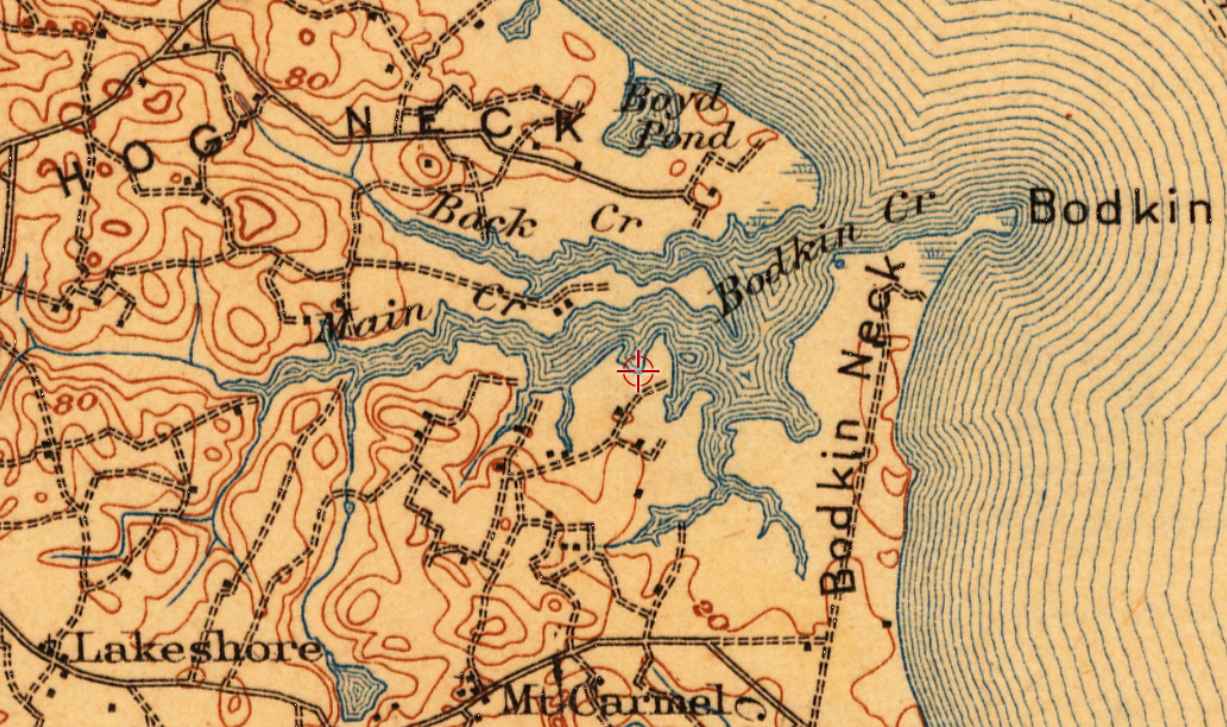
Bodkin Creek, USGS Topo, 1908
What Gabriel Moses Taught Sam Rabl
Some of Rabl's brief sketches of "Uncle Gabe" Moses, which I've copied below, may seem racially insensitive today. But Sam Rabl's deep respect for the black man's craftsmanship, and for the man himself, is unequivocal and speaks to us clearly from that time and place in which both men lived.
Excerpts below are from S. S. Rabl, Boatbuilding in Your Own Backyard, Cornell Maritime Press, 2d Edition, 1958.
Skiffbuilding on Bodkin Creek
On several occasions in the preceding chapters I have mentioned old Uncle Gabriel Moses, the negro skiff builder who lived over on Bodkin’s Creek. Uncle Gabe built the sweetest rowing skiffs that I have ever come in contact with. When they were fitted with a small sail they performed equally well. Back in the days when old Gabe lived we could still get cypress boat sides sixteen and eighteen inches wide. Today these widths can only be obtained in redwood from our West Coast. Toward the end, old Gabe started making his sides from two boards and without a doubt this was one of the things that contributed to his broken heart and hastened his death. We will assume that wide boards are no longer available and describe the construction using two boards to a side. ... While Uncle Gabe built a twelve -foot skiff occasionally, the fourteens and sixteens were his most frequent orders.
[p. 128]
Spiling Planks
Years ago when I saw professionals take a spiling, I stood enthralled. I had read how you use a pair of dividers set to an exact distance. The writers stressed that exact as though the entire success of the boat depended on it. I did not discover that this was a lot of “malarky” until some time later when I found old Uncle Gabe taking a spiling. “Don’t you use dividers?” I asked Uncle Gabe. ‘What is dey?” he asked in return.
I found that Uncle Gabe didn’t even have a pair in his tool-box but he got accurate spilings just the same. He used a notched stick. He took a couple of thin boards and nailed them together to conform, as close as straight lines would, to his curve. Holding the spiling stick in the same direction all the time. Uncle Gabe took his pencil from the woolly white head. Uncle Gabe then took off his spiling board and fastened it in the proper position on the flat plank to be fitted. He set the notch on the spilings and marked the board to be cut with the end of the spiling stick. When he was finished with his stick and board he hung them on nails in his shop. Old Gabe never tacked his spiling boards to the work; he always held them with a gadget resembling an enlarged clothespin which he had cut from hickory saplings. Even after I saw his method, I stuck to my dividers for a while —it took a long time for me to learn that every time you drop them they change their measurement.
[p. 36]
Chines, Stem, Transom
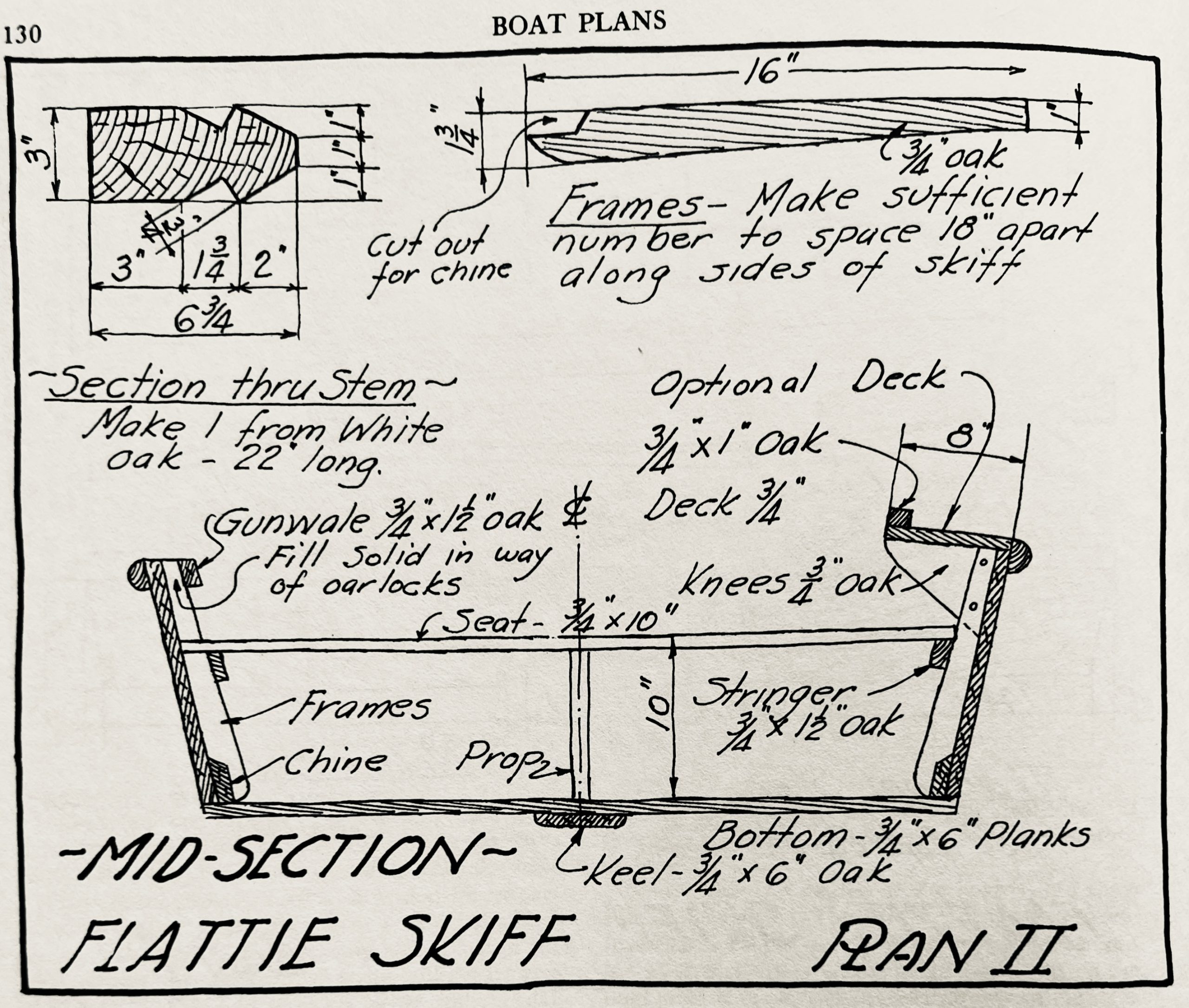
From two oak boards mark off the chines using the shape of the bottom of the sides as a template. Put these back to back and bevel their tops as shown on Plan I. Uncle Gabe always beveled his chines for this prevented water from lying on their tops. Some builders consider this an unnecessary refinement, but old Gabe’s skiffs were the best....
The stem is cut from a piece of 3″ x 7″ oak as Uncle Gabe used to make them and the rabbet was given a two-inch curvature in the 22″ of length. The forward edge was curved to suit this. If this sort of curved stem is to be used, the forward ends of the side planks will also have to be curved to fit the stem rabbet. If a straight stem is fitted (and there have been thousands of skiffs built this way), the stem may be cut from a piece of 3″ x 6″ or even 3″ x 5″. ...
Long screws should be used to fasten the side boards to the transom. Some builders fit a batten along the transom sides so that the side board screws will not have to be driven in the end grain of the transom boards. Uncle Gabe used such hard white oak that this was never necessary on his skiffs.
[pp. 129-130]
Bottom Planking
Six-inch boards are recommended to plank the bottom ... Starting from the mold the boat is planked forward and aft. A board is laid across the bottom and marked off. It is then removed for cutting, put back and fastened with nails or screws. Nails are preferred by most of the builders including Uncle Gabe.
Some method to make the chine seam tight must be used. Uncle Gabe always bought the worn-out woolen trousers that his ragpicker nephew secured in his trade. He would tear these in strips about an inch wide and, after soaking them in white lead, place them between the chines and bottom planks. Wool has the property of not rotting as quickly as cotton and holding the lead better. In modern work a strand of lampwicking soaked in black Staytite or Miracle Adhesive type M-T may be used.
A saw is laid between the planks to space them apart as they are fitted. Never fit the bottom planks tight if they are of cypress, pine or redwood. Even a six-inch plank will buckle under this condition and an eight-inch plank has been known to leave the chine.
[pp. 131-132]
Keelson and Mast
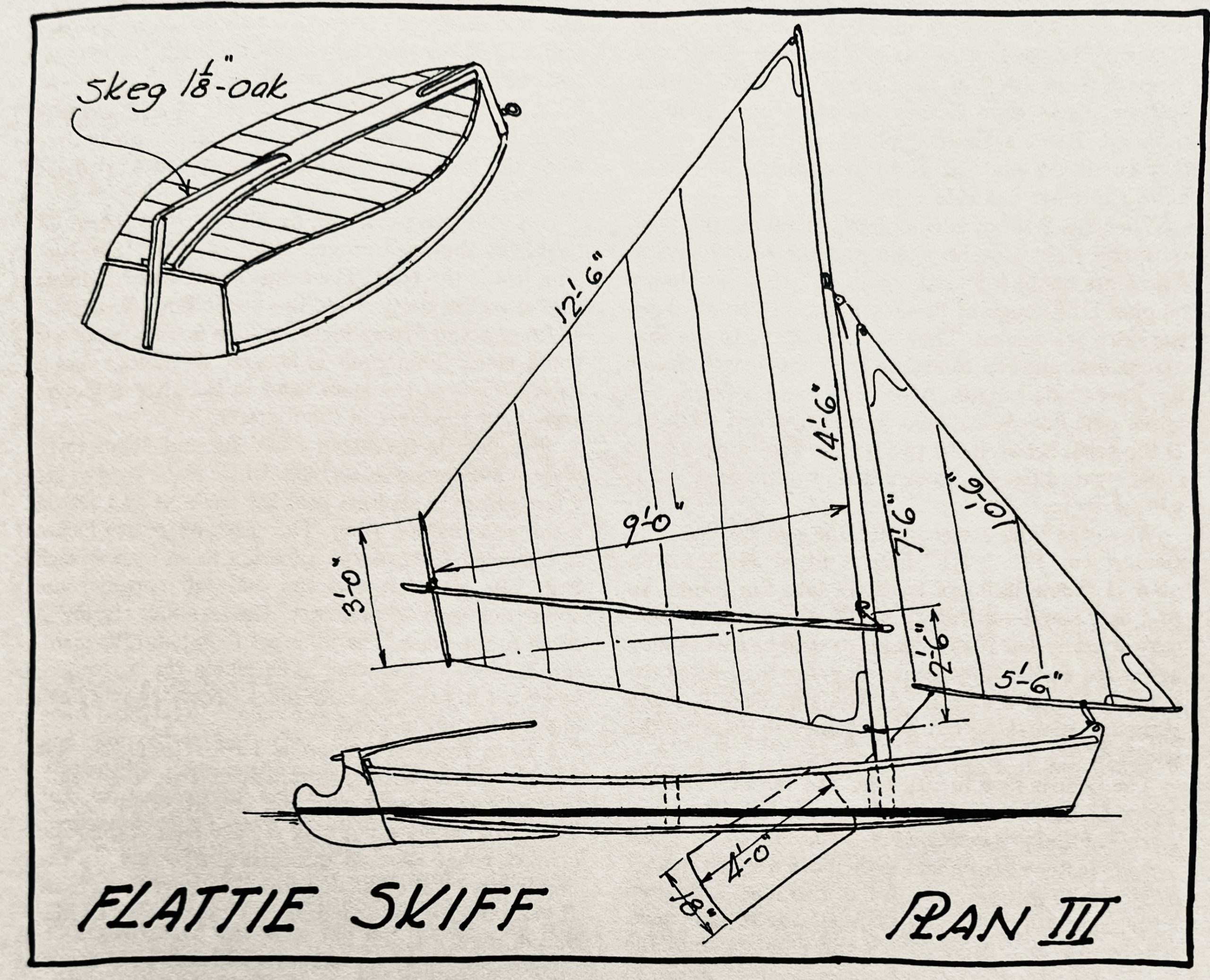
Some builders prefer to fit the keel strip inside the boat. Uncle Gabe contended that this was wrong because it prevented bilge water from draining from side to side and that the strip on the outside reduced wear on the bottom when the boat was dragged up on a beach. Perhaps he was right. ...
The mast is seventeen feet long and about three inches in diameter at its butt. Uncle Gabe used to get a straight pine sapling, peel the bark off and season a full year before using.
[p. 131]
Uncle Gabe’s Last Skiff
When Uncle Gabe launched his last skiff on Bodkins Creek, plywood was a thing to experiment with but not to trust. The wide cypress boat-side lumber that he used was becoming a thing of the past even before Gabe passed on. The outboard motor was increasing in power to the point where Gabe’s skiffs no longer performed satisfactorily ahead of them.
A new era had started. A new kind of skiff was required. Starting where Gabe left off, I experimented with various bottom shapes. A boat that will perform well under power is hard to row; one that is easy to row does not perform well under power. ... [My boat design] Teal, therefore, had to be a compromise.
[p. 136]
Archived Comments
These comments are preserved from the original WordPress site as read-only text.
Oh my gosh! You are not going to believe this Don but when I was completing Cinnamon Girl I also teamed up with a guy named Bill Doyle and the 2 of us ran a loosely based boatbuilding program at the fledgling Baltimore County sailing Center at Rocky Point park near Hart Miller Island. The boat building program paired with Sailing Center gave the pretext for using the county owned building for a year round program. The first two boats we build that first winter were Uncle Gabe skiffs to be used as chase boats for the sailing program. Cinnamon Girl was finished at that facility.
As far as I know, one of the flatties we built in the late 1990s was still in use as few as 5 or 6 years ago on the Eastern Shore near Crisfield. . The boats were built for the Baltimore County Sailing Center (then the Glen-Mar Sailing Club I think) to chase down the little Dyer sailboats that kids in their classes had managed to capsize and couldn't right. They were dragged on and off the each hundreds of times. We built the boats of medium density overlay, plywood used for highway signs in those days. The wood had a thick fiber coating on both sides that made a great finish easy. The stems were oak, the seams of fiberglass and epoxy fillets. Looking at the final plans in the article brought those days back - Bill Doyle hovering over me to make sure that my work met his VERY exacting standards, coming down on me like a ton of bricks every time I said something like "that's good enough." I once said "slap a coat of paint on it" and he went ballistic. Those evenings changed my life. I restored my first ancient canoe there, a 1923 Old Town. Without the help of Kevin and Bill I never could have accomplished that. As I write this I have a model of an Uncle Gabe skiff on my bench. I'm going to mount a battery gun on the bow and it will become a silent auction for Ducks Unlimited.
Kevin and Ron, Thanks for taking time to share these stories. The spirit of Uncle Gabe is everywhere!
Thank you for this, I've always wanted to know more about the back story!