
 Maryland
Howard Chapelle drew plans and described the two-masted stick-up rig on a Pocomoke (or Nanticoke) log canoe in American Small Sailing Craft (Figure 108) in 1951. He also drew plans for a two-masted stickup flattie which was built by Leslie Seward at Hudson, Md., in 1904. This skiff plan was drawn on 1954 but was not published. The plan is in the collection of the Chesapeake Bay Maritime Museum (CBMM). (Read more here.)
Below are the only historic photos I've seen of a two-masted stick-up rig on a skiff. Both photos were taken by George Barrie, Jr., on the Little Choptank River on the same occasion, possible between 1898 and 1909. Large-format photos are here.
Both photos show Barrie's yawl Irex in the background. Another photo of Irex from the CBMM collection is here.
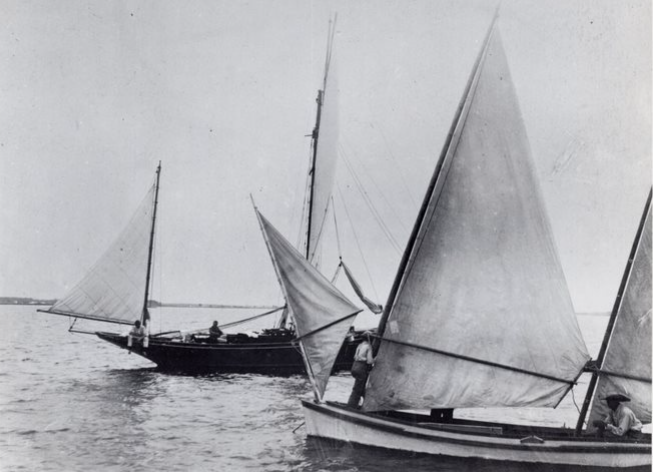
CBMM Catalog No. : 0000.0901.0379.00
TWO-MASTED STICK-UP RIGGED SKIFF ON LITTLE CHOPTANK
Photographer: George Barrie
Notation on reverse of photo, probably in Chapelle's handwriting:
""Two-masted stickup rigged skiff, v-bottom or flattie,
Little Choptank
Photo by Geo. Barrie, Jr."
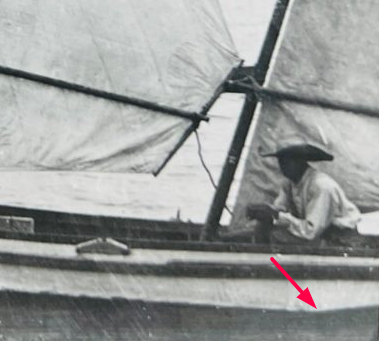
The two-masted stickup rig appeared on both log canoes and flatties (skiffs with deadrise in the stern). Canoes and skiffs are sometimes hard to differentiate from each other in historic photos. Chapelle's identification of this vessel as a flattie skiff is confirmed by the break in the waterline seen at the aft end of this vessel.
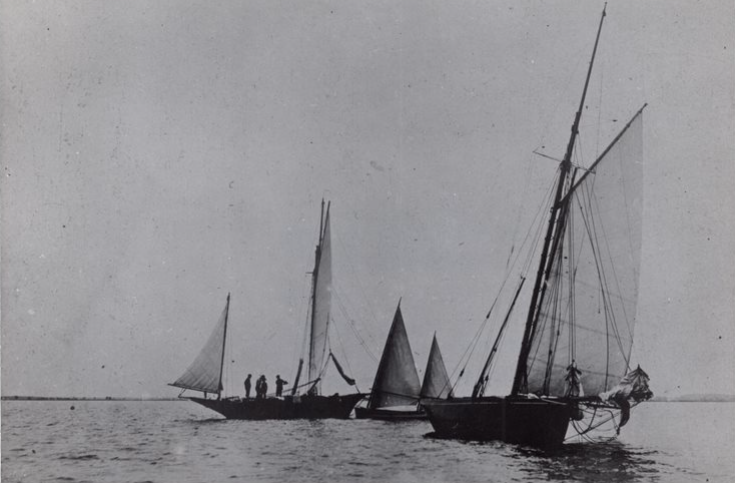
CBMM Catalog No. : 0000.0901.0373.00
TWO-MASTED STICK-UP RIGGED SKIFF ON LITTLE CHOPTANK
Photographer: George Barrie
What's happening here on the Little Choptank?
My friend Ed Thieler, Chesapeake maritime historian and model builder, offered observations and speculation about the Barrie photos:
Photos 0373 and 0379 were taken by George Barrie, Jr., from a fourth boat while cruising on the Little Choptank River, a branch of the Chesapeake Bay, in Dorchester County, Maryland.
These 'locals' came out in their stick-up to say hello, take a look aboard the yacht Irex, and perhaps lend a hand. The camera man, George Barrie, Jr on a third yacht, was intrigued by the peculiar rig and snapped the photos.
In photo 0379, the stick-up has anchored, and the men are talking.
The Irex, in the far background, appears to be lying to the breeze. What about the set of the sails on the yawl? I suspect it is aground; no one is at the tiller, the crew are waiting for the tide to rise and a wind to come to blow them off the shoal. A dinghy is behind the sails of the stick-up, perhaps taking out an anchor to kedge off when the tide comes up.
Is the stick-up a working boat? Tonging for oysters? Scraping or trotlining for crabs? It seems too clean, and no typical tools appear to be on board. The stick-up sail and main sail are tied on with individual ties - not a continuous lacing. The foresail looks like it is on a slide with slugs, and it has a down-haul if things get stuck.
In photo 0373, the stick-up has sailed up to the Irex, the stick-up mast has been un-shipped, and the crew are visiting on the yacht. The stick-up skipper with the big hat and white shirt is on the mid-deck. Perhaps they are discussing how to get the yawl afloat, as it has not moved in the time between photos.
The boat in the foreground may be aground also. Water is lapping at the weather waterline, there is a slight heel, and the water is flat under the lee, no anchor is out, and no one is on deck.
Seward, Barrie, and Chapelle
Ed also speculated on the coincidence of time and place between Seward the builder, Barrie the photographer, and Chapelle the historian:
The brothers Robert Barrie and George Barrie, Jr., cruised the Chesapeake Bay in a variety of sailboats in the early 1900s. Their stories were published as articles in several Yachting magazines over the years and combined into the book, Cruises, Mainly in the Bay of the Chesapeake, in 1909. These essays and the book are credited with opening the Bay to tourism and became a template for “cruising guides” to come. In several of the essays they mention their fondness for the Little Choptank River. The sailed Irex and other vessels on the Little Choptank during 1903-1905.
In 1940, Chapelle bought “Orem”, an old pillared manor house and 185-acre farm on Town Point Neck, overlooking Fishing Creek, a branch of the Little Choptank.
In 1954, Chapelle drew plans based on a ‘Little Choptank flattie’ that Leslie Seward built in 1906 at Hudson [also on the Little Choptank, a few miles from Chapelle]. Chapelle's plan says, "Lines laid off from notebook memos of builder as to moulds etc. checked against scaled photographs."
Chapelle draws the lines using Seward’s notebooks and photos. This would be both interesting and challenging for him. All he needed was his proportional dividers and his knowledge of Bay boat structure in general. Erasures and re-positioning of masts and oarlock-pads noted.
There are more notes on this plan than on other Chapelle drafts. It even seems that he and Seward might have shared some serious time and documentation, together. There were moulds – were there similar boats built?
More About the Eastern Shore Sitck-up Rig
Two-masted stick-up flattie plans at CBMM
Two-masted stick-up flattie model by Edward R. Thieler III
A unique stickup skiff on Cambridge Creek, 1899
More about CBMM Collections
Items that are not exhibited around the CBMM campus are kept in the Norman & Ellen Plummer Center for Museum Collections. This is a climate-controlled facility that was expanded and modernized in 2023.
You can search all the collections online here. Look for the links at lower left to search these collections separately:
- Objects, Photographs, Manuscripts, Ships Plans
- Regional Oral History Database
- Books and Periodicals
See my CBMM Collections Search Tips.
The collections and library are accessible only by appointment. Email collections@cbmm.org or visit the Library and Research page.
Voile-Aviron | Sail & Oar
I also write about sail-and-oar cruising in small open boats on the Chesapeake and its tributaries at Sail+Oar - Chesapeake Log.