
 Maryland
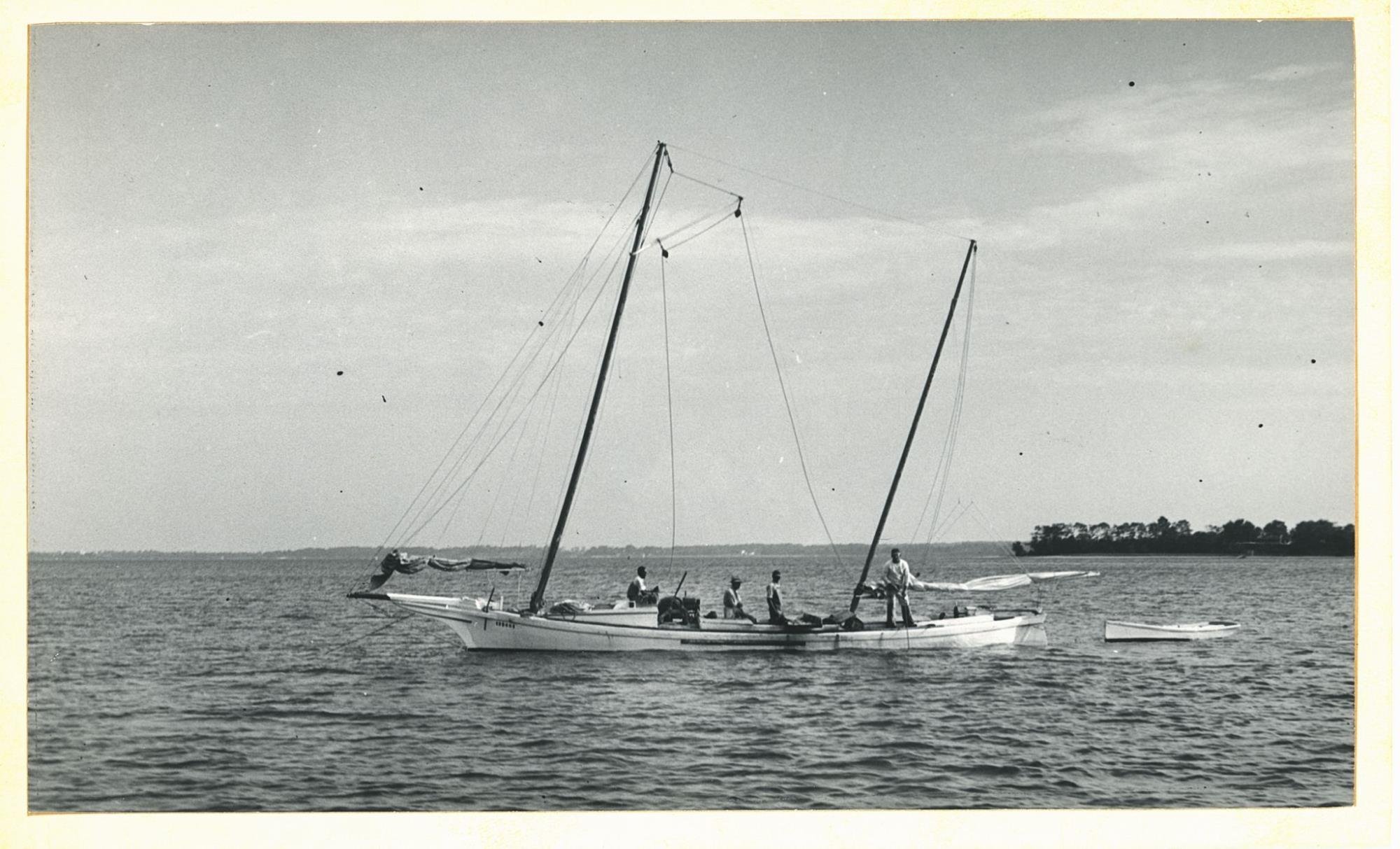
Unidentified Brogan on the Patuxent River, September 1941
CBMM Catalog #: 0000.0278.0001.00
John G. Earle, Photographer
Missing Links: Brogans, Coasting Canoes, and Cabin Skiffs
The dramatic expansion of the oyster market and depletion of shallow-water oyster beds after the Civil War drove the rapid development of oystering workboats that could reach deeper beds and more distant markets. The small log canoes and oyster tongers were replace by heavy oyster dredges hauled by bugeyes and skipjacks.
In between were the log-built brogans and coastal canoes, and the plank-built cabin skiffs. These intermediate-size sailing workboats are not so well documented as the log canoes, bugeyes, and skipjacks.
Below are excerpts from the writings of several Chesapeake Bay historians about the design, use, and historical context of the brogan.
Research advice, source notes, and a description of shaft and patent oyster tongs were provided by Chesapeake workboats historian and modeler Edward R. Thieler III.
See also:
Brogan Plans - Shamrock & Katie D
The missing link in the well-known evolution of Chesapeake Bay oyster fishermen is the Brogan. First came sailing log canoes, which are still extant on the Bay, and are raced very competitively to this day. Last came the bugeye and the skipjack. ... The canoes, brogans and bugeyes were constructed of logs. ...
The brogans were the direct ancestors of the bugeyes—also built with log bottoms and planked topsides, but smaller in size. The brogan rig ... continued to be used, on a larger scale, by the bugeyes and skipjacks...
[Reuel Parker, Chesapeake Bay Brogans, Wooden Boat Magazine, online.]
[Chesapeake Bay watermen] felt the need for oystering boats with larger capacity and longer range. On the lower half of the Chesapeake. the coasting canoe and the brogan appeared, essentially larger log canoes fitted with cabins.
[Lesher, Cabin Skiffs of the Miles River], Ash Breeze, Winter 1993. Monthly magazine of the Traditional Small Craft Association.]
The culmination of the simple, single log, trough-shaped Indian dugout was the bugeye.... There was an intermediate step between the canoe and the bugeye, the brogan, a large canoe, partially decked, with a cuddy forward in which a couple of men could sleep and cook. Its rig was that of a Tilghman's Island canoe.
At a short distance [the cabin skiff] could easily be mistaken for a brogan since it was a double-ender, half decked with a cuddy forward and a two masted canoe rig. But there the similarity ended, for the sides [of the cabin skiff] were of plank bent around a full V-bottom made of very heavy sawed lumber running fore-and-aft, the pieces edge-bolted together.
[Brewington, M. V., Chesapeake Bay; A Pictorial Maritime History, Cambridge, Maryland: Cornell Maritime Press, Inc., 1953.]
The bugeye came from genuine Chesapeake lineage and stock - the log canoe. The first ones were merely enlarged canoes, a result of the growth of the dugout into a type referred to as a "coasting canoe," which came into being during the first quarter of the 19th century. It measured 35 to 40 feet in length, had a fixed foremast and removable mainmast. A cuddy cabin forward with a couple of bunks and wood stove made these small craft livable during cold weather and enabled them to be sailed to more distant city markets with an oyster catch rather than sell the shellfish to a buy boat at less profit.
The bugeye came into being because a lusty growing America demanded more and more of the succulent oysters that lived in coastal waters, most abundantly in the Bay and its tributaries. Oyster beds worked by tongers in the more shallow waters were becoming depleted. More productive beds were found, but these were in deeper waters beyond the reach of tongs.
In the early 1800s a form of dredge, introduced by New England fishermen, had been used on the Bay, but its destructive effect on oyster beds caused it to be outlawed by the governments of Maryland and Virginia, During the mid-19th century Maryland, however, relaxed its ban on the dredge and permitted the use of a scrape in Somerset County waters. Coasting canoes were employed in dragging this device over the bottom, but it was soon realized that a longer, heavier craft could do a better job. The simple progressive step was to make the coasting canoe larger. This resulted in the log-built type, the brogan, measuring about 40 to 45 feer is length, and differing from her predecessor in that she had a deck, fixed masts with shrouds on the foremast, hatches, and a forward cabin.
Because dredging had been permitted in other Maryland waters, the use of the log boats spread and toward the end of the Civil War, Maryland permitted the use of the dredge in Chesapeake waters over 15 feet deep. The sloop, pungy, and schooner were active on the Bay but certain inherent disadvantages made them unsuitable for dredging. For example, the bulwarks of the sloop and schooner were too high and the pungy's draft was too deep. Corrective measures were taken to make these types suitable for use but the larger log boats were ideal if they could be further increased in size. This was done through the use of additional logs. These materials were close at hand around the Bay country and there was a good supply of men who could fashion a strong, well-designed hull that could sail smartly and be sturdy enough to pull the heavy dredges over the bottom. Log boats were less expensive to build than the framed sloops and schooners of the period.
[Burgess, Chesapeake Sailing Craft: Recollections of Robert H. Burgess, pg. 13]
During early 1600s, oysters were used as a food only when other supplies failed. Later, when colonists, following the Indians' example, made oysters a regular part of their diet, all one needed to do was to wade or pole a boat of some sort into shoal waters over an oyster bar and rake up as many as desired. For years it was "every man for himself" oysterwise. Then about 1760, the practice of individual food gathering waned, to be replaced by specialized providers of various life necessities. This led to establishment of a new business— that of the professional oystermen. By 1780, oysters became such a favorite that many inns and taverns specialized in serving them. The boats to supply the markets were log canoes of that period.
Such was the situation when a momentous event occurred, one which was to have a lasting effect on the industry and on its vessels. During the early 1800s a New England schooner came into the Bay, her captain offering to buy all the catch the small oystermen could supply. Oyster beds of Northern States had been exhausted, and the tremendous, virtually untouched beds of the Bay attracted numerous New England skippers. In addition to buying all available local oysters, the Yankees began to "fish" for their own lading using their notorious "dredge," then unknown on the Bay. To compete, Bay canoes gradually were built larger. To prohibit the Northern "foreigners" in schooners equipped with huge dredges from raking up all their oysters, both Maryland and Virginia legislatures by 1820 passed laws prohibiting use of all dredges, thus protecting Bay tongers.
By this time oyster consumption was shifting from small river communities to Baltimore, Norfolk, and Washington. In 1830, dredging of oysters was approved only for Maryland and Virginia residents. Oyster packing houses were established and by 1836, oysters were being shipped by a "line of wagons to Pittsburgh supplying even the West with fresh 6" to 8" oysters." Later, a new practice was inaugurated. Schooner "buy boats" from the North or nearby cities were sailed to the actual oyster grounds to buy the catches of the individual oystermen for something less than wholesale price.
In order to get a full wholesale price, the more enterprising oysterman continued to sail his canoe to market. He quickly found that it was too small a boat to carry a profitable load, and that a trip in an open canoe in winter months was hazardous and uncomfortable. A new and even larger type of craft was the remedy that suggested itself. In its earliest form this new vessel was little more than an enlarged open log canoe with keel, 35' to 40' in length, with a tiny cabin forward. As the craft grew in size, a number of alterations took place until a new variation, the "brogan," was evolved.
A standard brogan became a large centerboard canoe, usually of 5 logs, from 40' to 45' long, having a narrow deck with washboards around an open hatch. A cuddy forward housed two straw-filled bunks and a wood stove. There was a fixed bowsprit; standing rigging with deadeyes supporting a fixed foremast; a smaller removable unstayed main-mast; both sails leg-of-mutton.
Invention of deep-water tongs in 1887 by Charles Marsh of Solomons led to substitution of a gaff "square sail" on the foremast, thus permitting the gaff to be used as a derrick boom. The largest of these, Mary & Virginia, (54X16X4) was built at Pocomoke City by William Jones in 1885. In April 1905, George and Robert Barrie wrote: "We passed through a large fleet of brogans off Swan Point Bar (near Rock Hall harbor), two oystérmen in each. Instead of using tongs, they use what is called 'patent tongs'; being broader than the former and operated by a rope which draws the rakes together and then is used to hoist them; a small spar with windlass at the foot and a monkey-gaff complete the outfit. The operation consists of one man lowering the open tongs to the bottom; then several jerks on the rope bring the jaws together; then the other man turns the windlass, the tongs come up and the contents are dumped on the culling board."
Every oysterman could handle an axe and adze well enough to hew out a passable canoe or brogan, but competition demanded a larger vessel. Realizing if a brogan were made larger and given more sail area it could easily haul a dredge, some person added a couple of extra wing logs, put a deck on his enlarged dugout, and with that the bugeye was born.
[Tilp, Frederick. The Chesapeake Bay of Yore. Chesapeake Bay Foundation, Inc., 1982.]
More about shaft tongs and deep-water drop-tongs
Ed Thieler’s notes:
In shallow Chesapeake Bay waters oysters are caught by watermen, standing on the edge of a boat, using shaft-tongs – two long wooden shafts (8’ – 30’) hinged together, with paired metal toothed-baskets on the ends. The tongs are lowered into the water, the baskets are opened and closed to gather the oysters, and then lifted hand-over-hand into the boat to be culled (sorted). Harvesting oysters using shaft-tongs is limited to waters not much deeper than 15 feet.
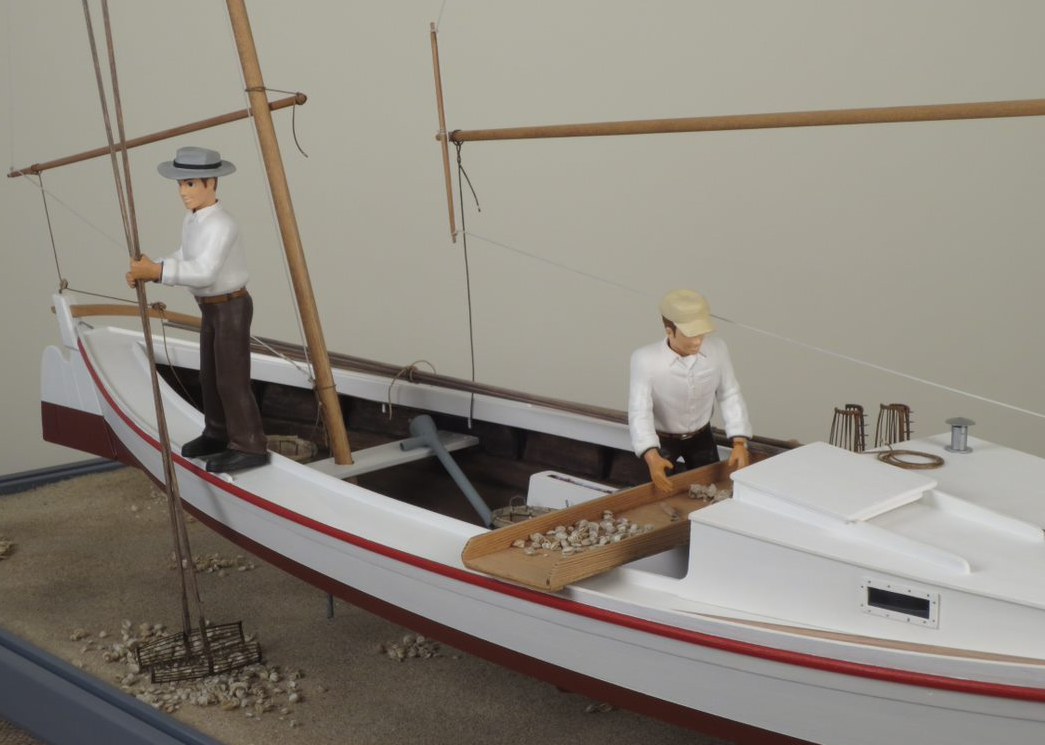
Near Solomons, Maryland, in the Patuxent River, rich oyster beds (rocks) are found in much deeper waters. To access them Charles L. Marsh in 1887, invented “deep-water” tongs – now known as “patent-drop-tongs.”
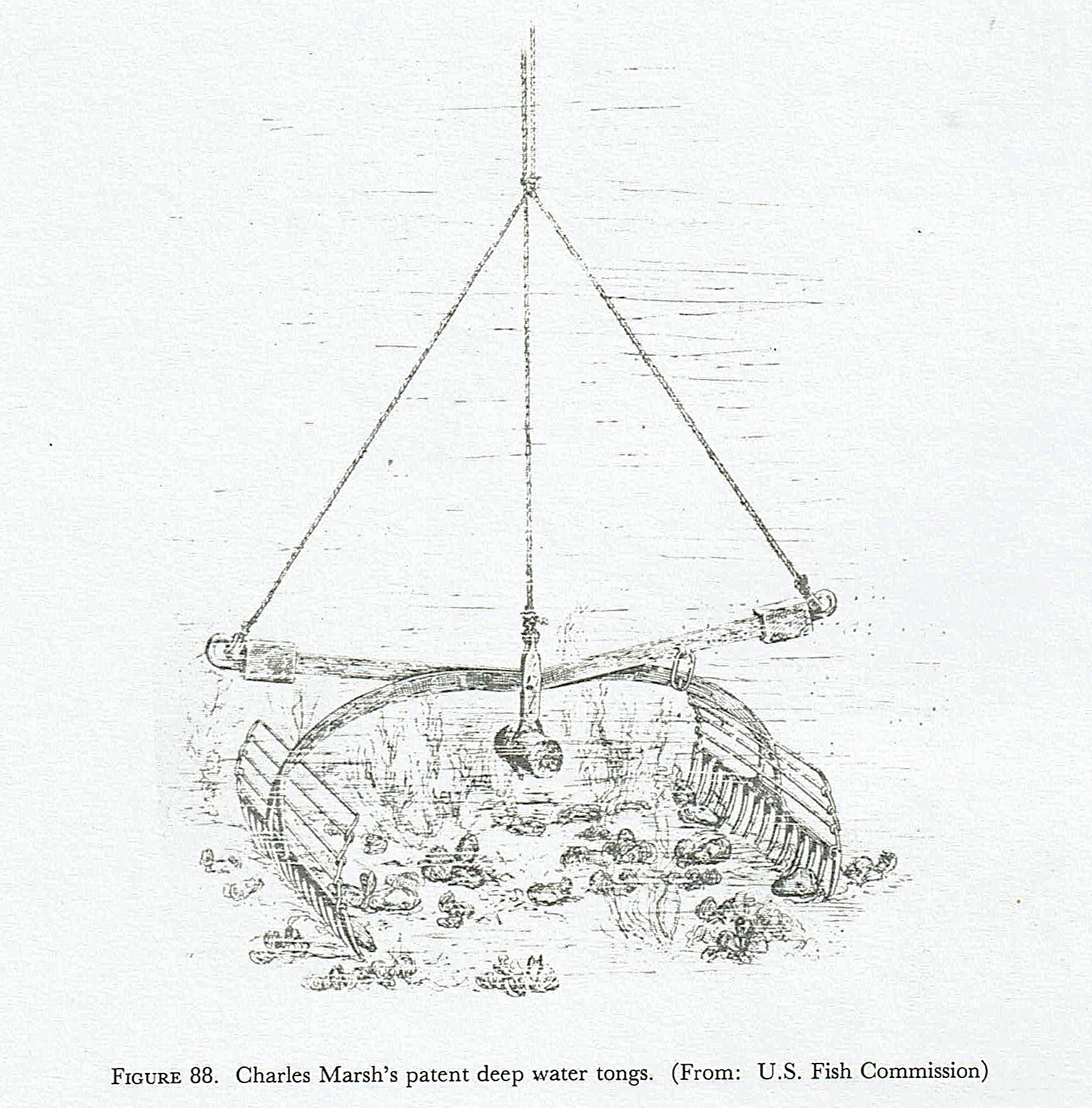
Brewington, M.V., Chesapeake Bay Log Canoes and Bugeyes, Cambridge, Maryland: Cornell Maritime Press, Inc., 1963. pp. 92, fig. 88.
When used from a brogan, as shown in the next photo, the foresail is removed from the foremast and the halyard is rigged to a short gaff-crane fitted with a block (pulley). A lift-line runs from the handles of the drop-tongs up to the block and down to a winch drum. In the early years the winch was hand-cranked, later a small gas “donkey-engine” did the heavy work of hauling the oyster filled drop-tongs on board.
Held open by a latch mechanism, the tongs are dropped onto the oyster bed. The latch is released by tugging on the lift-line, allowing the tongs to close on the oysters as they are winched back onto the boat, where the tongs are opened to spill the oysters onto the culling board for sorting.
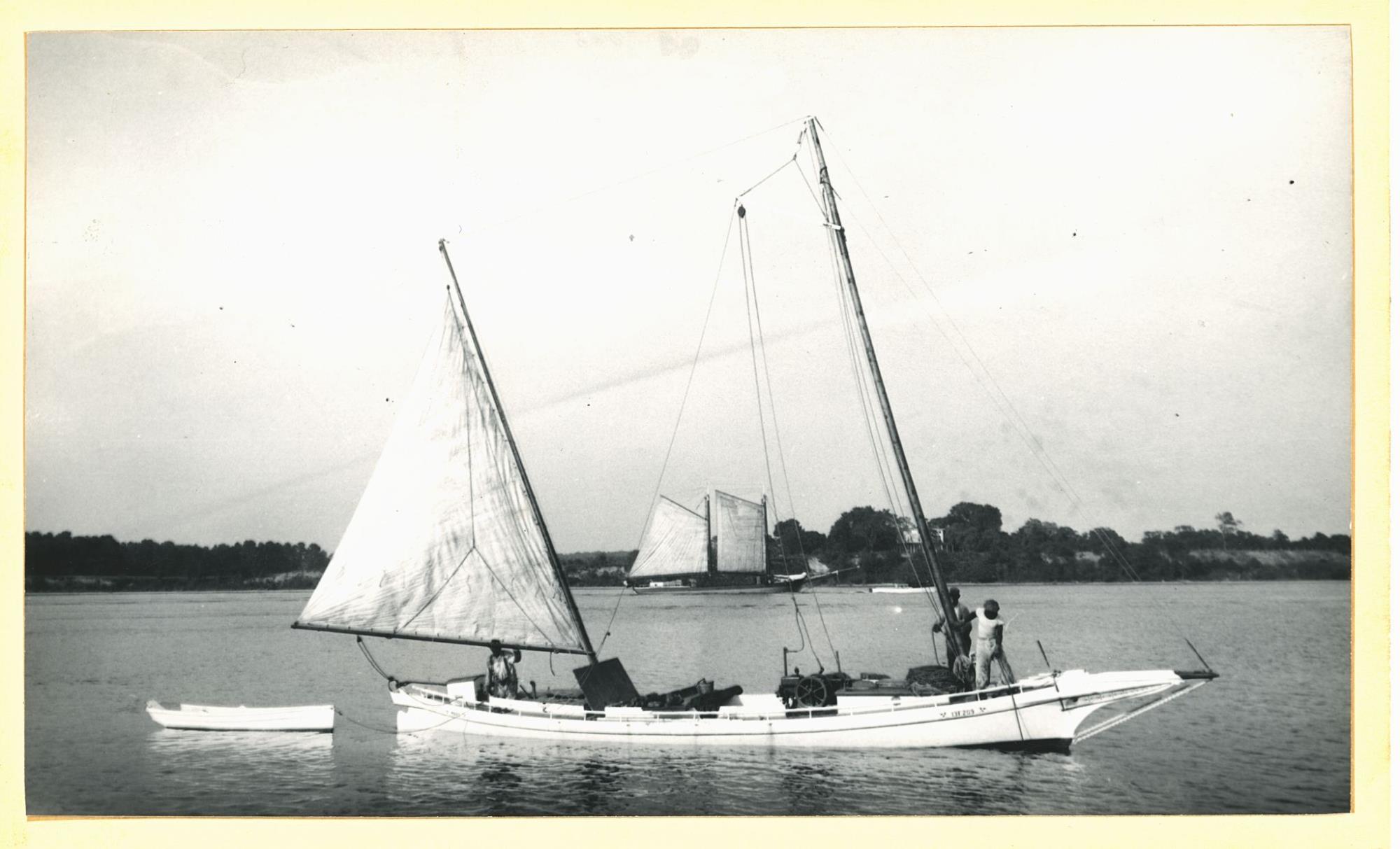
Catalog #: 0000.0278.0002.00
Brogan Marie off Drum Point, September 1941
Photographed by John G. Earle
More about CBMM Collections
Items that are not exhibited around the CBMM campus are kept in the Norman & Ellen Plummer Center for Museum Collections. This is a climate-controlled facility that was expanded and modernized in 2023.
You can search all the collections online here. Look for the links at lower left to search these collections separately:
- Objects, Photographs, Manuscripts, Ships Plans
- Regional Oral History Database
- Books and Periodicals
See my CBMM Collections Search Tips.
The collections and library are accessible only by appointment. Email collections@cbmm.org or visit the Library and Research page.
I also write
Sail+Oar - Chesapeake Log - Cruising in small open boats on the Chesapeake and its tributaries.
Small Boat Shed - Working with other volunteers to restore and conserve small craft at the Chesapeake Bay Maritime Center.