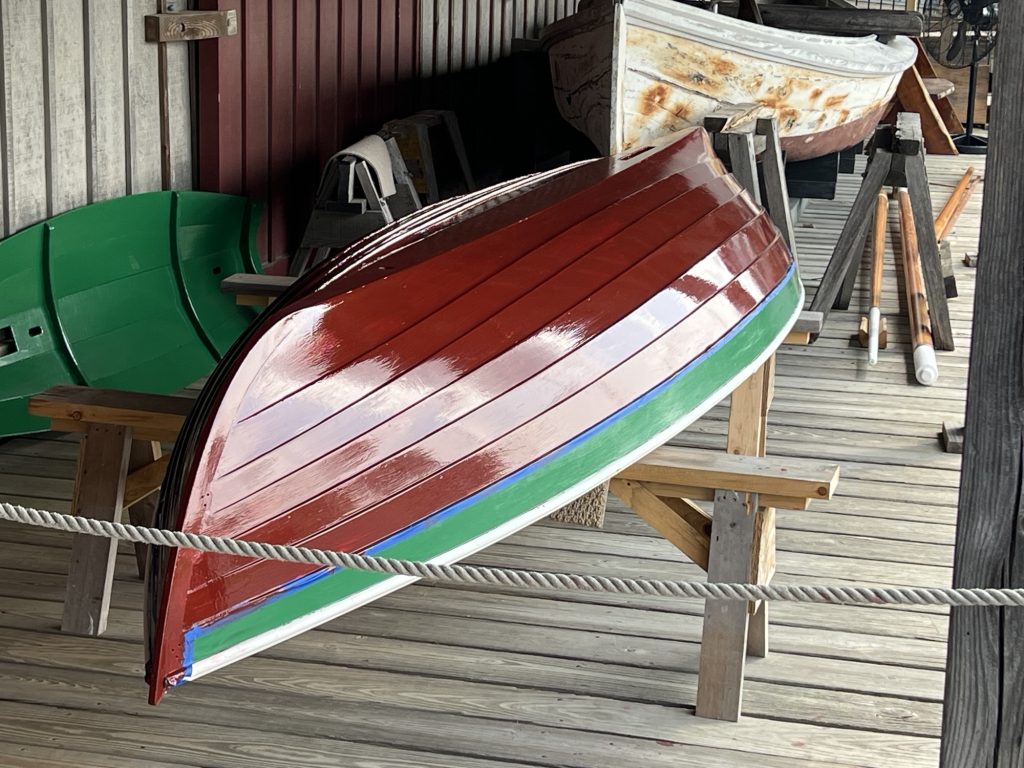
CBMM Cat. No.
None. This vessel is not part of the CBMM historic collection
Description
The Chesapeake Bay Maritime Museum (CBMM) has been closely associated with the Delaware Ducker in several meaningful ways:
- A museum boat built by Joe Liener in 1978
The author Ben Fuller recounts that his Ducker, named JOSEF W, was built by Joe Liener during his time as an adviser at CBMM. That boat is a faithful copy of Liener’s own vessel, GREENBRIAR, which is part of the museum’s collection.
Small Boats Magazine - CBMM has built its own versions
CBMM in St. Michaels has at least two traditionally built Duckers: one of them is in operation (in the “livery”) for visitors to sail or row, while others are more for exhibition or building programs.
WoodenBoat Forum
Lingering Lunacy - Historical models
The museum’s collections include a scale model of the Delaware Ducker, built by Edward R. Thieler, based on plans from American Small Sailing Craft.
Eastern Shore Sailing Workboats
AOK Library
Excerpts from the Delaware Ducker design profile by Ben Fuller in Small Boats Nation:
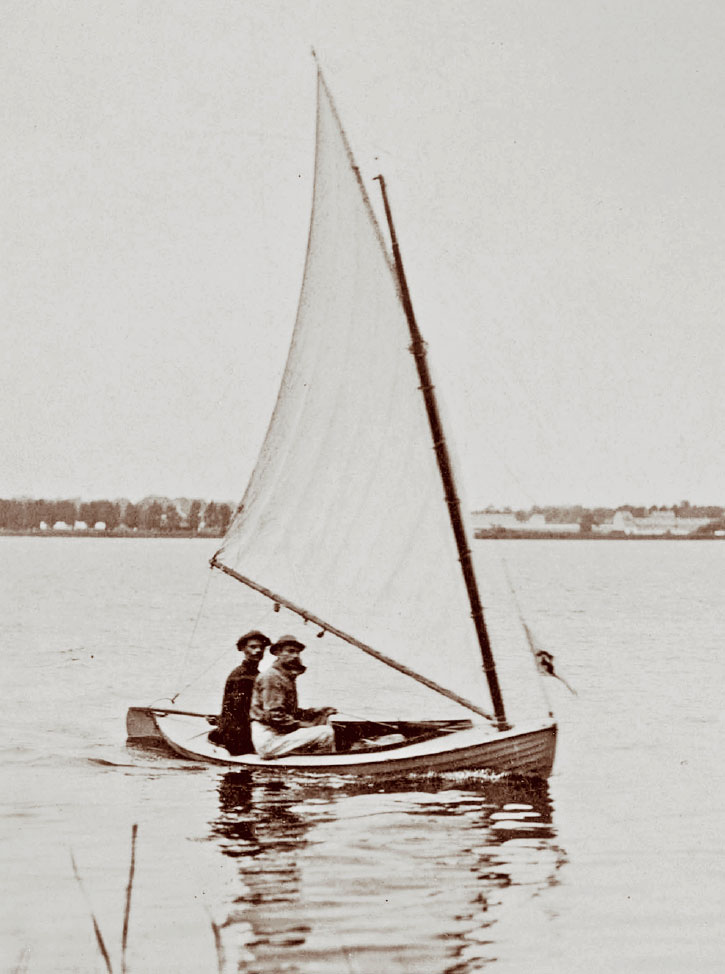
The Delaware ducker is a deceptively simple boat. It’s 15′ long, has a 4′ beam, and is low sided with side decks so that structurally there is no need for thwarts. There is a choice of rigs, depending on the crew’s intentions and abilities; they range from a 56-sq-ft gunning sail (as its name implies, the boat was developed for duck hunting) set with a sprit and a boom, to a 115-sq-ft gaff-headed racing rig.
The ducker is like a canoe: You need to step pretty close to the centerline when you board from the side. You need to have your hands on the coaming when you push off from the beach. And, if the wind is gusty, you must move from sitting or kneeling in the middle of the boat to the rail, where it seems you spend a goodly amount of time sitting on the low coaming. In short, it’s a sensitive boat that makes you move around. …
Still, the Ducker has some great virtues: It is one of the very few, perhaps the only, traditional working boat that would appeal to modern dinghy sailors—people used to boats that are tender and sensitive, boats that sail fast. There are no traditional boats that I know of that row as well as the ducker and can be sailed as well. It is one of the few traditional boats that will plane. It can be a demanding boat, but demanding boats are rewarding. There are boats that row faster and boats that sail faster, but there are few that will do both equally well.
I’ve owned my ducker, JOSEF W, for 30 years. She was built by Joe Liener in 1978 when he was an adviser to the Chesapeake Bay Maritime Museum, where I worked at the time. She is a copy of Joe’s own boat, GREENBRIAR. In honor of JOSEF W’s three decades, I had Nat Wilson replace her gunning sail last winter. He’d built the original sails, and the gunning sail had gone gray with age; patches were starting to go onto patches. With that new sail, I have been rediscovering the boat. …
For singlehanding, the gunning rig is pretty versatile. It will move you in a drifter, when you think oars might be a better way to go. Its spars are short enough so they will stow in the boat or can easily be carried. I have sailed this rig in Force 6 winds and 4′ seas— conditions that push the ducker to its limits. With the low sides and the big open cockpit amidships, spray climbs aboard and from time to time you must bail. If your conditions are generally a short chop, this is not as much of a problem. A canvas rough-water deck would be easy to add. And in a breeze, when you turn onto a reach, you will see that planing this double-ender is quite possible.
The ducker will capsize or swamp. Water on the side decks gives you some warning, and turning loose sheet and tiller will let the boat ride neatly broadside to wind and sea. I have not capsized but have seen it done, jibing in a breeze. She will float crew and gear but not high enough to bail. For more demanding conditions I put canoe float bags under the stern and bow decks, and we have rigged at least one of the duckers with side flotation bags. These would give you a chance at bailing the boat.
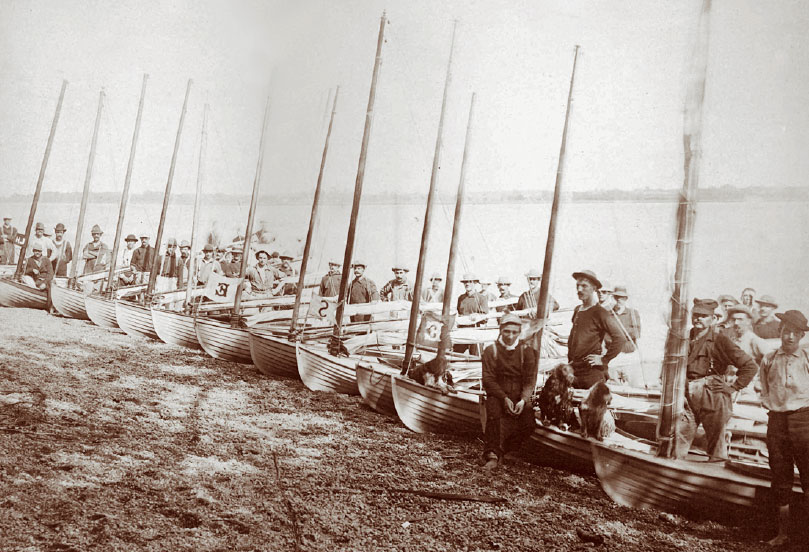
Historic Photos from the Ben Fuller Collection
Conservation Plan
No formal plan in place.
Work Sequence Photos
See the work log here.